





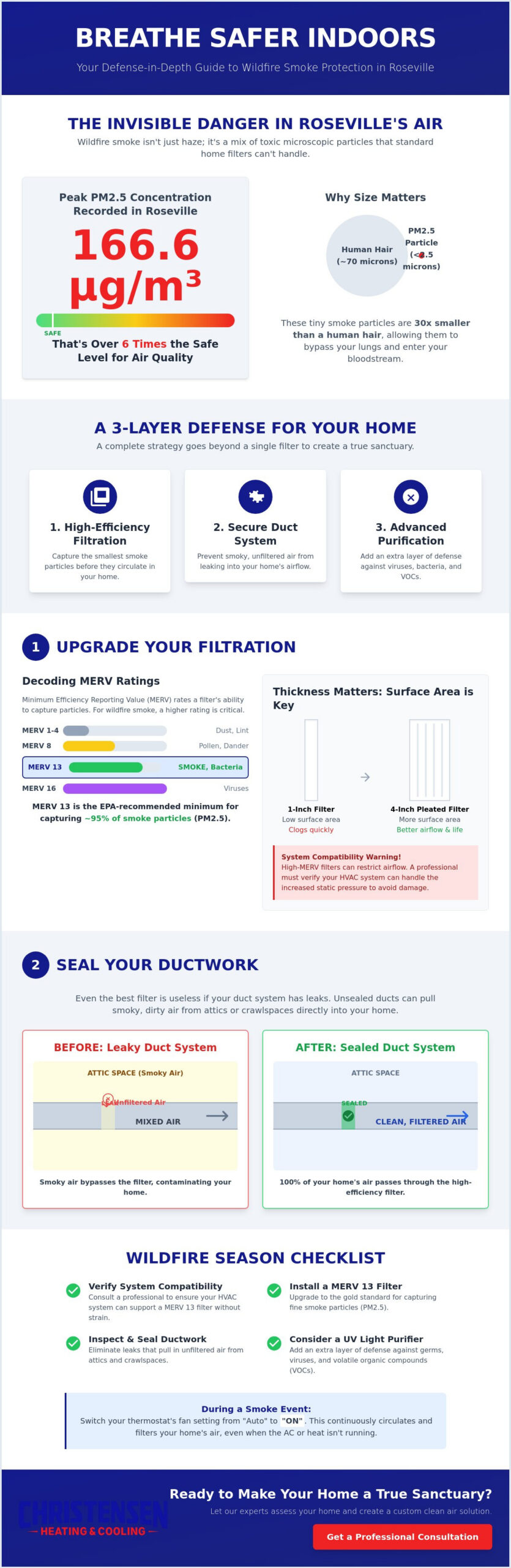
Did you know that during past fire seasons, Roseville’s PM2.5 concentration has spiked to a staggering 166.6 µg/m3? That is more than six times the level considered safe, and it’s exactly why so many of our neighbors wake up with scratchy throats and the smell of smoke inside their living rooms. We know how stressful it is when your home doesn’t feel like the safe haven it should be. You shouldn’t have to guess if your family is breathing clean air when the skies turn orange.
We’ve designed this guide to help you implement the best air filtration for wildfire smoke in Roseville using a “Defense-in-Depth” strategy. You’ll discover how to protect your household from fine particles while keeping your energy costs under control. We will walk you through the importance of MERV 13 filtration, the added protection of UV light installation, and how securing your duct system prevents smoky air from bypassing your filters entirely. Let’s work together to make your home a true sanctuary again.
Key Takeaways
- Learn why MERV 13 filters are the gold standard for capturing fine smoke particles and how we can help you verify your system’s compatibility.
- We identify the best air filtration for wildfire smoke in Roseville by comparing whole-home purification strategies with portable units for 2026.
- Discover why securing your duct system is a critical step to stop smoky, unconditioned air from leaking into your home from the attic.
- Get a proactive checklist for the upcoming fire season, including why you should switch your thermostat to the “On” setting during smoke events.
- See how specialized additions like UV light installation offer an extra layer of defense for your household’s long-term respiratory comfort.
The Reality of Wildfire Smoke in Roseville: Why Standard Filters Fail
Living in Roseville means we have all experienced those eerie orange afternoons when the sun barely peeks through a thick, gray haze. While it is easy to focus on the smell, The Reality of Wildfire Smoke is that it’s a complex, toxic cocktail of carbon monoxide, volatile organic compounds, and microscopic solid particles. These aren’t just simple dust particles; they are the microscopic remains of burnt structures, household chemicals, and timber. They don’t just sit on your furniture; they hang in the air you breathe every minute you’re at home.
Many of our neighbors assume that running their air conditioner with a standard filter is enough to keep their family safe. Unfortunately, these basic setups often fall short during active fire events. Finding the best air filtration for wildfire smoke in Roseville requires moving beyond the basic equipment that likely came with your home. We’ve seen how standard systems struggle to keep up when the local air quality index (AQI) hits hazardous levels, leaving families vulnerable to poor indoor air quality.
To better understand this concept, watch this helpful video:
PM2.5 and Your Health in Northern California
PM2.5 refers to particulate matter smaller than 2.5 microns in diameter. To put that in perspective, a single human hair is about 30 times larger than these particles. Because they’re so tiny, they don’t just stay in your lungs. They’re small enough to cross into your bloodstream. In Placer County, our geography often traps this smoke in the valley, leading to massive AQI spikes. This is especially dangerous for our children and seniors, whose respiratory systems are more sensitive. Breathing this wood smoke and ash for even a few days can have long-term impacts on your health and comfort.
The Limitations of Traditional HVAC Filtration
Most homes are built with simple one-inch fiberglass filters. These are often called “builder grade” because they’re designed to keep large dust bunnies out of your furnace or AC motor, not to scrub the air for your health. They offer almost zero protection against the fine soot and chemical vapors found in wildfire smoke. We also frequently find the “bypass” problem; this is when air flows around the edges of a poorly fitted or low-quality filter rather than through it. When you combine this with the “Roseville Infiltration” effect, where smoke seeps through window seals and door gaps, your indoor air quality can quickly reach unsafe levels. Understanding these gaps is the first step we take toward helping you build a safer, smoke-free sanctuary for your loved ones.
Decoding MERV Ratings: Choosing the Best Filter for Smoke Particles
When our neighbors ask us about the best air filtration for wildfire smoke in Roseville, we always start by explaining the MERV scale. MERV stands for Minimum Efficiency Reporting Value. This rating system ranges from 1 to 16, and it tells you exactly how well a filter can trap specific sizes of particles. While a MERV 8 filter is fine for catching common household dust and pet dander, it is simply not dense enough to stop the microscopic soot that drifts into our valley during fire season.
Following EPA guidelines on clean air is the best way to ensure your indoor environment stays safe when local air quality drops. For effective protection against wildfire smoke, a MERV 13 filter is the minimum recommended level. These filters are capable of blocking approximately 90% to 95% of fine particulate matter (PM2.5). However, you must be careful not to jump straight to a MERV 16 or HEPA filter without a professional evaluation. These high-density filters can create significant static pressure, which forces your blower motor to work much harder and can lead to a premature Air Conditioning Repair.
The physical thickness of the filter also matters more than most people realize. A 4-inch pleated filter has significantly more surface area than a standard 1-inch filter. This extra surface area allows the filter to trap more smoke particles without restricting the airflow your system needs to stay healthy. If you are unsure which filter thickness or rating your specific system can handle, we can help you find the right balance through our Comfort Club Maintenance Plan.
MERV 13 vs. MERV 16: Finding the Sweet Spot
MERV 13 filters are excellent at capturing the bulk of smoke-sized pollutants while maintaining proper airflow. MERV 16 filters offer even higher capture rates, but they often require specialized housing or more powerful fan motors to prevent system strain. For most Roseville homes, a MERV 13 filter provides the ideal balance of high-level respiratory protection and long-term HVAC equipment longevity.
The Role of Activated Carbon in Neutralizing Smoke Odors
Standard pleated filters are great for trapping solid particles, but they can’t stop the gases and volatile organic compounds (VOCs) that carry the “campfire smell.” This is why the scent of smoke often lingers in a home long after the skies have cleared. Activated carbon filters work differently; they use a process called adsorption to trap these gaseous pollutants. Combining a high-MERV pleated filter with an activated carbon insert is the most effective way to keep your home smelling fresh and your air feeling light during the 2026 fire season.
Whole-Home Air Purifiers vs. Portable Units: Which is Better?
When we talk to families about the best air filtration for wildfire smoke in Roseville, the conversation often turns to portable air cleaners. It’s common to see neighbors running three or four small units to keep the air clear. While these are useful for creating a “clean room” during an emergency, they rarely provide the comprehensive protection a large house needs. The Clean Air Delivery Rate (CADR) of most portable units is designed for very specific square footage. If you have an open-concept living area or high ceilings, a single portable unit will likely leave pockets of smoky air untouched.
Aesthetics and noise levels are also significant considerations for your daily comfort. Portable units can be incredibly loud when running on their highest “smoke” settings, making it difficult to sleep or hold a conversation. Integrated HVAC solutions are built directly into your ductwork, so they operate silently. You won’t have to worry about tripping over cords or finding floor space for bulky plastic boxes in every room. It’s a cleaner look that provides a more seamless sense of security for your household.
Maintaining your equipment shouldn’t be a part-time job. With a whole-home system, you only have one central point of maintenance. Instead of checking and replacing five different filters of varying sizes, you simply swap out your main HVAC filter. This ensures your system stays efficient and reduces the risk of a breakdown that might require an Air Conditioning Repair or Furnace Repair during the peak of fire season. We believe in making home protection as simple and reliable as possible.
The Problem with Portable Air Purifiers
Portable units simply cannot move enough air to reach every corner of a modern Roseville floor plan. This leads to “dead zones” in closets, bathrooms, or large rooms where smoke and PM2.5 particles can linger undisturbed. According to the EPA guide to indoor air quality, these units are best used as a supplement for specific rooms rather than a total home solution. They don’t address the air that enters through your home’s envelope, which is why they shouldn’t be your only line of defense.
Integrated Whole-Home Solutions
An integrated purifier works in tandem with your furnace or air conditioner to scrub every cubic foot of air in your home. It uses the system’s blower to pull air through a medical-grade filter and redistribute it evenly. This constant circulation ensures that every room stays protected, not just the one where a portable unit is plugged in. We often recommend adding a UV light installation to this setup. These lights help neutralize biological contaminants that can be stirred up by fire-related weather patterns, providing a more comprehensive layer of respiratory safety for your family.
Beyond the Filter: Ensuring Your Ductwork Isn’t Leaking Smoke
We often tell our neighbors that buying a high-end filter is only half the battle for a clean home. You could have the best air filtration for wildfire smoke in Roseville installed, but if your ductwork is compromised, the smoke will simply find another way in. Industry data shows that 20% to 30% of the air in a typical home is lost or gained through duct leaks. During a wildfire, those gaps don’t just let cool air escape; they act as entry points for unconditioned, smoky air from your attic or crawlspace to be pulled directly into your living areas.
This brings us to a phenomenon we call the “Vacuum Effect.” When you upgrade to a high-MERV filter, such as a MERV 13, you are adding more resistance to your HVAC system. This isn’t a bad thing, but it does mean your blower motor has to pull harder to move air. If your ducts aren’t perfectly airtight, that extra suction will pull air through the easiest path available. Often, that path is a tear or a loose connection in your attic ducts, which are surrounded by the very smoke you’re trying to avoid. Without a sealed system, your high-efficiency filter is being bypassed by the most polluted air in your home’s structure.
The Connection Between Leaky Ducts and Poor Air Quality
Smoke doesn’t just drift through your front door; it infiltrates your bedroom through the dark, dusty spaces of your home. If you’ve ever wondered why the smell of smoke persists even with the windows closed, leaky ducts are the likely culprit. This smoky air bypasses your filtration system entirely, depositing fine ash and soot directly into your rooms. If your ductwork is over 15 years old, a duct system replacement in Roseville might be the only way to truly reclaim your indoor air quality and protect your family’s health.
Sealing and Professional Duct Solutions
It’s important to understand the difference between structural integrity and simple maintenance. While many companies promote “duct cleaning,” we believe in solving the root of the problem through professional sealing and Duct System Replacement. Cleaning won’t fix a disconnected joint or a puncture in your flex duct that is sucking in attic smoke. A sealed system ensures that 100% of your air actually passes through your high-end filter before it reaches your lungs. Professional duct sealing is the most overlooked step in wildfire prep, yet it is the foundation of a healthy home. If you are concerned about your home’s defenses, we invite you to schedule a duct integrity inspection with our team today.
Preparing Your Home for the 2026 Fire Season: A Proactive Checklist
We have covered the technical side of filters and ducts, but the final piece of the puzzle is preparation. You shouldn’t wait until the sky turns orange to secure the best air filtration for wildfire smoke in Roseville. Local hardware stores often run out of high-MERV filters the moment a fire breaks out. We recommend stocking up on at least a three-month supply of MERV 13 filters before the summer heat arrives. This ensures you can swap them out frequently without stress when the air quality begins to dip.
One of the most effective strategies during an active smoke event is a simple change to your thermostat settings. We suggest switching your fan from “Auto” to “On.” While “Auto” only moves air when the system is actively cooling or heating, the “On” setting keeps air circulating through your filtration system constantly. This provides a continuous scrubbing effect that keeps PM2.5 levels much lower inside your home. It’s a small adjustment that makes a massive difference in your family’s respiratory comfort.
Finally, remember that post-fire maintenance is just as vital as pre-season prep. Wildfire smoke is incredibly dense, and it can clog a high-efficiency filter in a matter of weeks. Once the local air quality returns to safe levels, you should change your HVAC filter immediately. This prevents ash and soot from being pulled deeper into your system and ensures your equipment doesn’t have to work overtime to push air through a dirty medium. Keeping your system clean is the best way to protect your investment and your health.
The Christensen Comfort Club Advantage
Our Comfort Club Maintenance Plan is designed to take the guesswork out of home safety. During our regular visits, we check your system’s static pressure to ensure it can handle the resistance of smoke-rated filters without failing. Regular maintenance is the most reliable way to prevent a total system breakdown when the valley’s heat and smoke hit simultaneously. If you want more tips on keeping your equipment in top shape, check out our guide on how to make my HVAC system last longer. Club members also enjoy priority service, which is a lifesaver during the busiest weeks of the fire season.
Actionable Steps for Active Smoke Days
When smoke is thick, we recommend creating a “clean room” strategy. This involves choosing a central living area or bedroom where you run your HVAC system on “On” and perhaps supplement with a portable HEPA unit. You can monitor real-time local air quality using sensors like PurpleAir to get Roseville-specific data that is often more accurate than regional reports. If you notice your system is struggling to maintain temperature or making unusual noises while fighting the smoke, don’t hesitate to call for emergency AC repair in Roseville. We are here to ensure your home remains a safe, breathable sanctuary for those you love most.
Secure Your Family’s Comfort for the 2026 Fire Season
We’ve explored how a “Defense-in-Depth” strategy, combining MERV 13 filtration with airtight ductwork, creates a true fortress against PM2.5 particles. These proactive steps ensure that when smoke rolls into the Sacramento Valley, your home remains a clean, breathable sanctuary. Finding the best air filtration for wildfire smoke in Roseville doesn’t have to be a stressful guessing game when you have a local partner looking out for your well-being.
Since 2009, our family-owned team has served as Roseville’s trusted experts in high-efficiency filtration and UV Light Installation. We take personal pride in every home we service, offering our exclusive Comfort Club Maintenance Plan to provide year-round protection and peace of mind. Whether you are looking to upgrade your current system or simply want to ensure your ducts are sealed tight, we are here to help you breathe better.
You deserve to feel safe and refreshed in your own home, regardless of what the skies look like outside. Let’s work together to get your system fire-ready so you can focus on what matters most.
Frequently Asked Questions
Can I use a HEPA filter in my standard Roseville HVAC system?
Most standard residential systems cannot handle a true HEPA filter because the material is too dense. These filters restrict airflow so much that they can cause your blower motor to overheat or lead to an expensive Air Conditioning Repair. We usually recommend a MERV 13 filter instead, as it provides high-level protection without the risk of damaging your equipment.
How often should I change my air filter during an active wildfire?
You should check your filter every two weeks when smoke is visible outside. While a high-quality filter might normally last three months, heavy smoke can clog the pleats in as little as 14 days. If the filter looks gray or dark brown, it is time to swap it out to maintain your home’s air quality and system efficiency.
Do air purifiers help with the smell of smoke from wildfires?
Air purifiers help with odors only if they include an activated carbon or charcoal layer. Standard pleated filters are great for trapping solid particles like ash, but they cannot stop the gases that carry the “campfire” scent. We often install carbon inserts or specialized purifiers to adsorb these volatile organic compounds and keep your indoor air smelling fresh.
Is it safe to run my AC when it is smoky outside?
It is perfectly safe to run your air conditioner because the system recirculates the air already inside your home. The outdoor condenser unit only moves heat, not air, between the inside and outside. As long as your windows are closed and you have a clean filter in place, your AC is your best tool for staying cool and filtered.
What is the best MERV rating for wildfire smoke protection?
A MERV 13 rating is widely considered the best air filtration for wildfire smoke in Roseville residential homes. According to industry standards, a MERV 13 filter can block approximately 90% to 95% of fine smoke particles (PM2.5). This rating offers the ideal balance between respiratory safety and the mechanical health of your furnace or air conditioner.
Will a whole-home air purifier increase my energy bills significantly?
Modern whole-home purifiers are designed to be extremely energy efficient and typically cost very little to operate. In many cases, a professional system helps lower your bills by keeping your cooling coils cleaner for longer. A clean system doesn’t have to work as hard to move air, which protects your Furnace Installation or AC from unnecessary wear and tear.
How do I know if smoke is leaking into my house through my ducts?
If you notice the smell of smoke is stronger near certain vents or if you see fine gray dust settling around your registers, you likely have duct leaks. Smoky air from your attic can be sucked into gaps in your ductwork and blown directly into your rooms. We recommend a professional pressure test to identify these hidden leaks in your Duct System Replacement or existing setup.
What is the difference between an air filter and an air purifier?
An air filter is a passive piece of equipment that traps particles as air passes through it. An air purifier is an active device, like a UV Light Installation, that works to neutralize contaminants such as bacteria or smoke odors. For the highest level of protection, we recommend using both together to ensure your home remains a healthy sanctuary.