






Imagine waking up on a crisp Sacramento morning only to realize the reliable hum of your HVAC system has been replaced by an unsettling clatter or, even worse, total silence. That sudden chill in your living room brings an immediate wave of stress regarding unexpected repair bills and the loss of your family’s comfort. We know that your home is your sanctuary, and when the temperature swings, it feels like more than just a mechanical glitch. It is a disruption to your peace of mind.
It’s completely natural to feel overwhelmed by the complex behaviors of modern systems, especially with the latest 2026 Title 24 standards and new refrigerants now in use across California. We are here to partner with you in troubleshooting common heat pump problems so you can regain control over your environment and keep your home cozy. In this guide, we will show you how to identify specific issues, perform simple checks, and recognize exactly when it is time to call a trusted local professional to protect your household’s well-being year-round.
Key Takeaways
- Save time and stress by performing five simple DIY checks, such as verifying thermostat batteries, before you schedule a service call.
- Learn to identify the warning signs of low refrigerant or a faulty reversing valve to ensure your system properly switches between heating and cooling modes.
- Discover how to tell the difference between a normal defrost cycle and a frozen coil crisis that requires immediate attention to protect your equipment.
- Understand why “short-cycling” hurts your efficiency and why constant running is often a sign of healthy operation for modern inverter heat pumps.
- Master troubleshooting common heat pump problems by recognizing when a mechanical sound is a simple fix versus a signal to call in a local expert for help.
Heat Pump Not Working? Start with These 5 Quick DIY Checks
Finding your home at the wrong temperature is a stressful experience that usually happens at the most inconvenient times. We understand that your priority is restoring the comfort and safety of your household without immediately facing a massive repair bill. Before you assume the worst, it is helpful to understand What is a Heat Pump? and how its basic components interact to move heat in and out of your home. Many times, the solution is much simpler than a mechanical failure.
By starting with a few basic steps, you can save time and potentially avoid an unnecessary service call. We have found that troubleshooting common heat pump problems often begins with verifying the simplest links in the chain, from power sources to user settings. To better understand these initial steps, watch this helpful video:
The Power Check: Breakers and Disconnects
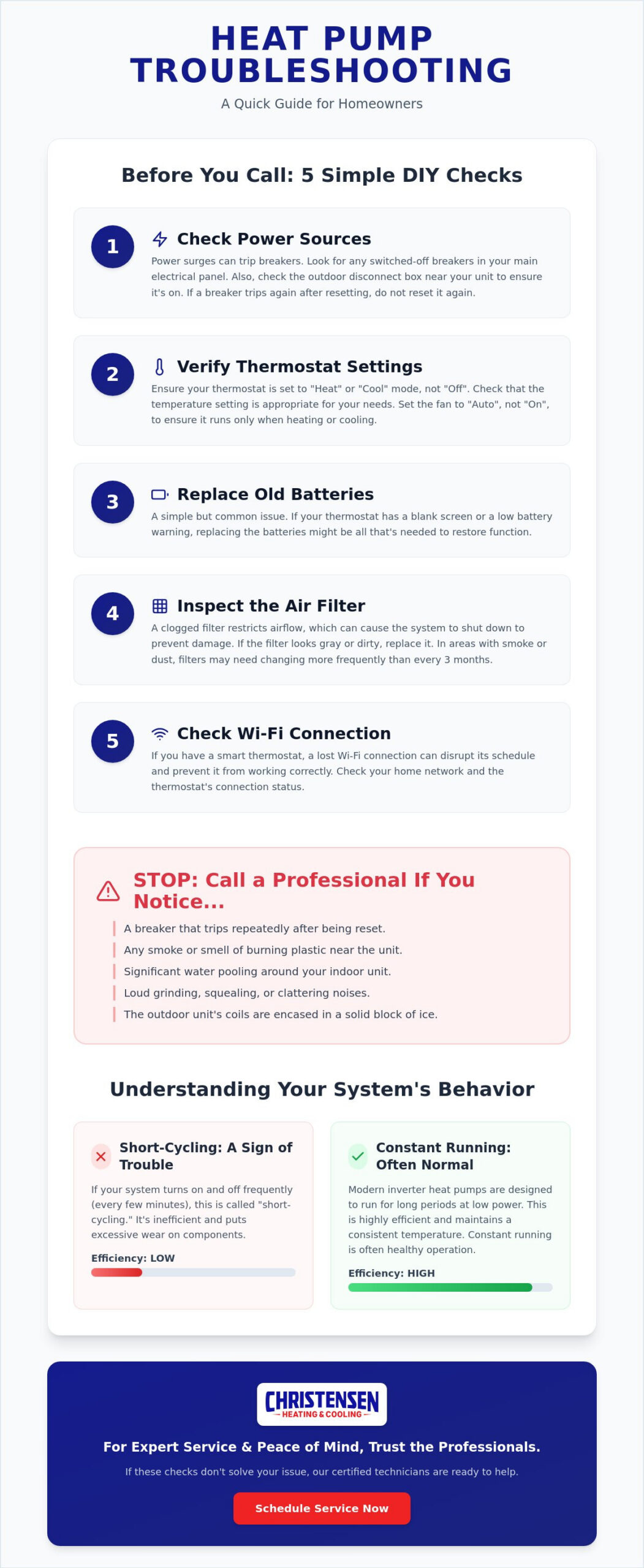
In areas like Roseville and the surrounding Sacramento valley, local power fluctuations can occur during peak demand or stormy weather. These surges may trip your HVAC breaker as a safety measure. Check your main electrical panel for any switches that aren’t fully in the “on” position. Additionally, ensure the outdoor disconnect box located near your unit is securely engaged and hasn’t been bumped by a landscaper or a pet. If you do find a tripped breaker, flip it back once. If it trips again immediately, stop what you’re doing. Repeatedly resetting a breaker can damage sensitive components like the compressor or the control board.
Thermostat Calibration and Settings
We often encounter the “Thermostat Ghost,” where a system appears broken but is actually just responding to incorrect settings. Ensure your system isn’t stuck in a “middle ground trap” where the temperature set point is too close to the current room temperature. If you use a smart thermostat, a simple Wi-Fi drop can sometimes disrupt your programmed schedule, leaving the house cold. Check if your fan is set to “Auto” rather than “On” to ensure the system cycles correctly based on temperature needs. Sometimes, simply replacing old batteries is the only fix you need to restore your home’s climate.
The Northern California Filter Factor
For our neighbors in Northern California, air filters play a critical role that goes beyond just dust. During wildfire season, smoke and fine particulates can clog a high efficiency filter much faster than the standard three month recommendation. A restricted filter chokes the airflow, which can cause the entire system to shut down to prevent overheating or freezing. If you’re troubleshooting common heat pump problems, check the filter first. If it looks grey or dark, a fresh one might be the only thing standing between you and a perfectly working system.
While these DIY steps are effective for minor issues, your safety is our top priority. If you see smoke, smell burning plastic, or notice standing water around your indoor unit, it is time to step away. At that point, the best move is to contact us at Christensen Heating and Cooling so our team can perform a professional diagnosis and keep your sanctuary safe.
Performance Troubleshooting: Why Is My Heat Pump Not Heating or Cooling?
When your system is running but your home remains uncomfortable, the issue often lies within the delicate balance of the heat transfer process. If you have already performed the basic power and thermostat checks we discussed, we need to look closer at the internal mechanics. Troubleshooting common heat pump problems frequently involves identifying whether the system is physically unable to move heat or if it is simply being choked by a lack of airflow. When a unit runs for hours without changing the indoor temperature, it is usually a sign that a specific component is struggling to do its job.
One of the most common performance issues involves the refrigerant levels. Because your system relies on the precise pressure and temperature of this fluid to transport heat, even a minor leak leads to lukewarm air and significantly longer run times. Similarly, dirty coils act as insulation in the worst way possible. If the outdoor condenser coil is covered in dirt or the indoor evaporator coil is dusty, the system cannot “grab” or “release” heat efficiently. This is why the U.S. Department of Energy highlights the value of professional maintenance to keep these surfaces clean and your refrigerant charge within factory specifications.
The Reversing Valve: The Heart of the Switch
The reversing valve is the specific component responsible for your heat pump’s unique ability to provide both heating and cooling by changing the direction of refrigerant flow. You might occasionally hear a distinct “whoosh” sound coming from your outdoor unit. This is the sound of the valve shifting and is perfectly normal operation. However, if the valve becomes physically stuck or the electrical solenoid fails, your system might stay in “cooling mode” even when you’re shivering. This often happens during the first major season change when the valve hasn’t moved for several months. If these performance issues feel complex, our team is always ready to provide expert Heat Pump Services to get your sanctuary back to the perfect temperature.
Airflow Restrictions and Blocked Vents
We often find that homeowners unintentionally strain their systems by closing interior doors or placing heavy furniture over floor registers. Your heat pump is designed to move a specific volume of air to maintain pressure balance throughout the house. When vents are blocked, the compressor must work much harder to push air through the system, which can lead to a total breakdown. If you notice that certain rooms are consistently uncomfortable, it might indicate that your home’s infrastructure needs attention. In some cases, a duct system replacement is the most effective way to ensure your system can breathe and operate at peak efficiency.
Finally, it is worth considering the weather outside. During an extreme Sacramento heatwave where temperatures exceed 110 degrees, a system that is slightly undersized may struggle to maintain a 70-degree interior. This isn’t always a mechanical failure; sometimes, the system is simply reaching its physical limit. Understanding the difference between a broken part and a system at its capacity is a key part of troubleshooting common heat pump problems and helps you decide when a professional upgrade might be a better long term solution than a repair.
Strange Noises and Frozen Coils: Diagnosing Physical Heat Pump Problems
Physical symptoms are often the most alarming part of troubleshooting common heat pump problems. When you see a block of ice on your outdoor unit or hear a sudden metallic clatter, it is easy to feel a sense of dread about the safety of your HVAC system. We want to reassure you that many of these signs are actually the system trying to protect itself or perform a routine maintenance task. Understanding the difference between a normal operational sound and a mechanical cry for help is the first step toward protecting your home’s sanctuary.
Our region’s unique environment presents specific challenges that many generic guides overlook. During the dry months in Northern California, Sacramento wildfire dust and fine ash can settle deep within the aluminum fins of your outdoor unit. This buildup creates a thermal blanket that prevents the system from shedding heat effectively, which can lead to overheating. When this happens, the system may begin “short-cycling,” or turning on and off every few minutes. This rapid cycling is a silent killer for your compressor’s lifespan, as the startup phase is the most taxing part of its operation. Following basic heat pump maintenance tips, such as gently rinsing the outdoor coil with a garden hose, can help keep these fins clear and your system breathing easy.
Ice and Defrost Mode: Normal or Not?
On damp Northern California winter mornings, it is perfectly normal to see a thin, white layer of frost on your outdoor unit. This triggers the “defrost cycle,” where the system temporarily reverses its flow to melt the frost. You might hear a loud “whoosh” or see steam rising from the unit, which can look like smoke but is actually just water vapor. However, if the ice becomes thicker than a quarter or covers the entire unit for several hours, you have a genuine crisis. This usually indicates a faulty defrost sensor or a refrigerant issue. Whatever you do, never use a screwdriver or ice pick to clear the ice. You risk puncturing the delicate coils and causing a permanent, expensive breakdown.
Deciphering Heat Pump Noises
Your heat pump has its own language, and changes in its “voice” are key indicators of its health. We have put together a quick sound library to help you identify the severity of common noises:
- Squealing: A high-pitched squeal often suggests a worn fan belt or a motor that needs lubrication.
- Grinding: Metal-on-metal sounds are urgent and usually mean the bearings within the motor are failing.
- Buzzing or Humming: This is often an electrical issue, such as a failing contactor or a weak capacitor struggling to start the motor.
- Rattling: Before you panic, check for loose access panels or local debris, like a twig or a pebble, caught in the fan housing.
Identifying these physical symptoms early is a vital part of troubleshooting common heat pump problems before they escalate. By paying attention to these cues, you can ensure your system remains a reliable source of comfort for your family throughout the seasons.
Short-Cycling and Constant Running: Fixing Efficiency Issues
We often hear from homeowners who are worried because their system never seems to stop running, or conversely, it starts and stops every few minutes. Troubleshooting common heat pump problems requires understanding that “normal” has changed significantly with modern technology. While an older system might cycle on and off twice an hour, newer equipment behaves differently to maintain a steady, comfortable environment. Identifying whether your system is performing a designed task or suffering from a technical glitch is essential for your peace of mind.
Short-cycling occurs when your heat pump turns on, runs for a few minutes, and shuts down before reaching the set temperature. This is often caused by a failing run capacitor, which is a small electrical component that provides the “push” needed to keep the motor spinning. If the capacitor is weak, the motor may start but then overheat and cut out. We also find that thermostat placement plays a major role. If your thermostat is located near a drafty window or a heat source like a kitchen oven, it receives false readings that trigger unnecessary cycles. Moving a thermostat or replacing a failing capacitor are straightforward fixes that prevent much larger issues down the road.
Inverter Technology: Why “Constant Running” is Often Normal
If you have recently upgraded to a modern inverter heat pump, you might notice that it runs for long periods at a very low, quiet speed. Unlike traditional systems that are either 100 percent “on” or completely “off,” inverter systems use variable-speed compressors to modulate their output. This is a feature, not a failure. It allows the system to maintain a precise temperature without the energy spikes associated with frequent restarts. You can tell your inverter system is struggling if the house never reaches the set temperature despite the constant operation. If the temperature is steady and your home feels great, the system is simply doing its job efficiently.
The High Cost of Short-Cycling
While constant running in an inverter system saves money, short-cycling in a traditional unit does the exact opposite. Every time your motor starts up, it draws a significant surge of electricity. Frequent starts can cause your monthly SMUD or PG&E bills to climb unexpectedly. Beyond the utility costs, this behavior puts immense strain on the compressor and fan motors, leading to premature component failure. If your system is cycling every five to ten minutes, it is likely either oversized for your home or suffering from a sensor error. We recommend a professional system audit if you notice these rapid patterns, as catching them early protects your long term investment. If your system’s rhythm feels off, our team is ready to provide expert Heat Pump Services to restore your home’s efficiency.
By understanding these different operational styles, you can better navigate the process of troubleshooting common heat pump problems. Whether it is a simple thermostat relocation or a technical capacitor replacement, keeping your system in its proper rhythm is the best way to ensure your family’s comfort remains uninterrupted throughout the year.
The Long-Term Solution: Professional Maintenance in Northern California
While we hope this guide empowers you in troubleshooting common heat pump problems, the most effective strategy for home comfort is always prevention. Most of the issues we’ve discussed, from clogged coils to failing capacitors, are the result of wear and tear that builds up over time. We believe your HVAC system is the heartbeat of your home’s sanctuary. By choosing a partner who values long-term relationships over quick transactions—a philosophy shared by specialists like Trust Boilers & Renewables—you protect the well-being of your household. Our legacy-driven service is built on treating your home with the same care and respect we’d apply to our own.
Professional care is especially important in our region. Our technicians perform deep cleanings to remove the unique Sacramento allergens and fine wildfire dust that can choke your system’s efficiency. These particles settle deep within the equipment where a standard garden hose cannot reach. Beyond cleanliness, our team checks the integrity of electrical connections and refrigerant levels to ensure everything meets the 2026 efficiency standards. We are dedicated to keeping your environment safe and your utility bills predictable.
The Christensen Comfort Club Advantage
Our Comfort Club Maintenance Plan is designed to take the guesswork out of system health. During a professional inspection, we go far beyond surface-level checks. We test every safety control and calibrate your system for the upcoming season. Regular visits also serve a critical administrative role; most manufacturers require documented professional maintenance to keep your warranty valid. As a member, you also receive priority service. This is a vital safety net during the peak of a Roseville summer when temperatures soar and cooling becomes a matter of safety. We prioritize your family’s comfort so you never have to worry about being left in the heat.
When Troubleshooting Fails: Calling the Pros
If your system is showing signs of distress that a simple filter change won’t fix, don’t wait for a total breakdown. You can Schedule your heat pump repair in Roseville today! and let our hardworking team take the burden off your shoulders. Troubleshooting common heat pump problems is a great way to understand your home, but professional care is what ensures that home remains a reliable, comfortable environment for years to come.
Securing Your Home’s Year-Round Comfort
Navigating the technical side of your HVAC system doesn’t have to be a source of stress. By mastering the basics of troubleshooting common heat pump problems, you have taken a major step toward protecting your home’s sanctuary and your family’s peace of mind. Remember that simple steps like checking your thermostat settings and keeping your air filters clear of Northern California’s regional dust can often resolve minor issues before they impact your daily life. Whether you are managing a traditional unit or one of the latest high-efficiency inverter systems, your proactive care ensures a more reliable environment for everyone under your roof.
We’ve been a family-owned fixture in the community since 2009, and we take personal pride in every home we serve. Our team specializes in the advanced diagnostics required for modern inverter heat pumps, ensuring that our neighbors in Roseville, Sacramento, and the Foothills always have a dependable partner to lean on. When DIY checks aren’t enough, we are here to provide the steady, expert guidance you deserve. Get Expert Heat Pump Repair and Service from Christensen Heating and Cooling to restore your comfort today. We look forward to treating your home with the same neighborly care we would apply to our own.
Frequently Asked Questions
Why is my heat pump blowing cold air in heat mode?
Your system is likely in its defrost mode, which temporarily reverses the flow of refrigerant to melt ice on the outdoor coils. During this short cycle, the indoor unit may blow cooler air for a few minutes. If the air stays cold for an extended period, it could indicate a stuck reversing valve or a failed heating element that requires professional attention.
Is it normal for my heat pump to have ice on it during winter?
A light coating of frost is a standard part of winter operation in our region. Your unit will periodically enter a defrost cycle to melt this frost, which might involve a temporary “whoosh” sound or steam rising from the unit. If the ice builds up into a thick block that does not melt, this is a sign that the defrost sensor or refrigerant levels need attention during your troubleshooting common heat pump problems.
How often should I change the air filter on my heat pump?
We recommend checking your filter every month and replacing it at least every three months. For our neighbors in Sacramento and Roseville, wildfire season or heavy spring pollen can clog a filter in as little as 30 days. Keeping a fresh filter is one of the easiest ways to prevent a system-wide shutdown and protect the sanctuary of your home.
What causes a heat pump to make a loud buzzing noise?
A loud buzzing or humming noise is usually an electrical issue, such as a failing contactor or a weak capacitor struggling to start the motor. It can also be caused by loose internal components vibrating against the cabinet. Since electrical issues can lead to more expensive repairs, it’s best to have a technician inspect the unit if the buzzing persists.
Can I pour hot water on my frozen heat pump?
You can use lukewarm water to gently melt surface ice, but you should never use boiling water or sharp objects like ice picks. Boiling water can crack cold components due to thermal shock, and sharp tools can easily puncture the delicate refrigerant coils. If the system’s own defrost mode isn’t clearing the ice, there is likely an underlying mechanical issue.
Why does my heat pump run constantly when it is cold outside?
Heat pumps are designed to run for longer periods than traditional furnaces because they move heat rather than creating it. When troubleshooting common heat pump problems, remember that modern inverter systems are specifically engineered to run almost constantly at lower, more efficient speeds. This behavior is normal as long as your home remains at your desired temperature.
How do I reset my heat pump after a power outage?
To reset your system, turn the thermostat to the “off” position and flip the HVAC breaker in your main panel to “off” for about 30 seconds. Flip the breaker back on and wait ten minutes before turning the thermostat back to “heat” or “cool.” This delay allows the system’s internal safety timers to cycle through properly after a sudden power loss.
What is the average lifespan of a heat pump in Northern California?
The average lifespan for a well-maintained unit in Northern California is between 12 and 15 years. While our Mediterranean climate is generally kind to outdoor equipment, the high heat of summer and winter dampness mean consistent care is vital. Regular professional inspections help your system reach its full potential while keeping your household comfortable.