





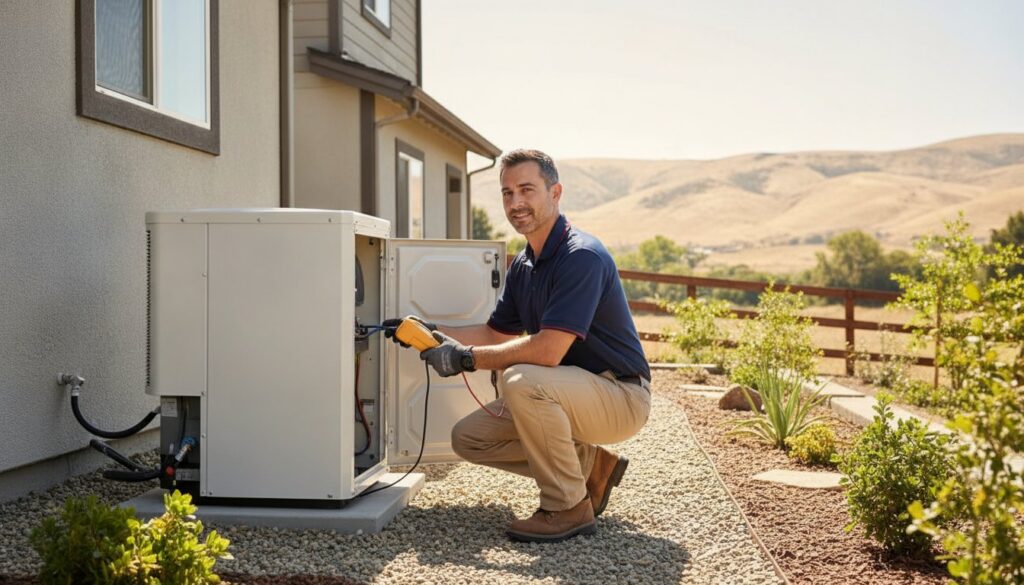
Did you know that keeping up with regular maintenance can lower your risk of a sudden equipment failure by up to 95%? We all know that stressful feeling when the thermometer hits 105°F and the sky turns that familiar wildfire orange. It’s the worst possible time to wonder how often should HVAC be serviced in California to keep the ash out and the cool air flowing. You want to keep your family safe and your SMUD or PG&E bills manageable without the constant fear of a total system breakdown.
We’ve put together this 2026 guide to help you protect your home sanctuary by establishing a schedule that accounts for our state’s unique climate and new environmental regulations. We’ll show you why bi-annual service is the new standard for modern heat pumps and how a professional tune-up can reduce your energy use by 15% to 20%. From understanding the R-410A refrigerant phase-out to preparing for upcoming zero-NOx furnace rules, we’ll give you the peace of mind you need to stay comfortable and secure all year long.
Key Takeaways
- Learn why the professional consensus for how often should HVAC be serviced in California is twice per year to protect your home from extreme heat and wildfire smoke.
- Understand the difference between a spring and fall tune-up, including why we focus on outdoor coil washing and condensate drains before the summer peak.
- Identify the critical warning signs like short-cycling or unusual noises that mean your system needs professional attention before a heatwave hits.
- Discover how regular maintenance can lower your monthly utility bills and help you avoid the high costs of emergency repairs or premature replacement.
- Find out how the Comfort Club Maintenance Plan simplifies your home care by automating your service schedule and providing priority support when you need it most.
The California Standard: How Often Should HVAC Be Serviced?
We’ve found that many homeowners in our community are surprised to learn that professional maintenance is more than just a quick checkup. At its core, HVAC maintenance is a proactive safety and efficiency protocol designed to protect your home and your budget. When you ask how often should HVAC be serviced in California, our answer is rooted in the unique demands of our local climate and regional energy standards.
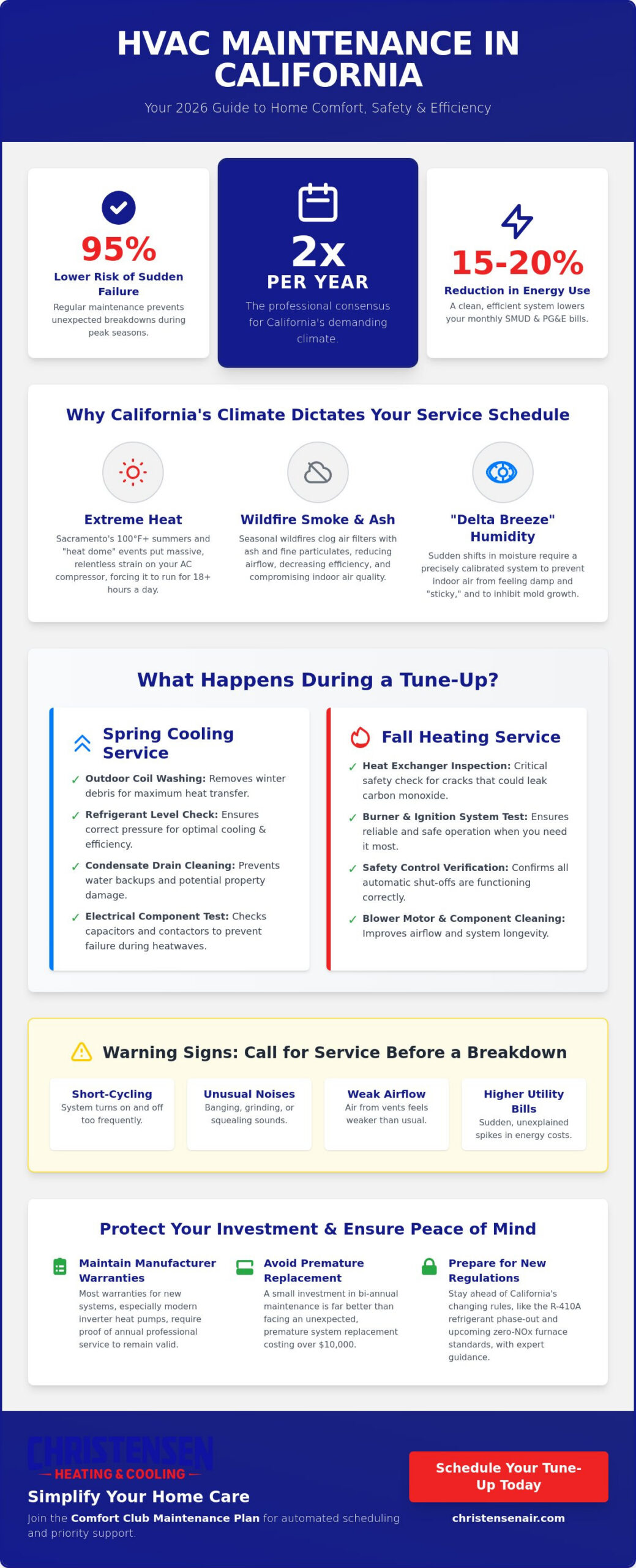
The professional consensus for our region is a bi-annual service schedule. We recommend this frequency because of the heavy workload placed on your system throughout the year. This rhythm helps your Heating, ventilation, and air conditioning (HVAC) system meet the high-performance requirements set by California Title 24 standards. Our team focuses on two key milestones:
- Spring service: This visit focuses on cooling performance and refrigerant levels before the Sacramento Valley heat hits.
- Fall service: We ensure heating reliability, safety, and electrical connections are secure before the first frost.
To help visualize why this schedule is so important for your home’s comfort, watch this brief explanation:
The “Once-a-Year” vs. “Twice-a-Year” Debate
While some areas of the country might get by with a single visit, California’s extreme seasons make a twice-a-year plan essential. This is especially true for heat pumps that provide both heating and cooling. When considering how often should HVAC be serviced in California, remember that our 100-degree Roseville summers put massive strain on your equipment. A neglected system might begin short-cycling, which is when it turns on and off too frequently. This wears out the compressor and spikes your energy bill. We believe the financial trade-off is clear: a small investment in bi-annual maintenance is much better than facing a $10,000 premature replacement cost.
Maintenance for New Systems vs. Older Units
If you’ve recently upgraded your home, you might think maintenance can wait. However, most manufacturer warranties require proof of annual professional service to remain valid. Modern inverter heat pumps use sophisticated electronics that need precise calibration to maintain their efficiency. For our neighbors with older units in Placer County, these visits are even more critical. We often find that older furnaces can develop small, dangerous cracks in the heat exchanger that only a trained eye can spot. Our goal is to catch these issues early to keep your sanctuary safe and warm.
Why the Northern California Climate Dictates Your Service Schedule
Living in Northern California means our homes face environmental pressures that most standard maintenance guides simply don’t account for. The Sacramento Valley often experiences a “heat dome” effect, where triple-digit temperatures linger for days and force AC compressors to run for eighteen hours or more without a break. This relentless workload is the primary reason why we emphasize the importance of how often should HVAC be serviced in California. In towns like Fair Oaks and Carmichael, we also manage the sudden humidity shifts that come with the “Delta Breeze.” While these cool evening winds are a relief, the rapid change in moisture levels requires a precisely calibrated system to keep your indoor air from feeling damp or “sticky.”
Our local environment is much harsher on mechanical equipment than many people realize. Staying ahead of these regional challenges is the only way to ensure long-term reliability for your family. When you consider how often should HVAC be serviced in California, remember that our specific mix of extreme heat and seasonal debris makes a bi-annual checkup a vital part of protecting your household sanctuary.
Wildfire Smoke and Air Filtration
Beyond the heat, we must prioritize improving indoor air quality during our increasingly intense wildfire seasons. Fine ash and smoke particles don’t just sit on the surface of your filter; they can penetrate high-efficiency MERV filters and coat your indoor evaporator coils in a layer of abrasive grit. When ash settles on the damp surfaces of these coils, it creates a mud-like sludge that restricts airflow and forces the blower motor to work twice as hard. This is why a simple filter swap isn’t enough after a major regional fire event. For many Roseville homeowners, we find that a UV light installation provides an essential second layer of protection by neutralizing organic pollutants that mechanical filters might miss.
High Energy Rates and System Efficiency
We also have to consider the financial impact of our regional utility rates. According to California’s energy standards, system efficiency is a top priority for reducing state-wide power strain. For your household, this means that even a 10% drop in efficiency can lead to a significant spike in your monthly bill, especially during SMUD “Peak” hours from 5 PM to 8 PM. When your condenser coils are caked with summer dust or spring pollen, the electrical draw of your outdoor unit increases. Preventative care is truly your best defense against these rising costs, and scheduling a local system checkup is a simple way to ensure your home remains both cool and affordable throughout the summer peak.
Spring vs. Fall: What Happens During a Professional Tune-Up?
When we visit your home for a seasonal checkup, our goal is to provide total peace of mind rather than a simple checklist. Many homeowners ask us how often should HVAC be serviced in California, but they also want to know what they are actually getting for their investment. A true professional tune-up is a comprehensive 20-30 point inspection. It’s a deep dive into the mechanical and electrical heart of your home sanctuary. We don’t just swap a filter and leave; we meticulously examine every component that keeps your family comfortable.
During these visits, we also prioritize duct system integrity. Even the most efficient unit will struggle if your ductwork is leaking conditioned air into your attic or crawlspace. By catching small tears or disconnected joints early, we help you avoid the high costs of a full system failure later on. This thoroughness is what distinguishes a neighborly service call from a generic corporate visit.
The Cooling Season Checklist (Spring)
As the Sacramento Valley prepares for the summer surge, our spring focus is on maximum heat rejection and electrical reliability. We pay special attention to the AC capacitor. This small component is the number one part that fails during a Roseville heatwave because it handles the massive electrical load required to start your compressor. We also measure the “Delta T,” which is the temperature split between the air entering your return and the air coming out of your vents. This measurement tells us exactly how well your system is performing. We finish by lubricating all moving parts to reduce friction and washing the outdoor coils to ensure your system doesn’t have to fight through a layer of winter grime. For our neighbors with modern inverter heat pumps or ductless mini-splits, we use specialized diagnostic tools to check the sensitive communication lines between your indoor and outdoor units.
The Heating Season Checklist (Fall)
When the air turns crisp in Placer County, our priority shifts to safety and reliability. We perform crucial safety checks for gas furnaces to ensure there are no hidden cracks in the heat exchanger that could lead to carbon monoxide leaks. Our team cleans the ignition assembly to prevent those frustrating “no-heat” calls on the first cold night of the year. We also calibrate your thermostat for accurate winter staging and inspect the flue pipe for any blockages or bird nests that may have appeared over the summer. This proactive approach ensures your heating system is a reliable source of warmth rather than a source of stress. When you consider how often should HVAC be serviced in California, remember that these seasonal adjustments are what keep your equipment running safely for its full expected lifespan.
Warning Signs You Need Service Before Your Scheduled Visit
While we’ve established how often should HVAC be serviced in California as a twice-yearly standard, your system might still send out distress signals between visits. Our goal is to help you catch these red flags before they turn into a major disruption of your home’s comfort. If you notice a sudden spike in your monthly energy bill without a change in your cooling habits, it’s a clear sign your equipment is struggling to maintain its efficiency. These spikes often happen because a component is working overtime to compensate for a hidden mechanical failure.
Weak airflow is another common indicator of trouble that shouldn’t be ignored. If your kitchen feels like a sauna while the rest of the house is cool, or if you notice “hot spots” in the master bedroom, your system may have a failing blower motor or compromised ductwork. Similarly, short-cycling is a serious concern. When your unit turns on and off every few minutes, it puts immense strain on the compressor and prevents your home from properly dehumidifying. Catching these issues early is the best way to protect your equipment and your monthly budget.
Identifying Strange Noises and Smells
Your ears and nose are often the first tools for diagnosing a problem within your home sanctuary. A musty “dirty sock” smell usually indicates that biological growth has formed on your indoor coils, which can impact your family’s health and system performance. We also listen for specific mechanical sounds that signal trouble. While a few clicks during startup are normal metal expansion sounds, a persistent squealing usually points to a failing belt or motor bearing. If you hear a loud shrieking coming from your AC unit in Rocklin, turn it off immediately. This sound often signals dangerously high internal pressure that can destroy your compressor. Banging or buzzing sounds are equally concerning, as they often indicate loose internal parts or electrical issues that require a professional eye.
Performance Red Flags
Seeing ice on your outdoor unit or the copper refrigerant lines during a 100-degree heatwave is a major warning sign. This “freezing up” usually happens due to restricted airflow or a refrigerant leak, and it will eventually cause the system to shut down entirely. You might also notice thermostat “drifting,” where the house never quite reaches the temperature you’ve set, regardless of how long the unit runs. We believe that emergency AC repair is often avoidable with early detection and a quick professional checkup. If your system is acting out, contact our team today to restore your peace of mind before the next big temperature spike hits the Sacramento Valley.
The Christensen Comfort Club: Reliable Maintenance for Placer County
Understanding how often should HVAC be serviced in California is the first step toward a comfortable home, but life often gets in the way of scheduling those vital visits. We created the Comfort Club Maintenance Plan to take that weight off your shoulders. This program automates your bi-annual service schedule, ensuring our team arrives at your door exactly when your system needs us. By making maintenance a permanent part of your home care routine, you protect your family from the stress of a sudden mid-summer breakdown.
One of the most significant benefits our members enjoy is priority scheduling. When the Sacramento Valley enters a week of triple-digit temperatures, repair queues can grow long very quickly. As a club member, you move to the front of the line. We also provide exclusive discounts on repairs and diagnostic fees, which helps keep your long-term costs predictable. We take personal pride in being a family-owned team. Unlike large corporate franchises, we view our customers as neighbors. We treat your home with the same care and respect we would apply to our own sanctuary.
What’s Included in the Comfort Club?
Our membership is designed to be comprehensive, covering every aspect of your system’s health. Each year, you receive two professional precision tune-ups. We focus on your cooling system in the spring and your heating system in the fall. These visits include:
- Safety Inspections: We perform deep checks to protect your household from fire hazards and carbon monoxide risks.
- Performance Calibration: Our technicians fine-tune your equipment to ensure it operates at peak efficiency during peak utility hours.
- Documented Service History: We maintain a clear record of every visit. This documentation is a powerful asset if you ever decide to sell your home, as it proves to buyers in Sacramento that the HVAC system has been meticulously maintained.
How to Get Started
We’ve explored the essential reasons why bi-annual maintenance is the gold standard for our region. From neutralizing the impact of wildfire ash on your air filters to ensuring your system can withstand a Sacramento “heat dome,” staying proactive is the only way to guarantee long-term efficiency. Understanding how often should HVAC be serviced in California helps you avoid the stress of emergency breakdowns and keeps your monthly utility bills under control. We want you to feel confident that your home is ready for whatever the 2026 seasons bring.
As a family-owned and operated team since 2009, we’ve spent over 15 years serving the Roseville and Greater Sacramento area. We are specialists in high-efficiency inverter heat pumps and are dedicated to protecting the comfort of our neighbors. Our team takes personal pride in every task; we treat your environment with the same care we would apply to our own homes. Join the Christensen Comfort Club and Schedule Your Tune-Up Today to enjoy priority service and total peace of mind. We look forward to keeping your sanctuary comfortable all year long.
Frequently Asked Questions
Is it really necessary to service my HVAC twice a year in Roseville?
Yes, we strongly recommend bi-annual service because of the intense workload our local climate places on your equipment. In Roseville, your system must transition from triple-digit summer heat to freezing winter nights, often while filtering heavy wildfire ash. This schedule ensures your cooling components are ready for the June surge and your heating system is safe for the December frost. It’s the best way to maintain a reliable sanctuary for your family.
What happens if I skip HVAC maintenance for a year?
Skipping professional care often leads to a 15% to 20% drop in system efficiency and a much higher risk of emergency failure. Neglected components like dirty coils or worn capacitors are the primary causes of mid-summer breakdowns when you need cooling the most. Additionally, you may unknowingly void your manufacturer’s warranty, leaving you responsible for the full cost of any major repairs that might arise during the year.
How much does a typical HVAC tune-up cost in California?
While we don’t quote specific pricing here as costs can vary based on your system’s type and age, professional tune-ups are a minor investment compared to major repairs. Industry reports suggest that proactive care is significantly more affordable than replacing a compressor or heat exchanger. We recommend checking with local providers for current regional rates. Many homeowners find that a maintenance plan offers the most predictable value for their household budget.
Does HVAC maintenance actually lower my utility bills?
Regular maintenance lowers your monthly costs by ensuring your system doesn’t have to work harder to overcome dirty filters or clogged coils. When your equipment is precisely calibrated, it uses less electricity to reach your desired temperature. This efficiency is especially important during peak SMUD or PG&E hours when energy rates are at their highest. A well-maintained system can reduce your HVAC-related energy costs by up to 40% in some cases.
Can I perform HVAC maintenance myself to save money?
You can certainly help by changing your air filters every 30 to 90 days, but technical maintenance requires professional expertise. Our technicians handle high-voltage electrical testing, refrigerant level checks, and heat exchanger inspections that require specialized tools and safety training. Attempting these tasks yourself can be dangerous and may lead to accidental damage that costs more to fix than a professional visit. We are here to handle the technical heavy lifting for you.
How long does a professional HVAC service appointment take?
A thorough precision tune-up typically takes between 60 and 90 minutes to complete. This timeframe allows our team to perform a detailed 20-30 point inspection of both your indoor and outdoor units. We take the time to clean coils, test electrical components, and clear condensate drains so you can feel confident that your home is protected. We respect your time and strive to work efficiently while maintaining our high standards of care.
Will regular servicing help with wildfire smoke smells in my house?
Professional servicing is essential for managing indoor air quality during fire season. We clean the ash and soot that settle on your evaporator coils and blower motor, which are often the source of lingering smoke smells. When considering how often should HVAC be serviced in California, remember that fire season adds a unique layer of abrasive debris that standard filtration alone cannot handle. We can also discuss specialized air purification options during these visits.
Does my new HVAC warranty require professional maintenance?
Almost every major HVAC manufacturer requires proof of annual professional maintenance to keep the parts warranty valid. If your system fails and you cannot provide service records, the manufacturer may deny your claim, leaving you with a large repair bill. Maintaining a consistent schedule for how often should HVAC be serviced in California ensures you stay compliant with these requirements. This proactive approach protects your long-term investment and your home’s comfort for years to come.