





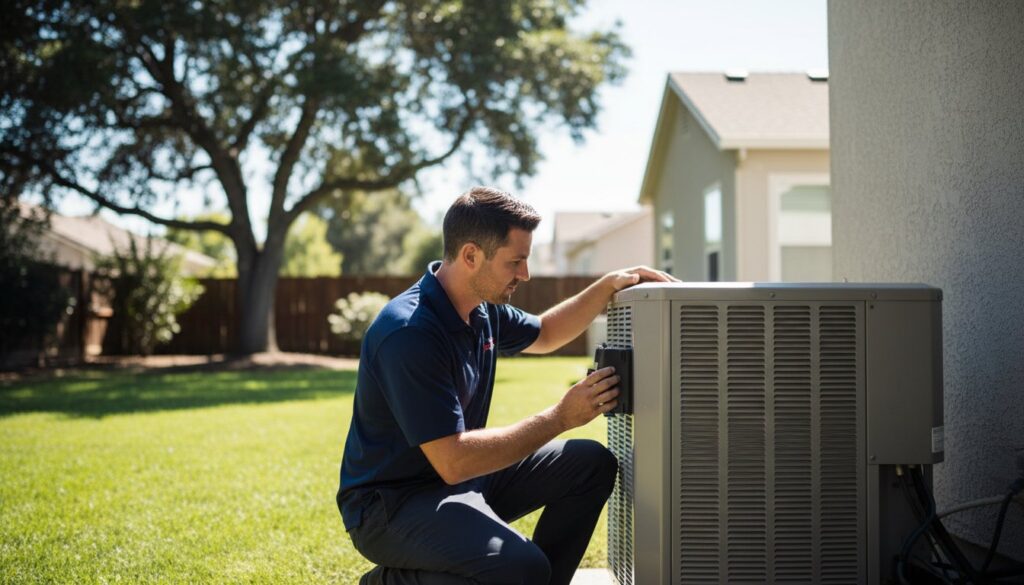
It’s 4:00 PM on a sweltering Roseville afternoon, and instead of a crisp breeze, your vents are pushing out lukewarm humidity. You’re likely asking yourself, why is my AC blowing warm air? We know that sinking feeling when your home starts to feel more like a sauna than a sanctuary. We understand the immediate stress of a cooling failure, especially when you’re balancing your family’s comfort against the fear of a repair bill that typically averages around $1,000 in California.
As a family-owned team, we believe in protecting your household with honest, neighborly advice. This guide will help you identify the most common causes of warm air so you can restore comfort quickly. We’ll walk you through a “Thermostat-to-Transformer” checklist that covers everything from Sacramento Valley dust to the new 2026 SEER 15 efficiency standards. You’ll learn how to spot simple DIY fixes and recognize exactly when it’s time to call in a local expert to handle complex technical issues like the new R-454B refrigerant systems.
Key Takeaways
- Start with the basics by verifying your thermostat settings and circuit breaker to rule out simple power issues.
- Understand how Sacramento Valley dust can clog your filters and lead to the frustrating problem of why is my AC blowing warm air.
- Learn how to safely inspect your outdoor condenser unit for debris or power loss to ensure proper heat transfer.
- Identify red flags like hissing sounds or oily residue that signal a refrigerant leak requiring professional attention.
- Discover when to stop troubleshooting and trust our family-owned team to restore your home’s peace of mind.
First Steps: Quick Thermostat and Power Checks
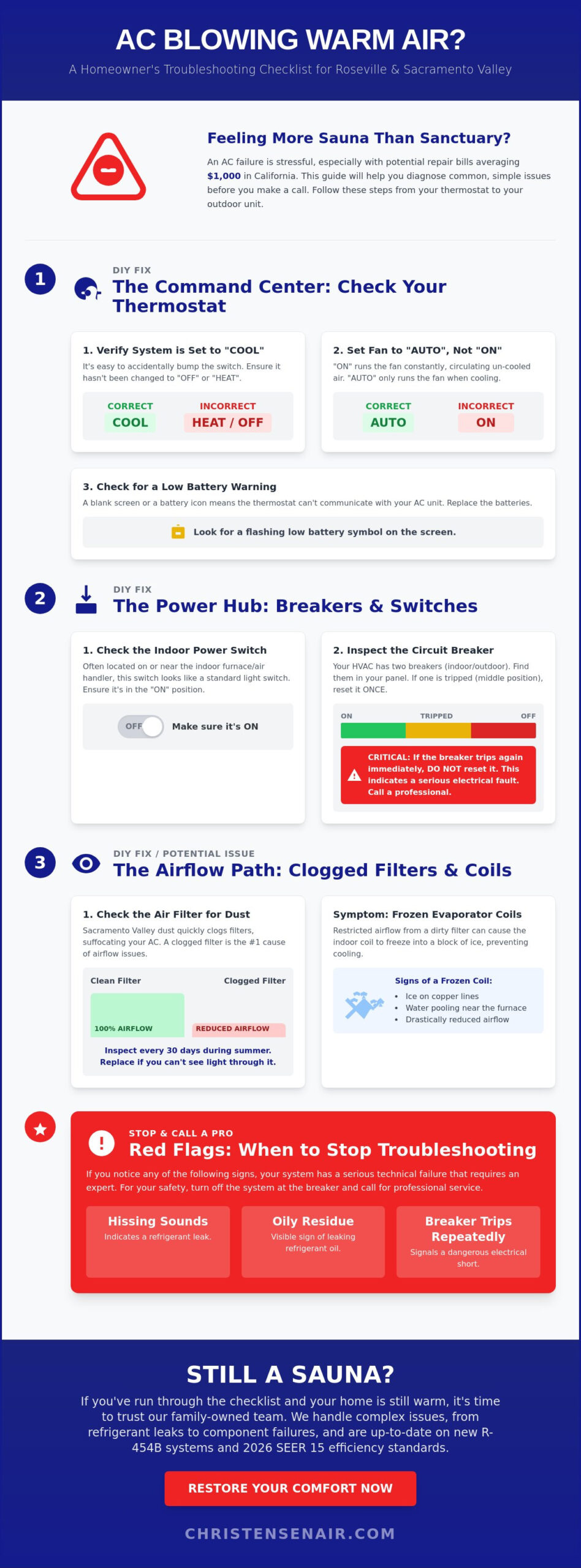
Before you start worrying about a total system failure, we recommend starting with the simplest solutions. We’ve seen many cases where a quick adjustment restores comfort without the need for a service call. First, check your thermostat batteries. If the screen is blank or flashing a low-battery icon, the device loses communication with your cooling unit. Next, confirm it’s actually set to “COOL.” It sounds simple, but we’ve helped many neighbors who didn’t realize a family member bumped the setting to “HEAT” or “OFF.”
Also, look for the indoor power switch. This switch looks exactly like a standard light switch and is usually located on the side of your furnace or on a nearby wall in the garage or attic. If someone accidentally flipped it while reaching for storage, your system won’t receive power. This is a common reason why is my AC blowing warm air, and it’s a fix that takes only a second of your time.
To better understand these preliminary steps and other common causes, watch this helpful video:
The ‘Fan ON’ vs. ‘Fan AUTO’ Mistake
One of the most frequent reasons you might feel lukewarm air is the fan setting. If your thermostat is set to “ON,” the blower fan runs 24/7, even when the outdoor compressor isn’t actually cooling the air. This results in the system pushing unconditioned, room-temperature air through your vents between cooling cycles. We always suggest switching your thermostat to “AUTO.” This ensures the fan only blows when the air is actively being chilled by the evaporator coil. This simple change prevents that humid, warm sensation and helps maintain the peace of mind you expect from your home’s cooling system.
Checking Your Circuit Breakers
Your HVAC system uses two separate breakers: one for the indoor unit and one for the outdoor condenser. Head to your electrical panel and look for labels like “AC,” “Condenser,” or “HVAC.” If a switch is in the middle position, it has tripped. Flip it all the way to “OFF” and then back to “ON” to reset it. During intense Roseville heat waves, where temperatures can stay above 100 degrees for days, older breakers may trip under the heavy electrical load. Understanding why is my AC blowing warm air often starts with these simple electrical checks. However, if the breaker trips again immediately, please don’t try to reset it again. This is a safety mechanism that protects your home from electrical fires and indicates a failing component or a short circuit that needs a professional’s touch.
Airflow Obstructions: The Impact of Sacramento Valley Dust
Living in Roseville means dealing with the unique environmental factors of the Sacramento Valley. While our region is beautiful, the combination of agricultural activity and seasonal winds creates a high volume of fine dust and pollen. We often find that these local particles are the primary reason homeowners ask, why is my AC blowing warm air? When your air filter becomes a wall of debris, your system essentially suffocates. It can’t pull enough warm air from your rooms to complete the cooling cycle, which leaves your vents pushing out tepid, unconditioned air.
We recommend a strict maintenance schedule during our peak California summers. From May through September, you should inspect your filter every 30 days. If you have pets or live near open fields, you might need to replace it monthly to keep your system breathing easily. Ignoring a dirty filter doesn’t just make you uncomfortable; it puts immense strain on your blower motor, which can lead to expensive component failures that are entirely preventable with a five-dollar part.
How a Dirty Filter Freezes Your System
The evaporator coil is the heart of your indoor unit’s heat exchange process. Its job is to absorb heat from your home’s air using cold refrigerant. However, if a clogged filter restricts airflow, the coil doesn’t have enough heat to “soak up.” This causes the temperature of the coil to drop below freezing. Any moisture in the air then turns to ice, eventually encasing the entire coil in a frozen block. If you see ice forming on the copper lines leading to your unit or notice water pooling around the furnace base, your system has likely frozen over. This is a common answer to why is my AC blowing warm air, as the ice acts as an insulator, preventing any actual cooling from reaching your living spaces.
Local Air Quality and Your HVAC
Beyond simple dust, our local environment plays a significant role in how your system performs. We’ve written extensively about how to improve indoor air quality, but it’s important to remember that your filter’s first job is protecting the equipment. In the Sacramento Valley, we see heavy concentrations of oak pollen and fine silt that can bypass cheap fiberglass filters. However, be careful with high-MERV “allergy” filters. These are often so thick they restrict airflow as much as a dirty filter does. If your system wasn’t designed for high-static pressure, these filters might actually be the cause of your warm air issues. If you’re unsure which filter is right for your home, our team can help you find a balance that protects both your family’s health and your system’s efficiency. Keeping your system clean is the best way to ensure lasting comfort and peace of mind for your household.
Inspecting the Outdoor Condenser Unit in Local Heat
Once you’ve ruled out thermostat issues and indoor filter clogs, it’s time to head outside. Your outdoor condenser unit is responsible for releasing the heat collected from inside your home. In Roseville, where summer temperatures frequently climb above 100 degrees, this unit works under extreme pressure. We often find that a neglected outdoor unit is the primary reason why is my AC blowing warm air. If the condenser can’t “breathe,” it can’t dump heat, which means that heat stays inside your living room.
Walk around the unit and check for any obstructions. We recommend maintaining a 2-foot “breathing zone” on all sides of the equipment. We’ve seen many cases where overgrown shrubs, stacked firewood, or even patio furniture block the airflow. This congestion forces the compressor to run hotter and longer, which significantly shortens its lifespan and compromises your family’s comfort. While you’re there, listen for any unusual noises. A loud humming or a persistent clicking sound often indicates that a component is struggling to start under the midday sun.
Cleaning Your Condenser Safely
Our local environment in Placer County presents specific challenges for outdoor equipment. During the late spring and summer, cottonwood seeds and dry grass clippings from lawn mowing can get sucked into the condenser fins. This debris acts as an insulating blanket that traps heat. We suggest a gentle cleaning to restore efficiency. First, turn off the power at the outdoor disconnect switch. Then, use a standard garden hose to rinse the fins with a soft spray from the inside out. Never use a pressure washer for this task. The high-pressure stream will flatten the delicate aluminum fins, causing permanent airflow restriction and leading to the very problem you’re trying to solve.
Identifying Fan and Motor Issues
If the outdoor fan isn’t spinning, your system has no way to dissipate heat. This is a common answer to why is my AC blowing warm air during a heat wave. You can usually see the fan through the top grille of the unit. If it’s stationary while the system is calling for cool air, you likely have a failed capacitor. This small, cylindrical component acts like a high-powered battery to kick-start the fan and compressor motors. Because extreme heat causes electrical components to degrade faster, capacitors are the most frequent failure point we see in Roseville. If you see the fan spinning slowly or hear the motor “growling” without turning, it’s a clear sign that the electrical system needs professional attention to protect the more expensive compressor from burning out.
Identifying Technical Failures: When to Stop Troubleshooting
While we always hope for a simple fix like a dirty filter, some situations require a deeper look into the mechanical heart of your system. If you’ve performed the basic checks and still find yourself asking why is my AC blowing warm air, the problem might be a technical failure hidden from plain sight. One common sign of a serious issue is an oily residue on the copper refrigerant lines or a faint hissing sound coming from the unit. These are telltale signs of a refrigerant leak. Unlike a car’s gas tank, an air conditioner shouldn’t “run out” of refrigerant; it’s a closed loop that only loses pressure if there’s a hole in the line.
You might also encounter the “Warm Air, Cold Pipe” scenario. If you touch the larger, insulated copper pipe outside and it feels ice-cold or is covered in sweat, but your indoor vents are blowing warm, the cooling process is actually working. In this specific case, the issue usually lies with your indoor blower motor or a massive internal airflow blockage. Conversely, if the outdoor unit is humming but the fan isn’t spinning and the pipes are warm, your compressor or contactor has likely failed. The contactor is the electrical switch that tells your system to start. Over time, these can become pitted or burnt, especially during our intense Roseville summers when the system cycles on and off constantly.
The Dangers of Low Refrigerant
It’s a common misconception that systems just need a “recharge” every few years. Because your AC is a sealed system, any drop in refrigerant levels means a leak is present. Simply adding more refrigerant without finding and sealing the leak is a temporary, expensive band-aid. Handling these chemicals requires specialized equipment and EPA certification. As of January 1, 2025, the industry began a major transition away from R-410A refrigerant. Any service involving these high-pressure gases must comply with California’s strict reclamation standards to protect the environment and your system’s long-term health.
Expert contractors, including Ultra Air Heating and Cooling in Southwest Florida, follow similar high standards to ensure that refrigerant issues are handled safely and effectively, regardless of the local climate.
The Professional Danger Zone
There’s a point where DIY efforts can become hazardous to both your safety and your wallet. We strongly advise against opening the electrical cabinet on your outdoor unit. The capacitors we mentioned earlier can hold a lethal electrical charge even after the power is turned off. For tasks involving high-voltage wiring, refrigerant handling, or internal compressor testing, you should always seek professional AC repair in Roseville. Attempting to repair a compressor yourself can immediately void your manufacturer’s warranty, leaving you responsible for the full cost of a replacement. If your troubleshooting has led you to a mechanical dead end, contact our family-owned team to restore your home’s comfort safely and honestly.
Professional AC Repair in Roseville: Restoring Your Family’s Comfort
If you’ve gone through our checklist and still find yourself asking why is my AC blowing warm air, it’s time to let a professional take over. We understand that inviting a technician into your home is an act of trust. That’s why our diagnostic process is built on transparency and precision. We use high-tech thermal imaging cameras to identify hotspots in your electrical components and sensitive electronic leak detectors to find even the smallest refrigerant leaks. These tools allow us to pinpoint the exact failure without guesswork. You’ll only pay for the repairs you actually need to restore your peace of mind.
We treat your home like our own. Our family-owned team takes pride in every job, whether it’s a minor capacitor swap or a complex compressor replacement. We don’t just fix machines; we protect the sanctuary of your household. By focusing on long-term relationships rather than quick transactions, we’ve become a trusted fixture in the Roseville community. We’re here to ensure your family stays cool, no matter how high the Sacramento Valley temperatures climb.
The Christensen Difference
Our roots in Roseville run deep. We’ve spent years serving our neighbors with a no-pressure approach that prioritizes your needs. Whether you need a deep dive into your system’s efficiency or a simple explanation of HVAC service, we speak your language. Our team stays current on all 2026 California energy standards, including the transition to SEER 15 requirements. This expertise extends across all home comfort systems, from high-efficiency cooling units to modern gas furnaces. We provide clear, informative guidance so you can make the best decision for your home’s future.
Joining the Comfort Club
The best way to stop asking why is my AC blowing warm air is to prevent the problem before it starts. Our Comfort Club maintenance plan is designed to catch small issues like worn contactors or dusty coils before they lead to a mid-July breakdown. In 2026, an annual maintenance contract typically costs between $150 and $500. This is a smart investment when you consider that a major AC repair in California can often reach $3,500. Prevention saves you money and stress. Benefits of the club include:
- Two comprehensive tune-ups per year to ensure peak efficiency and safety.
- Priority service for members during Sacramento’s most intense heat waves.
- Lower utility bills by maintaining your system’s optimal performance levels.
- Extended equipment lifespan through regular, professional care by experts who know your system.
Protecting your family’s well-being is our primary mission. When you partner with us, you’re not just getting a repair; you’re gaining the confidence that your home’s comfort is in expert hands. We’re ready to help you get back to the cool, relaxing environment you deserve.
Restoring Cool Air to Your Roseville Sanctuary
You shouldn’t have to spend your evenings sweating through the valley heat. Understanding why is my AC blowing warm air starts with the simple checks we’ve discussed, from verifying your thermostat settings to clearing away Sacramento Valley dust from your filters. While many issues have DIY solutions, others like refrigerant leaks or electrical failures require the precision and safety of a professional.
We’ve been a family-owned and operated business since 2009, and we take pride in treating every neighbor’s home like our own. Whether you have a traditional system or one of the high-efficiency inverter heat pumps that are becoming the new standard in California, our team has the technical expertise to get your system back on track. We’re proud to serve Roseville, Rocklin, and the entire Sacramento area with honesty and reliability.
Don’t let a minor glitch turn into an expensive emergency. Schedule your professional AC repair with Christensen Heating and Cooling today! We’re here to protect your household’s well-being and ensure you enjoy the peace of mind that comes with a perfectly cooled home.
Frequently Asked Questions
Is it safe to keep running my AC if it is blowing warm air?
No, you should turn your system off immediately to prevent permanent damage. Running an air conditioner that isn’t cooling puts extreme stress on the compressor, which is the most expensive part of your unit. Since a major compressor replacement in California can exceed $2,000, shutting it down now protects your wallet and your home’s long-term comfort.
How much does it usually cost to fix an AC blowing warm air in Roseville?
Repair costs in California typically range from $400 to $3,500, with a common average of around $1,000. You should also expect a standard diagnostic fee between $100 and $250 to have a technician assess the problem. Minor repairs, such as replacing a capacitor or a thermostat, often fall in the $150 to $500 range.
Why is my AC blowing warm air but the outside unit is running?
This usually indicates that while your system has power, it isn’t successfully moving heat out of your home. If you’re wondering why is my AC blowing warm air despite the outdoor fan spinning, the cause is often a refrigerant leak or a failed compressor. The system is trying to cycle, but without the proper chemical balance, it can’t chill the air.
Can a dirty air filter really cause my AC to blow hot air?
Yes, a clogged filter is one of the most common reasons for cooling failure in the Sacramento Valley. When airflow is restricted, the evaporator coil can’t absorb enough heat and will eventually freeze into a block of ice. This ice acts as an insulator, blocking cold air from entering your ductwork and leaving you with nothing but warm air.
What does it mean if my AC is blowing warm air only during the day?
This often suggests your system is struggling with the intense Roseville afternoon heat. It might be caused by a dirty outdoor condenser or an aging system that no longer meets the 15 SEER efficiency standards required for modern California homes. When the sun is at its peak, a compromised system simply can’t dump heat fast enough to keep you cool.
How do I know if my AC needs more refrigerant?
Common signs include a hissing sound near the indoor unit or ice forming on the copper refrigerant lines. It’s important to remember that AC systems are sealed and don’t “consume” refrigerant. If your levels are low, it means there’s a leak that must be repaired by a licensed professional to comply with California’s strict environmental regulations.
Should I turn off my AC if the coils are frozen?
Yes, you must turn the cooling off immediately but keep the fan setting on “AUTO” or “ON” to help the ice melt. Running the compressor while the coils are frozen can lead to a complete system slugging, which destroys the motor. Let the unit thaw completely, which typically takes about 24 hours, before attempting to restart it or calling for a repair.
How long do air conditioners typically last in the Sacramento climate?
In our region, air conditioners generally last between 10 and 15 years. The extreme summer temperatures in Placer County mean our systems work significantly harder than those in milder climates. If your system is approaching the 12-year mark and requires frequent repairs, it may be more cost-effective to upgrade to a high-efficiency heat pump.