






Imagine it’s a blistering 104-degree afternoon in Roseville and your aging air conditioner is making a rhythmic clanking sound that signals the end. You know it’s time for a replacement, but you’re already bracing for the difficult kitchen table conversation about the price tag. Figuring out how to get buy-in from your spouse for a new HVAC doesn’t have to be a source of household tension. We understand that these decisions are about more than just machinery; they’re about keeping your family safe and your monthly budget predictable.
We’ve helped many of our neighbors turn this stressful debate into a logical, unified investment plan. You’ll learn how to present a clear case for a new system by focusing on comfort ROI and the significant 2026 financial incentives available to your family. We will walk you through the specifics of the $2,000 federal tax credit for heat pumps, the rising costs of repairing obsolete R-410A units, and how a professional assessment can serve as a neutral tie-breaker. By the end of this guide, you’ll have a strategy to move forward together toward a cooler, more efficient home.
Key Takeaways
- Learn why waiting for a total system failure leads to an “emergency premium” and how planned installations protect your family’s budget.
- Discover the specific steps for how to get buy-in from spouse for new HVAC by timing the conversation and focusing on logic over technical jargon.
- Explore the 2026 financial landscape, including $2,000 federal tax credits and local utility rebates that make high-efficiency systems more affordable.
- See how to translate energy efficiency into “comfort ROI,” turning technical specs into tangible benefits like lower utility bills and better sleep.
- Find out how a professional assessment acts as a neutral tie-breaker to help your family make a unified, pressure-free investment in your home.
Why ‘Waiting Until It Breaks’ Is the Most Expensive Strategy
We’ve all been there. You hope the system lasts just one more summer. But waiting for a total breakdown is often the most expensive gamble a Roseville homeowner can take. In our region, a mid-July heatwave isn’t just uncomfortable; it’s an economic trap. When every HVAC company in the area is booked out for weeks, you lose your power to negotiate or shop for the best value. This is the first hurdle in learning how to get buy-in from spouse for new HVAC: proving that proactive planning saves thousands over reactive panic.
Beyond the immediate repair bill, aging systems levy a silent tax on your family every month. You might notice your utility bills creeping up even though your habits haven’t changed. Older units lose efficiency over time, working twice as hard to provide half the comfort. Understanding how air conditioning works helps clarify why a worn-out compressor draws so much more power than a modern system. Frequent service calls for $500 here and there might feel manageable in the moment, but they rarely solve the underlying mechanical fatigue.
To see how partnership and planning play a role in household decisions, watch this helpful video:
A failing unit doesn’t just hurt your wallet; it strains your entire home. Excessive vibration can rattle ductwork joints loose, and a struggling motor can even cause electrical issues in your main panel. Then there’s the emotional cost. The stress of a 105-degree day without cooling can turn a sanctuary into a pressure cooker, affecting sleep and family harmony. Making a decision now prevents the high-pressure environment of an emergency failure.
The 5,000 Rule: A Data-Driven Decision Tool
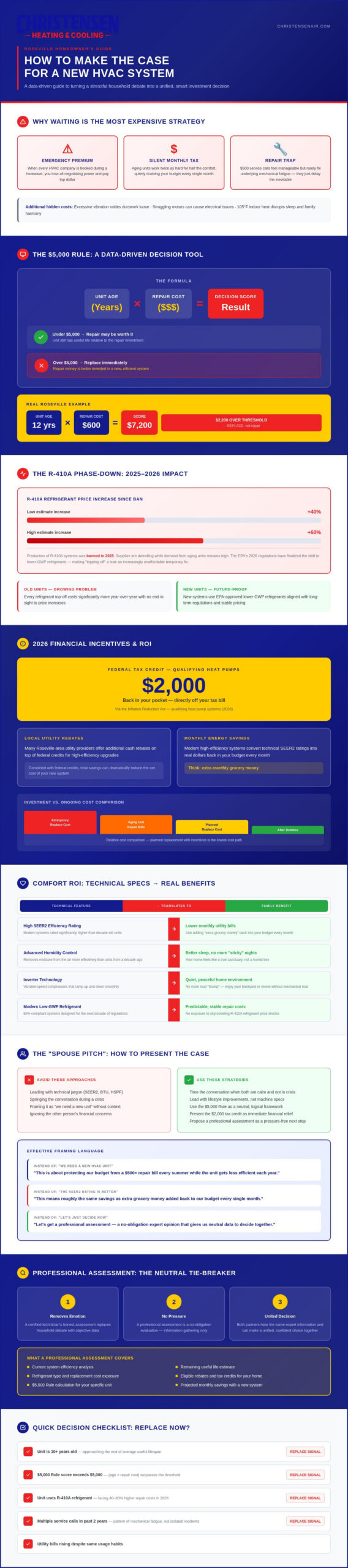
This mathematical baseline is a great way to simplify how to get buy-in from spouse for new HVAC because it removes emotion from the equation. The rule is simple: multiply the age of the unit by the cost of the repair. If the total exceeds 5,000, a replacement is the logical financial choice. For many Roseville homes built 10 to 15 years ago, a $600 repair on a 12-year-old unit equals 7,200. Since this is well over the 5,000 threshold, investing that money into a new, efficient system provides a much better return than patching a sinking ship.
The R-410A Phase-Down Impact in 2026
The landscape of home cooling changed significantly when the production of R-410A systems was banned in 2025. By 2026, the price of this older refrigerant for repairs has increased by 40% to 60% compared to just a few years ago. “Topping off” a leaking unit is no longer a viable long-term financial plan because the supplies are dwindling and costs are skyrocketing. The EPA’s 2026 regulations have finalized the shift toward lower-GWP refrigerants, causing the price of older R-410A supplies to skyrocket for those still clinging to aging units.
Translating Technical Specs into Family Benefits
When you’re discussing how to get buy-in from spouse for new HVAC, the secret is moving away from abstract numbers and toward lifestyle improvements. Most people don’t get excited about a SEER2 rating, but everyone understands the value of extra “monthly grocery money.” A high-efficiency system isn’t just a machine; it’s a financial tool that lowers your overhead. By taking advantage of the 2026 federal tax credits, which can offer up to $2,000 for qualifying heat pumps, the initial investment becomes a much easier pill to swallow for the family budget.
We often talk to neighbors who struggle with “sticky” summer nights. This isn’t just about the temperature; it’s about humidity control. Modern systems are designed to pull moisture out of the air more effectively than units from a decade ago. This leads to better sleep and a home that feels like a true sanctuary rather than a humid box. Additionally, modern inverter systems eliminate the loud “thump” that older units make when they kick on. This noise reduction creates a peaceful environment where you can actually enjoy your backyard or a movie without a mechanical roar in the background.
Wildfire Season and Indoor Air Quality (IAQ)
In the Sacramento Valley, we have to take wildfire season seriously. A new system allows for advanced filtration that older units simply can’t handle. High-MERV filters and UV light installations work together to trap smoke particles and neutralize pathogens. If you have children or seniors in the home, learning how to improve indoor air quality is a powerful argument for health and safety. It protects your family’s lungs when the outdoor air becomes hazardous.
Inverter Technology: The ‘Cruise Control’ for Comfort
We often recommend inverter heat pumps because they act like cruise control for your home’s climate. Instead of blasting on and off, they modulate their speed to maintain a perfectly steady temperature. This technology is ideal for our fluctuating climate, as it eliminates the frustrating hot and cold spots common in older Roseville homes. You can find more details on what is an inverter heat pump and how does it work to help explain the mechanical magic to your spouse. If you want to ensure your system stays this efficient for years to reach, consider joining our Comfort Club Maintenance Plan for ongoing peace of mind.
The Financial Case: ROI, Rebates, and 2026 Incentives
Building a financial case is often the most effective way to secure a unified decision. In 2026, the combination of federal tax credits and utility rebates makes the math more favorable than it’s been in decades. The Energy Efficient Home Improvement Credit allows you to claim 30% of the cost of qualifying equipment. For those choosing an inverter heat pump, this credit can reach up to $2,000 annually. Presenting these numbers shows you’re not just asking for a purchase. You’re showing a way to recover a significant portion of the investment through tax savings.
Local incentives in the Sacramento Valley add another layer of savings. Whether you’re a SMUD or PG&E customer, there are often specific rebates for transitioning to high-efficiency electric systems. While the HEEHRA rebates for California single-family homes are currently on a waitlist as of February 2026, utility-specific programs continue to offer relief. This local data is vital for how to get buy-in from spouse for new HVAC, as it shows you’ve done the homework on Roseville-specific benefits.
We also encourage couples to look at the “avoided cost” of staying with an old unit. As we mentioned earlier, the cost of R-410A refrigerant for servicing existing units has increased by 40% to 60% since 2023. Subtracting these projected, wasted repair costs from the price of a new system reveals the true net investment. If you’re concerned about cash flow, low-interest financing can act as a smart hedge against inflation. This allows you to pay for the system with tomorrow’s dollars while enjoying lower utility bills today.
High-Efficiency ROI in Northern California
High-efficiency units in our region see a much faster return on investment than in milder climates. By integrating a smart thermostat with SMUD’s time-of-use rates, you can automate your cooling to run during off-peak hours, significantly cutting your monthly bills. In the Roseville climate, the average payback period for a high-efficiency HVAC system through energy savings is typically between five and eight years.
Maintenance Savings with the Comfort Club
Think of our Comfort Club Maintenance Plan as an insurance policy for your new investment. Regular tune-ups extend the life of your equipment and prevent those “sticker shock” repairs that cause household stress. Perhaps most importantly, members get priority service. When the “Sacramento Sizzler” hits and temperatures stay in the triple digits for a week, knowing you’re at the front of the line provides emotional security that money can’t buy.
The ‘Spouse Pitch’: How to Present the Case
Presenting a major home investment to your partner is about partnership, not persuasion. We’ve seen that the most successful conversations happen when both people feel like they’re on the same team. Instead of focusing on the mechanical specs, start by organizing your thoughts. Collect the last two years of repair receipts and utility statements. This data makes the “silent tax” we discussed earlier visible. It changes the topic from a personal preference to a logical look at what your current system is costing the family budget. This is the first step in how to get buy-in from spouse for new HVAC without creating unnecessary friction.
Timing is just as important as the data itself. Avoid starting this conversation during a 100-degree Roseville afternoon or right after opening a high utility bill. Stress levels are already high during those times, and it’s hard to make a logical decision when you’re feeling the heat. Pick a quiet evening when you’re both relaxed. Frame the discussion around shared family goals. You aren’t just buying a new machine. You’re investing in your children’s health through better air filtration and your own financial security through predictable monthly costs.
When you present your findings, offer three distinct paths: a reliable “good” option, a high-value “better” choice, and the “best” long-term investment. This gives your spouse a sense of agency and control over the household budget. Finally, if the conversation feels stuck, call in a neutral expert. A professional assessment from a local team can provide an objective look at your home’s needs without the emotional weight of a household debate. You can schedule a professional assessment today to help your family make the right choice together.
Handling Common Objections
Objections are a natural part of any large household decision. If the concern is the budget, discuss how low-interest financing can make the monthly cost lower than your current energy waste. If your partner wants to wait, show them the data we covered regarding emergency premiums during peak season. For those who don’t notice the noise or smells, share the indoor air quality data or professional inspection findings. Addressing these concerns with data rather than emotion keeps the conversation productive.
Creating a ‘Home Sanctuary’ Vision
Ultimately, you’re creating a home sanctuary. A reliable system reduces the mental load of worrying about a breakdown during a heatwave. It means better sleep, less dust, and a quieter environment for your family to enjoy. Choosing a local, family-owned installer ensures you get neighborly care rather than a high-pressure sales pitch. This focus on family well-being is a priority for many quality service providers, such as U-First Dental Care, who emphasize professional and compassionate care. By shifting the focus to quality of life, you help your spouse see the system as a way to protect the sanctuary and well-being of your household.
The Christensen Assessment: Your Neutral Tie-Breaker
We’ve walked through the data, the financial incentives, and the strategy for a successful household discussion. However, sometimes the most effective way to reach a unified decision is to bring in a professional third party. Our assessment isn’t a high-pressure sales pitch. It’s an objective, data-driven evaluation of your home’s current health. By providing a neutral perspective, we help remove the emotional weight from the decision-making process. This clear, professional roadmap is often the final step in how to get buy-in from spouse for new HVAC because it replaces guesswork with expert verification.
Our “Comfort First” approach goes much deeper than just looking at the mechanical box outside. We take a holistic view of your home’s sanctuary. This includes inspecting your ductwork for leaks, evaluating your current insulation levels, and checking your indoor air quality (IAQ) sensors. A new unit won’t perform at its peak if the rest of the house isn’t ready. We’ve been a family-owned fixture in the community since 2009, and we take personal pride in providing transparent pricing that your family can trust. We recommend scheduling a time when both partners can be present so we can answer every question in real-time, ensuring total transparency for everyone involved.
Why Local Expertise Matters
Every home in the Sacramento Valley faces unique challenges based on its specific location. The cooling needs for a home in the foothills of Auburn are different than those in the flatter, heat-retaining areas of Roseville or the urban center of Sacramento. We understand these microclimates because we live and work here too. Our commitment to long-term relationships means we’re more interested in your family’s comfort than a one-time transaction. If your current unit still has life in it, we’ll tell you. If you just need a reliable AC repair Roseville homeowners can count on, we’ll handle it with the same care as a full installation.
Start Your Journey to a More Comfortable Home
Taking the first step toward a more efficient home shouldn’t be a source of stress. We’ve designed our scheduling process to be easy and flexible for busy families. For immediate peace of mind, many of our neighbors choose to join the Comfort Club Maintenance Plan. This ensures your investment is protected from day one and helps you avoid the “emergency premium” repairs we discussed earlier. We treat every home with the same respect and care we’d apply to our own. Let’s work together to make your home the cool, quiet, and healthy sanctuary your family deserves.
Taking the Next Step Toward Your Home Sanctuary
We’ve explored how a proactive approach saves your family from the “emergency premium” and how modern high-efficiency systems provide tangible health benefits. By focusing on the 2026 financial incentives and shifting the conversation toward shared goals like better sleep and lower utility bills, you turn a technical purchase into a family win. Learning how to get buy-in from spouse for new HVAC is ultimately about finding common ground in the long-term well-being of your household. It’s about moving from a place of stress to a position of financial and emotional security.
As a family-owned business since 2009, we’ve spent over 15 years building trust in the Roseville community. We specialize in high-efficiency IAQ and heat pump solutions that protect your sanctuary and your budget. Let us help you and your partner make a confident, data-driven choice that brings lasting comfort to your home. You don’t have to navigate these technical decisions alone. We are here to partner with you and ensure your home remains a safe, comfortable place for your loved ones for many years to come.
Schedule a Neutral Professional Assessment with Christensen Heating and Cooling today.
Frequently Asked Questions
Is it better to repair or replace an HVAC system that is 12 years old?
A 12-year-old system is often nearing the end of its reliable lifespan in the Roseville climate. We recommend using the 5,000 rule by multiplying the age of the unit by the repair cost. If that number exceeds 5,000, replacing the unit is usually the smarter financial move. This helps when you’re looking at how to get buy-in from spouse for new HVAC because it provides a clear, mathematical reason to stop spending money on an aging system.
How much can I actually save on my SMUD bill with a high-efficiency AC?
Switching to a high-efficiency system can lead to substantial savings on your monthly SMUD bill. While exact numbers depend on your usage, modern units use significantly less electricity to maintain the same level of comfort. When you pair a high-efficiency installation with SMUD’s time-of-use rates, you can maximize your savings by cooling your home more effectively during off-peak hours.
What are the current 2026 tax credits for installing a heat pump?
The 2026 federal tax credit for qualifying heat pumps is 30% of the total cost, capped at $2,000 per year. This is part of the Energy Efficient Home Improvement Credit (25C) under the Inflation Reduction Act. For central air conditioners or furnaces, the credit is typically capped at $600. These incentives are designed to make high-efficiency upgrades more accessible for local families.
How long does a typical HVAC installation take in the Roseville area?
Most full system installations are completed within one to two days. We aim to minimize disruption to your home’s sanctuary by working efficiently and cleaning up thoroughly. If your project involves a more complex duct system replacement, it might take a bit longer. We provide a clear timeline before any work begins so your family knows exactly what to expect.
Can a new HVAC system really help with my child’s allergies during fire season?
Yes, a modern system equipped with high-MERV filtration and UV light installation can significantly improve indoor air quality. These systems are designed to trap smoke particles and neutralize allergens that older units often miss. This is a powerful point for how to get buy-in from spouse for new HVAC, as it directly impacts your family’s health and safety during hazardous air days.
What financing options are available for homeowners with average credit?
Homeowners have several options to help manage the investment of a new system. Many local families utilize low-interest or 0% financing programs that allow them to pay for the system over time. We recommend checking with your contractor for the specific programs available in 2026. This can help turn a large upfront expense into a manageable monthly payment that fits your family’s budget.
How do I know if my ductwork needs replacing along with the AC unit?
If your home has hot and cold spots or your energy bills remain high after a tune-up, your ducts might be the culprit. We often see older ductwork that is leaky or undersized for modern high-efficiency units. A professional assessment can determine if a duct system replacement is necessary to ensure your new HVAC system operates at its full potential.
Why is my spouse seeing different prices online than our local quotes?
Online prices usually only cover the equipment and ignore the complexities of a professional installation. These prices often don’t account for local permits, California’s SEER2 minimum efficiency standards, or the labor required for a safe setup. A local quote includes the expertise needed to handle the R-410A refrigerant phase-out and ensures your system is sized correctly for the specific Roseville climate.