





What if waiting for your air conditioner to fail is actually the most expensive way to keep your Roseville home cool? We’ve all felt that familiar anxiety when the Northern California heat climbs and the vents start blowing lukewarm air. Most homeowners wait for an emergency to act, but identifying the best time of year to buy a new HVAC system can save you more than just a headache. By planning your upgrade during the mild shoulder seasons, you avoid the peak-season price hikes and long wait times that plague our hottest months.
We know that navigating 2026 refrigerant mandates and complex utility incentives can feel overwhelming. You deserve a system that lowers your monthly bills and protects your family’s comfort without the stress of a mid-summer breakdown. This guide will show you how to strategically time your purchase to secure the best technicians and maximize your savings. We’ll explore how to leverage current SMUD rebates and federal tax credits to make your home more efficient while keeping more money in your pocket.
Key Takeaways
- Target the shoulder seasons between March and May or September and November to avoid peak-season pricing and ensure faster scheduling.
- Discover why the best time of year to buy a new HVAC system in Roseville is during the spring and fall when demand is low and manufacturer promotions are at their peak.
- Secure the highest quality installation by avoiding the summer rush, giving our expert technicians the time needed for a meticulous, unhurried setup.
- Maximize your return on investment by combining 2026 federal tax credits with local SMUD rebates for high-efficiency inverter heat pumps.
- Use the “Rule of 5,000” to calculate whether a repair is a sound investment or if a proactive replacement will save you more in the long run.
When is the Best Time to Buy a New HVAC System in Northern California?
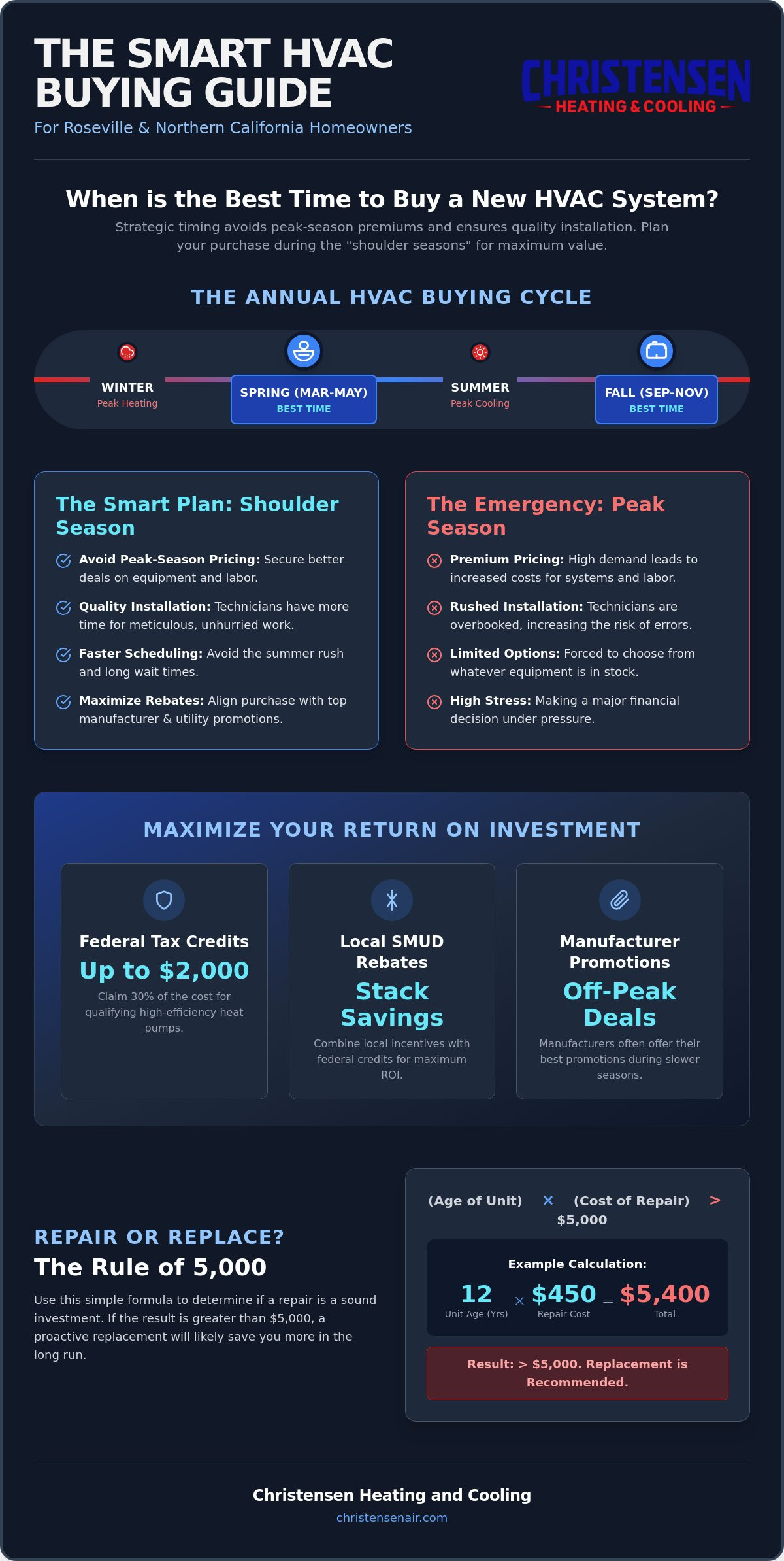
In the Sacramento Valley, we don’t just deal with heat; we manage a unique cycle of extreme temperature swings and seasonal shifts. Finding the best time of year to buy a new HVAC system isn’t just about catching a sale; it’s about strategic timing to protect your home’s comfort. While many homeowners wait for a breakdown in July, we recommend looking at the “shoulder seasons.” A shoulder season in the HVAC industry refers to the mild transition months when outdoor temperatures don’t require heavy use of heating or cooling equipment. For Roseville families, these windows fall between March and May, and again from September to November.
Understanding the basics of Heating, ventilation, and air conditioning (HVAC) helps you see why these gaps are so valuable. During these months, local demand for emergency repairs drops, which means our team has more flexibility to focus on meticulous installations. April stands out as the ultimate “sweet spot.” It’s late enough to avoid the tail end of winter but early enough to beat the first triple-digit heat spikes that often hit our region in late May or early June.
To better understand why timing your purchase is so critical in 2026, watch this helpful video:
Our climate makes this timing more critical than in many other states. In Northern California, we face an intense “Summer Rush” that begins as early as mid-June. If you wait until the heat is already oppressive, you’ll likely face higher labor demand and limited equipment availability. By acting during the spring or fall, you ensure your home is a sanctuary before the valley heat or the foothill frost becomes a problem. This proactive approach allows us to treat your home with the dedicated care it deserves, rather than rushing to the next emergency call.
The Spring Window: Beating the Heat and Smoke
Installing your system before May does more than just keep you cool; it protects your indoor air quality before fire season begins. Modern systems with high-efficiency filtration are your first line of defense against seasonal smoke. By securing your equipment in early spring, you also avoid the inventory shortages that often occur when manufacturers struggle to keep up with summer demand across the West Coast. It’s the most reliable way to ensure you have your choice of top-tier inverter heat pumps before the rush starts.
The Fall Window: Preparing for the Central Valley Chill
Once the summer heat breaks, October offers another excellent opportunity for upgrades. Contractors are often eager to fill their schedules after the frantic summer months, which can lead to better scheduling options for your family. It’s the perfect time to ensure your heat pump is ready before the first frost hits Auburn or Placerville. This window is also the ideal time for a duct system replacement, as attic temperatures are finally safe enough for our technicians to perform the detailed sealing work your new system needs to run efficiently.
Maximizing Your ROI: Rebates, Incentives, and Off-Peak Pricing
Timing your purchase isn’t just about avoiding a sweaty afternoon in July; it’s a calculated financial strategy. For Roseville homeowners, the best time of year to buy a new HVAC system often aligns with the periods when financial incentives are most aggressive. In 2026, the federal government continues to offer substantial support through the Energy Efficient Home Improvement Credit (25C). This allows you to claim a tax credit of up to 30% of the total installation cost, with an annual cap of $2,000 for qualifying high-efficiency heat pumps. By leveraging these federal tax credits and rebates, you can significantly offset the initial investment of a modern system.
Planned replacements always cost less than emergency ones. When a system dies during a heatwave, you lose the luxury of time. You’re forced to choose from whatever inventory is currently on the truck and pay the prevailing market rates for labor. By contrast, shopping in the spring or fall allows you to compare quotes, research equipment, and secure off-peak pricing. Manufacturers often launch major “Spring Promotion” cycles between March and May to move inventory before the summer rush. These factory-direct rebates can save you a substantial amount, but they’re typically only available during these narrow windows.
Local Utility Incentives: SMUD and PG&E Cycles
In our region, the Sacramento Municipal Utility District (SMUD) provides some of the most robust incentives in the country. As of early 2026, SMUD offers rebates up to $3,000 for gas-to-electric conversions and $1,000 for electric-to-electric upgrades when you install inverter heat pumps. Filing for these rebates during the shoulder season often leads to faster processing times because the utility’s administrative staff isn’t buried under peak-season applications. We can help you navigate these requirements to ensure your installation meets the 2025 California Energy Code standards that went into effect this year.
Manufacturer Rebates vs. Dealer Discounts
It’s vital to distinguish between factory-direct savings and the discounts we offer as local contractors. The best dealers provide their most competitive pricing when the phones aren’t ringing off the hook. During the mild months, we’re more focused on keeping our skilled team busy than on managing a backlog of emergency calls. Upgrading to a SEER2-rated system significantly reduces long-term operational costs by delivering more cooling power for every watt of electricity consumed. If you’re curious about which current promotions apply to your home, you can reach out to our team for a transparent look at the current savings landscape.
The Technician Factor: Why Timing Affects Installation Quality
Choosing the best time of year to buy a new HVAC system isn’t just a financial decision; it’s a quality control measure. During the “Summer Rush,” our industry faces a reality where the most experienced technicians are often prioritized for emergency repairs to keep vulnerable neighbors safe during heatwaves. When you schedule your installation in the spring or fall, you aren’t competing with emergency calls. This allows our team to take an unhurried, meticulous approach to every detail of your home’s comfort system. A rushed installation can lead to a 30% drop in operating efficiency according to Energy Star, effectively erasing the benefits of a high-efficiency unit from day one.
We take the time to perform a deep inspection of your ductwork and ensure your new system is sized perfectly for your specific Roseville floor plan. With a nationwide shortage of 110,000 HVAC technicians, the demand for skilled labor in California is higher than almost anywhere else in the country. By planning your upgrade during the shoulder season, you ensure that our most seasoned experts are the ones handling your project. This extra time allows us to focus on the small details, like precision duct sealing and optimal refrigerant charging, which protect the long-term health of your investment.
Expertise Availability in Placer County
We want our “A-Team” on your project, especially for complex ductless mini split installations that require precise electrical work and mounting. Scheduling in the off-season gives us the luxury of time for a comprehensive home comfort assessment. We can look at your home as a whole, rather than just swapping out a box. This timing also makes it much easier to coordinate our work with other home remodels you might have planned for your Roseville or Rocklin home.
Safety and Testing Protocols
Testing a new air conditioner is actually more accurate when outdoor temperatures are moderate. Extreme heat can sometimes mask subtle airflow issues that are easier to calibrate during a mild spring day. We believe every family deserves a thorough post-installation walkthrough without the pressure of a technician needing to rush off to ten other emergency calls. This ensures every component of your new system meets our neighborly standards of care and provides the sanctuary your household needs before the valley heat returns.
The ‘Wait and See’ Risk: Emergency vs. Planned Replacement
Waiting until your unit stops blowing cold air might seem like a way to save money, but it often leads to the most expensive outcome possible. When a system fails during a 105-degree Roseville heatwave, you lose the ability to shop around for the best time of year to buy a new HVAC system. Instead, you’re forced into an emergency situation where equipment choice is limited to whatever is currently in stock. Emergency replacements often come with premium labor rates because technicians are already working around the clock to handle the seasonal surge. Beyond the financial cost, there’s the emotional toll of seeing your home’s sanctuary compromised when your family needs it most.
To help our neighbors make informed decisions, we use a simple mathematical framework called the “Rule of 5,000.” Multiply the age of your system by the cost of the pending repair. If the total is more than 5,000, a replacement is typically the more responsible financial choice. For example, a $600 repair on a 10-year-old system equals 6,000; this suggests that your money is better spent on a new, efficient unit rather than a temporary fix. Planning your replacement during the mild spring or fall months ensures you aren’t making these big financial decisions under the stress of a failing compressor.
Signs Your Current System Won’t Make it Through Summer
Your equipment usually sends out warning signals before it quits entirely. If you’ve had to call for frequent residential AC repairs in Carmichael or Roseville over the last two seasons, your system is likely on its last legs. Watch your utility statements closely; a 20% spike in year-over-year energy costs is a major red flag that your components are working too hard to maintain basic comfort. Strange grinding noises or inconsistent cooling between rooms often indicate that the compressor is struggling to keep up with the demands of the Sacramento Valley climate.
Modern Efficiency: Why 2026 Tech Outperforms 2010 Tech
The leap in technology over the last decade is significant. Modern inverter heat pumps don’t just turn on and off like older models; they modulate their speed to provide a steady, whisper-quiet flow of air. This precision prevents the humid “hot spots” common in older homes. While making your HVAC system last longer starts with a quality installation, even the best-maintained 15-year-old unit cannot compete with the 2026 efficiency standards. Upgrading now allows you to integrate smart, connected controls that optimize your energy use during peak utility hours. If you’re ready to stop the cycle of endless repairs, contact us today to discuss a proactive plan for your home’s long-term comfort.
Strategic Planning with Christensen Heating and Cooling
We’ve spent years helping our neighbors understand that the best time of year to buy a new HVAC system is whenever you have the time to make a calm, informed decision. Since 2009, our family-owned team has focused on building long-term relationships rather than chasing quick, high-pressure transactions. This legacy-driven approach means we’ll always give you an honest assessment. We use the data from your system’s performance to help you decide if a repair is truly viable or if a proactive replacement is the safer path for your household’s sanctuary.
Navigating the 2026 rebate landscape doesn’t have to be a solo mission. We actively track the latest SMUD incentives and federal tax credit requirements so you don’t have to spend hours researching complicated utility codes. Our goal is to ensure you maximize every available dollar of savings while installing a system that lowers your energy bills for the next decade. When you choose a shoulder-season installation, our office team has the administrative breathing room to walk you through every step of the rebate process, ensuring nothing is left on the table.
Once your new system is in place, we want to ensure it stays as efficient as the day we installed it. The Christensen Comfort Club is our way of providing that ongoing security. Regular maintenance isn’t just a technical requirement; it’s a commitment to your family’s safety and long-term comfort. By joining the club, you’re protecting your investment with a team that takes personal pride in the health of your home’s air and the integrity of your ductwork.
Your Local HVAC Partner in Roseville and Beyond
Our roots run deep in the Sacramento Valley. We serve families from Folsom to Citrus Heights with the same neighborly care we’d provide our own relatives. Our technicians take special pride in our shoulder-season projects because they have the time to engage with you personally and answer every question you have about your new inverter heat pump. We don’t just want to fix a machine; we want to ensure your environment is exactly what you need it to be before the next heatwave arrives. Getting a priority assessment during the mild months means you’re at the front of the line, not waiting on a long list when the temperature hits triple digits.
Next Steps for Your Home Comfort
The first step toward a more comfortable home is a simple, no-pressure evaluation. We’ll look at your current unit, inspect your ductwork for integrity, and provide a clear roadmap for your upgrade. We’ve helped hundreds of Placer County families secure their homes against the extremes of our climate. We’re ready to do the same for you. Scheduling your home evaluation today ensures a seamless installation experience without the stress of an emergency. Let’s work together to ensure your home remains the comfortable sanctuary your family deserves for years to come.
Secure Your Home’s Comfort Before the Next Heatwave
By choosing the shoulder seasons between March and May or September and November, you avoid the frantic summer rush and secure the highest quality installation. Timing your purchase allows you to take full advantage of 2026 utility rebates and federal tax credits, keeping your investment affordable and efficient. Identifying the best time of year to buy a new HVAC system is the smartest way to protect your family’s sanctuary while lowering your long-term energy costs.
As a family-owned and operated team serving the Roseville community since 2009, we’ve spent over 15 years specializing in high-efficiency and inverter technology. We’re here to help you navigate these choices with the honesty and neighborly care you deserve. Schedule Your Pre-Season Comfort Consultation with Christensen Heating and Cooling today. You don’t have to face another sweltering valley summer with an unreliable system; we’re ready to help you prepare your home for years of dependable, worry-free comfort.
Frequently Asked Questions
What is the cheapest month to buy a new HVAC system?
March and April are typically the most affordable months to secure a new unit in Roseville. During this window, manufacturers release major promotional incentives to clear inventory before the summer heat arrives. We also have more flexibility in our schedule, which allows us to offer the most competitive value to our neighbors. Identifying the best time of year to buy a new HVAC system helps you avoid the price hikes common in June and July.
Are HVAC systems really cheaper in the winter?
Not necessarily. While winter is technically an off-season for cooling, it’s the peak season for furnace repairs and installations. In Northern California, true off-peak periods occur during the mild spring and fall months. You’ll find better scheduling availability and manufacturer deals when the weather is temperate and demand for emergency heating or cooling is at its lowest point of the year.
Should I wait for my AC to break before buying a new one?
We don’t recommend waiting for a total system failure. Emergency replacements often lead to limited equipment choices and higher labor costs due to the urgent nature of the work. By planning your upgrade, you can research high-efficiency inverter heat pumps and ensure you’re getting the best possible return on your investment. It’s much better to replace a struggling unit on your own terms than to suffer through a 100-degree day without air.
How much can I save by purchasing an HVAC unit in the off-season?
You can save thousands of dollars by combining off-season manufacturer rebates with local utility incentives. In 2026, SMUD offers substantial rebates for heat pump conversions that are easier to process during the shoulder season. When you avoid the peak summer rush, you also sidestep the premium labor rates that many contractors charge when their crews are stretched thin. It’s the most financially responsible way to protect your home’s comfort.
Do manufacturers offer better rebates in the spring or fall?
Both seasons offer great opportunities, but spring often features the most aggressive promotions. Manufacturers want to incentivize homeowners to upgrade before the massive summer demand hits. However, fall is also an excellent time, especially if you’re looking to upgrade your heating capabilities before the first frost. We track these cycles closely to help our clients find the best time of year to buy a new HVAC system based on current factory offers.
How long does it take to install a new HVAC system in the shoulder season?
A standard installation usually takes one to two days to complete. The real advantage of the shoulder season is how quickly we can get you on the calendar. During the summer, you might wait two weeks or more for an installation team to become available. In the spring or fall, we can often begin your project within just a few days of your initial comfort consultation.
Are there specific 2026 tax credits for buying a high-efficiency AC?
Yes, the 25C Energy Efficient Home Improvement Credit is active through 2026. This federal incentive provides a tax credit of up to 30% of the total cost, capped at $2,000 annually for qualifying high-efficiency heat pumps. These credits make it much easier for Roseville families to invest in premium technology that lowers monthly energy bills. We can help you verify which specific models qualify for these significant savings.
What happens if my HVAC fails during a Sacramento heatwave?
If your system fails during a heatwave, you’ll likely face long wait times for both parts and labor. Most reputable companies in the Sacramento area see a massive surge in calls when temperatures exceed 100 degrees, meaning emergency repairs take priority over new installations. This is why we emphasize proactive planning; it ensures your family stays safe and cool without the anxiety and discomfort of a mid-summer breakdown.