





The cheapest heat pump quote you get might cost you the most money over time. If you’ve been wondering how much is a new heat pump in El Dorado Hills, you’re probably also wrestling with summer electricity bills that feel out of control, uncertainty about switching from gas, and a nagging worry that a standard system won’t keep up with those cold foothill nights in January.
You’re right to think carefully about this. A heat pump is one of the biggest investments you’ll make in your home’s comfort, and the sticker price on the proposal rarely tells the whole story. Rebates, efficiency ratings, and the technology inside the unit all shape what you’ll actually pay, and what you’ll save for years to come.
This guide gives you a transparent, El Dorado Hills-specific look at installation costs, the local rebates and federal tax credits available in 2026, and why inverter heat pump technology tends to deliver the best long-term value for homes in this area. We’ll also walk you through what to watch for so you can make a confident, pressure-free decision for your household.
Key Takeaways
- Understanding how much is a new heat pump in El Dorado Hills means looking beyond the sticker price — installation costs, efficiency ratings, and available rebates all shape your true out-of-pocket investment.
- El Dorado Hills homes often require larger-tonnage systems due to the area’s climate demands, which directly affects your quote and why comparing proposals on size and SEER2 rating matters as much as price.
- Inverter heat pumps cost more upfront than single-stage units, but their long-term energy savings and consistent comfort — especially on cold foothill nights — can make them the smarter financial choice over time.
- 2026 federal tax credits and local utility rebates can significantly reduce your net cost, but knowing whether your home falls under SMUD or PG&E service is essential before you count on specific savings.
- Choosing a local installer who knows the 95762 and 95672 zip codes means your system gets calibrated for how El Dorado Hills actually feels — not just what a national spec sheet recommends.
Estimating Your Investment: Heat Pump Costs in El Dorado Hills for 2026
Most national pricing guides treat heat pump costs as a flat range that applies equally to a 1,400-square-foot ranch in Sacramento and a 3,200-square-foot custom build in the El Dorado Hills foothills. That’s a problem. When homeowners ask how much is a new heat pump in El Dorado Hills, the honest answer starts with understanding why this market is different from the broader Northern California average.
El Dorado Hills homes tend to be larger than regional norms. Many of the master-planned communities along Bass Lake Road and the custom builds scattered through the upper foothill neighborhoods exceed 2,500 square feet, often with open floor plans, high ceilings, and significant window exposure. Those features push system sizing up, and system size is one of the single biggest drivers of total installed cost.
The Impact of El Dorado Hills Housing Stock on Price
Newer developments in El Dorado Hills were largely built with energy efficiency in mind, but they also feature vaulted ceilings and large window surfaces that increase heat gain in summer and heat loss on cold January nights. Older custom builds on larger lots in the 95672 zip code often have non-standard duct configurations or attic spaces that complicate installation. Both scenarios can require a 4-ton or 5-ton system where a Sacramento Valley home of similar square footage might only need a 3-ton unit.
Labor complexity matters too. A straightforward ground-level horizontal installation costs less than a vertical attic installation that requires additional rigging, custom line set routing, or duct modifications. These aren’t upsells; they’re real differences in what it takes to do the job correctly for your specific home.
Hybrid (Dual Fuel) vs. All-Electric Systems
Some homeowners in El Dorado Hills choose a hybrid setup, pairing a heat pump with their existing gas furnace as a backup. This approach lowers the upfront equipment cost because you’re not replacing everything at once. However, you’re also maintaining two systems, two service contracts, and continued exposure to gas utility pricing.
An all-electric inverter heat pump eliminates that ongoing dual-system complexity. In the 95762 climate, where winter temperatures rarely drop to the extreme lows that stress all-electric systems in colder regions, a properly sized inverter heat pump can handle the full heating and cooling load efficiently. The higher upfront cost of going all-electric tends to be offset over time through lower operating costs and the rebates and tax credits we’ll cover in a later section.
The sticker price on any proposal is only part of the picture. Total installed cost includes equipment, labor, any necessary electrical panel upgrades, permit fees, and duct modifications. Getting an itemized quote lets you compare proposals accurately, rather than choosing the lowest number without knowing what it actually includes.
The Three Pillars of Heat Pump Pricing: Size, SEER2, and Technology
Every heat pump quote you receive is shaped by three variables: how large the system needs to be, how efficiently it’s rated to operate, and what technology sits inside the unit. Understanding each one helps you read a proposal clearly instead of just comparing bottom-line numbers. When homeowners ask how much is a new heat pump in El Dorado Hills, these three factors explain why two quotes for the same house can differ by thousands of dollars and both be legitimate.
Tonnage and Capacity Requirements
Tonnage refers to a heat pump’s cooling and heating capacity, not its physical weight. Residential systems typically range from 2-ton to 5-ton units, and each step up in size carries a meaningful cost difference. The only reliable way to determine the right size for your home is a Manual J load calculation, a room-by-room analysis that accounts for your home’s square footage, ceiling height, insulation levels, window orientation, and local climate data. Without it, a contractor is essentially guessing.
Undersizing a system for a two-story El Dorado Hills home is a costly mistake. A unit that’s too small for the load will run continuously without reaching your set temperature on a 105-degree July afternoon, driving up your electricity bill while wearing out the compressor prematurely. Oversizing creates a different problem: short-cycling, where the unit reaches temperature too quickly, shuts off, and restarts repeatedly. Short-cycling reduces efficiency, increases mechanical wear, and leaves your home feeling humid because the system never runs long enough to complete a full dehumidification cycle. Precise sizing isn’t a premium option; it’s the baseline for a system that actually performs.
Efficiency Ratings and Regulatory Standards
SEER2 (Seasonal Energy Efficiency Ratio 2) measures cooling efficiency under updated testing conditions that more accurately reflect real-world performance than the older SEER standard. A higher SEER2 rating means lower monthly cooling costs, but it also means a higher equipment price. The relationship isn’t linear; moving from a minimum-compliant system to a mid-tier unit often delivers strong payback over time, while the jump to the highest-tier units can take longer to recoup depending on your usage patterns.
HSPF2 (Heating Seasonal Performance Factor 2) measures heating efficiency, and as of 2026, the federal minimum standard for split-system heat pumps is 7.5 HSPF2 in the Northern climate region. Efficiency matters here for another practical reason: many utility rebate programs, including those available to SMUD customers in parts of El Dorado Hills, set minimum SEER2 and HSPF2 thresholds for rebate eligibility. A system that falls below those benchmarks won’t qualify, regardless of its installed cost.
Technology adds a third pricing layer. Inverter-driven compressors modulate their output continuously rather than switching fully on or off, which is what makes them quieter, more efficient at part-load conditions, and better suited to the wide temperature swings El Dorado Hills experiences between seasons. That variable-speed capability commands a higher upfront price than single-stage equipment, but it’s also what makes the efficiency ratings on paper translate into real savings on your bill. If you want to understand how inverter technology affects your specific home’s long-term costs, talking with a local heat pump specialist is a practical first step before you commit to any proposal.
Inverter Heat Pumps: Higher Upfront Cost vs. Long-Term ROI
A standard single-stage heat pump operates like a light switch: fully on or fully off. An inverter heat pump works more like a dimmer, continuously adjusting its output to match exactly what your home needs at any given moment. That distinction sounds simple, but it changes nearly everything about how the system performs, what it costs to run, and how comfortable your home actually feels.
Single-stage units reach your set temperature and shut off. Then the house drifts. Then the unit kicks back on at full power. You feel that cycle as a recurring temperature swing, and your electricity meter registers each hard start. Inverter-driven compressors avoid that pattern entirely by modulating output in small increments, which means steadier temperatures, quieter operation, and a compressor that isn’t absorbing the mechanical stress of repeated full-power starts.
At Christensen Heating and Cooling, we’ve specialized in inverter technology since our founding in 2009 because we’ve seen firsthand what the difference looks like on a customer’s utility bill and in their day-to-day comfort. It’s not a premium for its own sake. It’s the right tool for this climate.
Why Inverters Win in the Northern California Climate
El Dorado Hills asks a lot from HVAC equipment. July and August routinely push past 100 degrees in the Sacramento Valley, while January mornings in the upper foothill neighborhoods can drop into the mid-20s. A single-stage system sized to handle the peak cooling load will be dramatically oversized for a mild spring afternoon, running inefficiently and short-cycling constantly. An inverter system scales down to meet lighter loads without sacrificing efficiency, which is exactly what you want during the long shoulder seasons that define this region.
On cold foothill mornings, inverter heat pumps maintain their efficiency advantage by running at lower, sustained speeds rather than hammering the heating load all at once. That consistent low-speed operation is also where the energy savings accumulate most visibly on a monthly bill. Industry data from equipment manufacturers consistently shows that variable-speed inverter systems can reduce heating and cooling energy consumption by 30 to 50 percent compared to single-stage equipment operating under similar conditions. For a larger El Dorado Hills home running significant cooling hours from May through October, that reduction translates into meaningful annual savings. To understand exactly how the technology produces those results, this guide on how inverter heat pumps work walks through the mechanics clearly.
Calculating the ROI for EDH Homeowners
When homeowners ask how much is a new heat pump in El Dorado Hills, the inverter premium is one of the first things that raises eyebrows on a proposal. But the comparison that matters isn’t the purchase price side by side. It’s the 10-year utility spend.
Consider a 2,800-square-foot home running a standard single-stage system versus an inverter unit of equivalent capacity. The inverter system costs more upfront. But over a decade of El Dorado Hills summers and foothill winters, the cumulative difference in monthly SMUD or PG&E bills often closes that gap well before the midpoint of the system’s expected lifespan. Add the rebate eligibility that higher-efficiency inverter systems typically unlock, and the net-cost picture shifts further.
There’s also a quieter benefit worth naming directly. El Dorado Hills homeowners invest in their outdoor spaces. A variable-speed system running at 60 percent capacity on a warm evening produces noticeably less noise than a single-stage unit cycling on at full power. That’s a real quality-of-life difference when you’re on a patio in June, and it’s one of the reasons customers who upgrade from single-stage equipment consistently mention the sound reduction as a surprise they didn’t anticipate valuing as much as they do.
Maximizing Your Savings: 2026 Rebates and Tax Credits
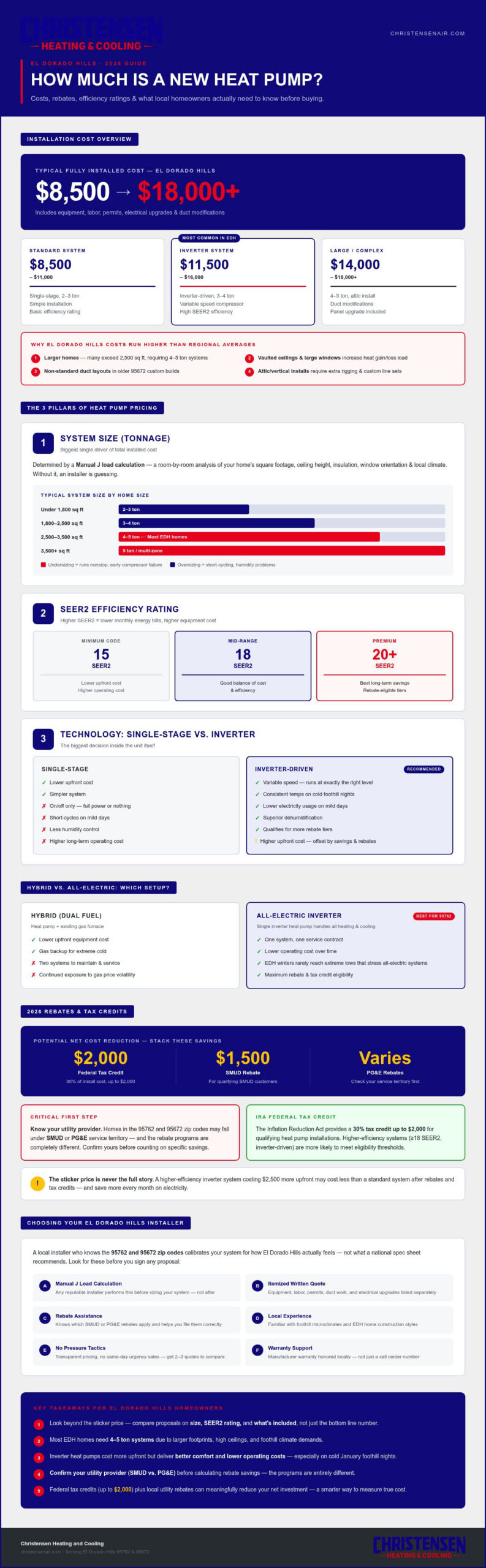
The sticker price on a heat pump proposal isn’t your final number. Between federal tax credits, utility rebates, and manufacturer promotions, El Dorado Hills homeowners can meaningfully reduce what they actually pay out of pocket. But the savings don’t happen automatically. You have to know what’s available, whether your home qualifies, and how to file correctly. This is one of the areas where asking how much is a new heat pump in El Dorado Hills without factoring in incentives gives you an incomplete picture.
The Inflation Reduction Act and Heat Pumps
The federal 25C tax credit allows homeowners to claim up to $2,000 per year for qualifying heat pump installations. This is a direct tax credit, not a deduction, which means it reduces what you owe dollar-for-dollar on your federal return. To qualify, the equipment must meet specific efficiency thresholds set by the IRS, and you’ll claim the credit when you file your 2026 return using IRS Form 5695.
Income-qualified El Dorado County residents may also be eligible for the High-Efficiency Electric Home Rebate Act (HEEHRA) program, which is administered at the state level and structured as an upfront rebate rather than a tax credit. Eligibility is tied to household income as a percentage of the area median income. If your household qualifies, this program can stack with the 25C credit, reducing your net cost further. Check current income thresholds through the California Energy Commission before assuming eligibility, as program details are subject to change.
Local Utility Programs: SMUD and PG&E
This is where El Dorado Hills gets specific in a way most national guides miss entirely. Parts of El Dorado Hills fall under SMUD service territory, while others are served by PG&E. Which utility serves your address directly determines which rebate programs you can access, and the two programs differ in structure and requirements.
SMUD offers residential rebates for qualifying heat pump installations, with minimum SEER2 and HSPF2 thresholds that must be met for eligibility. PG&E’s Switch Is On program provides incentives for customers transitioning from gas to electric heating, which can be particularly relevant for hybrid-to-all-electric upgrades. Before counting on either program, confirm your utility provider using your service address.
Rebate paperwork is one of those things that’s easy to let slip. Deadlines are firm, documentation requirements are specific, and missing a step can mean losing the rebate entirely. At Christensen Heating and Cooling, we help our customers navigate the filing process so the savings you’re entitled to don’t get left on the table through an administrative oversight.
Manufacturer rebates add another layer. Equipment brands periodically run seasonal promotions that can be combined with utility and federal incentives, though availability changes throughout the year. The combination of federal, utility, and manufacturer savings is one of the strongest arguments for timing your installation thoughtfully rather than waiting until your old system fails in August.
Ready to see what your actual net cost looks like after incentives? Talk with our team about your specific address and equipment options so we can map out the rebates that apply to your home before you commit to any proposal.
Choosing the Right Partner for Your El Dorado Hills Installation
The lowest quote on your table might also be the one that costs you the most over the next decade. When homeowners research how much is a new heat pump in El Dorado Hills, the final number they pay isn’t just about equipment and labor. It’s about whether the person who installs the system actually understands how this specific area behaves, and whether they’ll still be accountable to you five years from now.
Christensen Heating and Cooling has been family-owned and operated since 2009, and we’ve built our reputation in this community the same way neighbors build trust: by showing up, doing the work correctly, and not disappearing after the invoice is paid. We don’t use high-pressure sales tactics because we don’t need to. Our customers come back, and they refer their neighbors, because the system we installed still runs the way we said it would.
Local expertise matters in ways that a national franchise or a low-bid contractor can’t replicate. The 95762 and 95672 zip codes have distinct characteristics: housing stock that skews larger, attic configurations that complicate line set routing, and a climate that swings hard between July heat and January cold. A properly calibrated system accounts for all of that. A system sized off a national spec sheet often doesn’t.
The Critical Role of Ductwork Health
A high-efficiency inverter heat pump installed on a leaking, undersized, or poorly configured duct system will never deliver its rated performance. The equipment becomes the scapegoat for a problem that was there before it arrived. Leaky ducts can bleed conditioned air into attic spaces, create uneven room temperatures, and force the system to work harder than it should, erasing the efficiency gains you paid for. Before any installation, duct condition should be assessed and addressed. Our duct system replacement guide for Roseville and Sacramento walks through what healthy ductwork looks like and when replacement is the right call.
Protecting Your Investment with the Comfort Club
Even the best heat pump degrades without regular maintenance. Dirty coils, low refrigerant, and worn electrical contacts quietly reduce efficiency and accelerate component wear. Our Comfort Club maintenance plan is designed to catch those issues before they become repair bills, extending the useful life of your system and keeping it operating at the efficiency level you paid for. Priority service for our El Dorado Hills neighbors is part of that commitment. If you want a deeper look at what consistent maintenance actually does for system longevity, our guide on how to make your HVAC system last longer covers the specifics clearly.
Answering how much is a new heat pump in El Dorado Hills is really a question about long-term value. The right partner doesn’t just install the equipment. They size it correctly, prepare the duct system to support it, and stay involved after the job is done. That’s the difference between a system that performs for 15 years and one that disappoints you in year three.
Make a Confident Decision for Your Home’s Comfort
Answering how much is a new heat pump in El Dorado Hills comes down to three things working together: a system sized correctly for your home, efficiency ratings that unlock available rebates, and technology that actually performs through July heat and January cold. Get those three right, and the investment pays for itself over time. Get them wrong, and the cheapest quote becomes the most expensive mistake.
At Christensen Heating and Cooling, we’ve been a family-owned part of this community since 2009. We specialize in inverter heat pumps because we know what this climate demands, and we hold an A+ rating because we stand behind every installation long after the job is done. No pressure, no guesswork, just a transparent estimate built around your specific home.
Ready to see your real numbers? Get a free, transparent heat pump estimate for your El Dorado Hills home and let’s find the right fit for your household and your budget. You’ll walk away with clarity, not confusion.
Frequently Asked Questions About Heat Pump Installation in El Dorado Hills
How long does a heat pump installation take in El Dorado Hills?
Most straightforward heat pump installations take one to two days from start to finish. A single-day timeline is realistic when the existing ductwork is in good condition, the electrical service is adequate, and the line set routing doesn’t require significant modifications. Homes with attic installations, non-standard duct configurations, or panel upgrade requirements typically add a day or more to the schedule.
Permit inspection timing can also extend the overall project window. El Dorado County requires an inspection after installation, and scheduling that depends on the county’s current workload. Your installer should pull the permit before work begins and coordinate the inspection so your system is fully commissioned without unnecessary delays.
Is a heat pump enough to heat my home during a cold El Dorado County winter?
Yes, a properly sized inverter heat pump handles the full heating load for most El Dorado Hills homes. The upper foothill neighborhoods can see overnight lows in the mid-20s in January, but modern inverter heat pumps maintain effective heating performance well below freezing, unlike older single-stage equipment that struggled at low temperatures. The key word is “properly sized,” which requires a Manual J load calculation, not a rough estimate.
If your home is particularly large or has significant air leakage, a hybrid setup pairing a heat pump with a gas furnace backup is an option. However, for most 95762 and 95672 homes with reasonable insulation, an all-electric inverter system handles winter comfortably without a backup fuel source.
What is the average lifespan of a new heat pump in Northern California?
A well-maintained heat pump in Northern California typically lasts 15 to 20 years. The range reflects real differences in installation quality, maintenance consistency, and how hard the system works relative to its size. A correctly sized inverter unit that receives annual maintenance will consistently outperform an oversized or undersized system that’s been neglected, often by several years of useful life.
El Dorado Hills systems run significant cooling hours from May through October, which accumulates wear faster than in milder climates. That’s exactly why regular maintenance matters here more than the national average suggests. Catching a refrigerant issue or a dirty coil early keeps the system operating efficiently and extends the compressor’s lifespan considerably.
Do I need to upgrade my electrical panel for a new heat pump?
It depends on your current panel capacity and what it’s already serving. Many El Dorado Hills homes built in the 1990s and early 2000s have 200-amp panels that can accommodate a heat pump without upgrades. Older homes or those with heavily loaded panels may need a service upgrade before installation, which adds to the total project cost and should be itemized clearly in any proposal you receive.
If you’re switching from a gas furnace to an all-electric heat pump, the electrical demand increases, so panel capacity is always worth verifying upfront. A qualified installer will assess your panel during the estimate process. Don’t assume it’s fine without that check, because discovering the issue mid-installation creates delays and unexpected costs.
Can I use my existing ductwork with a new inverter heat pump?
Sometimes yes, sometimes no, and the answer matters a lot for how much is a new heat pump in El Dorado Hills actually costs you over time. Existing ductwork that’s properly sealed, correctly sized, and in good physical condition can work well with a new system. Leaky or undersized ducts, on the other hand, will undermine the performance of even the best inverter unit, leaving you with higher bills and uneven comfort despite a premium installation.
A duct assessment should be part of any responsible pre-installation process. If significant leakage or sizing issues are found, addressing them before the new system goes in is far more cost-effective than trying to retrofit repairs afterward. Your installer should walk you through what they find and explain the options clearly before you commit.
What is the difference between an air-source and a ground-source heat pump?
An air-source heat pump transfers heat between your home and the outdoor air. A ground-source (or geothermal) heat pump uses the stable temperature of the earth below the frost line as its heat exchange medium. Ground-source systems are highly efficient because ground temperatures stay consistent year-round, but they require significant excavation or vertical drilling, which makes installation considerably more complex and expensive.
For most El Dorado Hills homeowners, an air-source inverter heat pump delivers strong efficiency without the installation complexity or cost of a ground-source system. The climate here doesn’t push air-source units to their limits the way colder regions might, so the efficiency premium of geothermal is harder to justify given the much higher upfront investment.
Are there specific permits required for HVAC installation in El Dorado County?
Yes. El Dorado County requires a mechanical permit for heat pump installations, and the work must pass a county inspection after completion. Any electrical work associated with the installation, such as a new dedicated circuit or panel upgrade, requires a separate electrical permit. A reputable installer handles permit applications as part of the job; if a contractor suggests skipping permits to save time or money, that’s a serious red flag.
Unpermitted HVAC work creates real problems down the line. It can complicate home sales, void manufacturer warranties, and leave you without recourse if something goes wrong. Confirming that your installer pulls all required permits before work begins protects your investment and your home’s resale value.
How much can I actually save on my monthly bill by switching to a heat pump?
The honest answer is that it varies based on your current system type, your home’s size, your utility provider, and how you use the system. Homeowners switching from older single-stage air conditioning paired with a gas furnace generally see meaningful reductions in total energy costs, particularly during the long cooling season. The efficiency gains from an inverter heat pump compared to aging equipment are often substantial, though the exact dollar amount depends on factors specific to your home.
What’s more predictable is the direction of the savings. Higher SEER2 and HSPF2 ratings mean lower operating costs per unit of heating or cooling delivered. Combined with available SMUD or PG&E rebates and the federal 25C tax credit, the net first-year cost can look quite different from the sticker price on the proposal. Running the numbers for your specific address and utility provider gives you a realistic picture before you commit.