





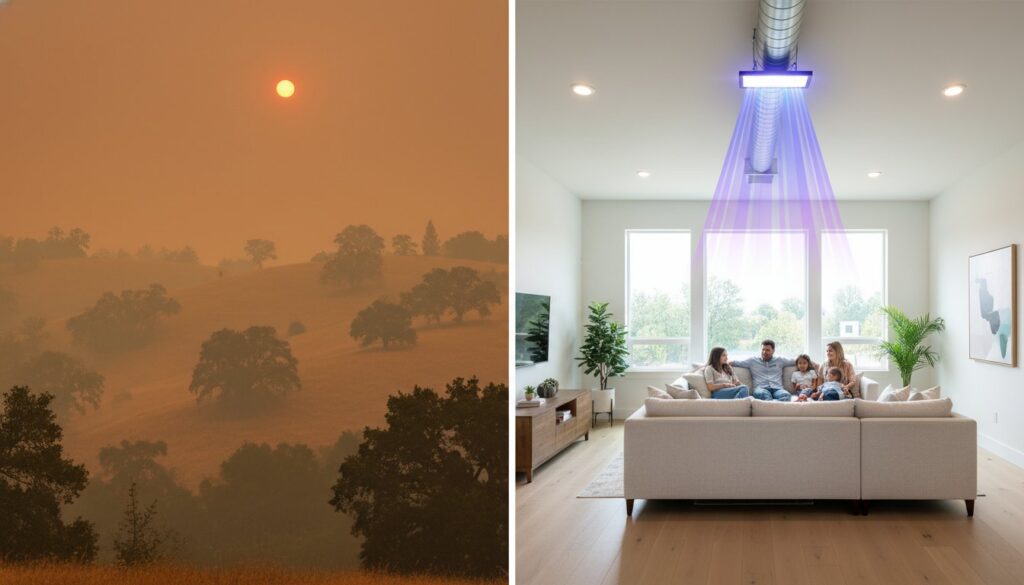
Will installing a UV light in your HVAC system actually stop wildfire smoke from hurting your family? It’s a question we hear often from our Roseville neighbors as the summer haze begins to settle over Northern California. While many homeowners hope a single device can solve every air quality woe, the reality is more nuanced. So, do UV lights help with wildfire smoke? The short answer is that while they aren’t a vacuum for ash, they play a vital role in neutralizing the invisible threats that standard filters often miss.
We understand how stressful it is to watch your children or elderly parents struggle with respiratory irritation when the air quality index spikes. You want a home that feels like a true sanctuary, free from persistent smoke odors and harmful gases. In this guide, we’ll explain how UV technology interacts with wildfire pollutants and why a multi-layered filtration strategy is the best way to smoke-proof your house. We’ll also help you decide if UV light installation is a worthy investment for your family’s long-term comfort and safety.
Key Takeaways
- Understand that while UV lights don’t trap physical ash, they are essential for neutralizing the toxic gases and persistent odors left behind by wildfires.
- Learn the difference between standard germicidal lamps and PCO technology to determine which system best protects your family’s indoor air quality.
- Discover why a multi-layered strategy is the best way to address the question, “do UV lights help with wildfire smoke,” by pairing high-efficiency filters with light-based purification.
- Separate fact from fiction regarding ozone production and filter maintenance to ensure your home’s air remains safe and breathable throughout the summer.
- Get a practical roadmap for smoke-proofing your Roseville home to provide lasting comfort and relief for those with sensitive respiratory systems.
Do UV Lights Help with Wildfire Smoke? The Short Answer for Roseville Homeowners
When our Roseville neighbors ask us, “do UV lights help with wildfire smoke,” we believe in giving a straight, honest answer. It’s a bit of a “yes and no” situation. If you’re looking for a device to pull physical ash and soot out of your living room air, a UV light isn’t the tool for that specific job. Those heavy, physical bits are best handled by high-quality mechanical filters. However, if you’re struggling with that lingering, metallic “burnt” smell that stays in your curtains and carpets for weeks, UV technology is incredibly effective at clearing the air.
We often see homeowners get frustrated because even their expensive air filters don’t seem to stop the smoke smell. This happens because smoke is a mix of solid debris and invisible gases. While Ultraviolet germicidal irradiation (UVGI) was originally designed to neutralize biological threats like mold and bacteria, it’s also a powerhouse for breaking down the chemical components of smoke. By integrating these lights into your HVAC system, we can help you address the parts of the smoke that a standard filter simply cannot touch.
To better understand this concept, watch this helpful video:
Particles vs. Gases: What’s Hiding in Wildfire Smoke?
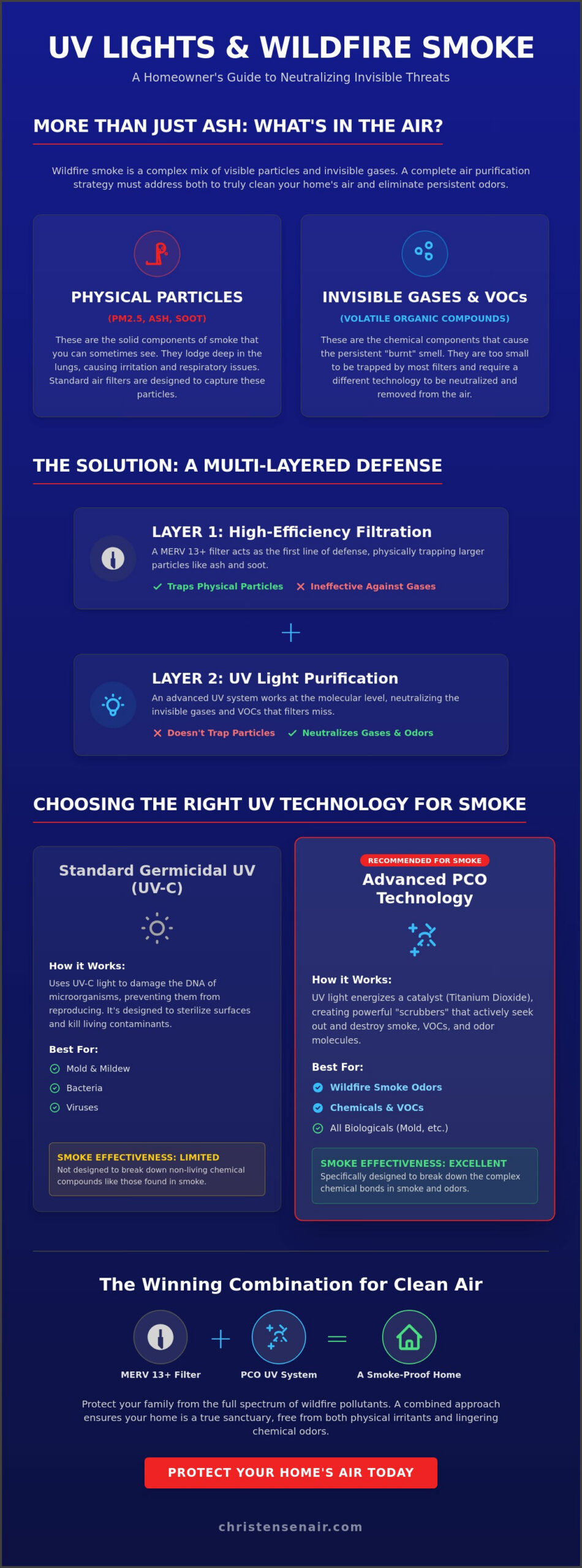
Wildfire smoke is a complex cocktail of pollutants. The most famous ingredient is PM2.5, which refers to fine particles smaller than 2.5 microns. These are the physical threats that can get deep into your lungs and cause immediate irritation. Standard HVAC filters are built to trap these solids. But smoke also contains Volatile Organic Compounds (VOCs). These are the gases responsible for that persistent, heavy ‘burnt’ odor. Because these are gases and not solids, they slip right through most mechanical filters. This is why you can have a brand-new filter installed and still smell the fires while you’re sitting on your couch.
The ‘Aged Smoke’ Factor in the Sacramento Valley
Living in Roseville, we face a unique atmospheric challenge. As smoke drifts from the foothills and settles into our valley, it undergoes a process called “aging.” Sunlight and heat essentially bake the smoke as it sits over the Sacramento area. This process causes chemical reactions that can make the air even more irritating than the fresh smoke found near the fire line. This “cooked” smoke is packed with complex chemical bonds that are difficult to break. A UV light system targets these ‘cooked’ chemical bonds by disrupting their molecular structure, effectively neutralizing the odor before it ever reaches your family’s bedrooms. By combining a strong mechanical filter with a UV system, we help you tackle both the visible ash and the invisible chemical haze that threatens your home’s sanctuary.
Germicidal UV vs. PCO: Which Technology Actually Fights Smoke?
Many homeowners assume all UV lights are created equal. When we discuss whether do UV lights help with wildfire smoke, we have to look closely at the specific technology inside the unit. Standard UV-C lamps are fantastic for biological threats. They neutralize mold spores, bacteria, and viruses that might grow in your ductwork. However, these germicidal lamps often struggle when faced with the heavy chemical load of a Northern California wildfire. They are designed to “kill” living organisms, but smoke particles and gases aren’t alive.
To truly tackle the smell of a fire, we look toward Photocatalytic Oxidation (PCO). This technology takes a standard UV lamp and pairs it with a titanium dioxide catalyst. When the UV light hits the catalyst, it creates “scrubbers” that actively seek out and break down smoke molecules in the air stream. According to the EPA’s Guide to Air Cleaners, while PCO is a more advanced approach, its effectiveness depends heavily on the system’s design and airflow. For Roseville families, this means choosing a system specifically engineered to handle high-volume odors rather than a generic off-the-shelf unit.
We’ve seen how much of a difference this makes for our clients during the peak of fire season. You can explore more about the year-round benefits of HVAC UV light installation to see how it protects your home even when the skies are clear. If you’re unsure which technology fits your home’s ductwork, our team can help you evaluate your current setup with a quick indoor air quality assessment.
How PCO Systems Neutralize Smoke Odors
The magic of PCO happens at a molecular level. While activated carbon filters are popular, they act like a sponge that eventually gets full and needs replacing. In contrast, a PCO system uses a continuous chemical reaction to dismantle Volatile Organic Compounds (VOCs). This is particularly important during high-volume smoke events when a standard filter might become overwhelmed in just a few days. The titanium dioxide catalyst doesn’t get “used up” in the same way, providing a more consistent defense against that heavy, metallic smoke smell that often plagues the Sacramento Valley.
UV-C Lamps: The Secondary Defense
If PCO is the primary attacker for odors, standard UV-C lamps serve as your defensive line. During a smoky summer, your AC unit works overtime. Ash and fine dust can settle on your cooling coils, creating a sticky environment where mold and bacteria thrive. A well-placed UV-C lamp keeps these components clean and efficient. While it won’t “kill” a smoke particle, it prevents your HVAC system from becoming a breeding ground for secondary pollutants. We always recommend combining these lights with high-efficiency mechanical filtration, as this multi-layered approach ensures both the physical ash and the invisible gases are addressed simultaneously.
Why UV Lights Alone Aren’t Enough: The Multi-Layered Defense
While we’ve established that PCO and UV technology are powerhouses for odor control, we always remind our Roseville clients that these systems don’t work in a vacuum. To truly smoke-proof your home, you need a multi-layered defense. Think of it like a security system. A sturdy lock is great, but you also want an alarm and perhaps a fence. In the context of your home air, the question isn’t just “do UV lights help with wildfire smoke,” but rather how they fit into a total air quality strategy. We’ve found that a four-step approach is the only way to provide the domestic comfort your family deserves.
First, you must have high-efficiency filtration to catch the physical ash. Second, the UV or PCO system steps in to dismantle the chemical gases. Third, we have to ensure your ductwork is sealed tight so smoke doesn’t bypass your filters entirely. Finally, we look at your home’s internal pressure. On “red-flag days” when the wind is howling and the sky is orange, your house can actually suck smoke in through tiny gaps around doors and windows. By managing “make-up air,” we help you keep the smoke out and the clean air in. According to the EPA’s Guide to Air Cleaners, combining different technologies is often necessary because no single device can remove every type of pollutant found in wildfire smoke.
The Role of MERV Ratings in Smoke Defense
We generally recommend MERV 13 filters as the “sweet spot” for Roseville homes during fire season. These filters are dense enough to trap the tiny PM2.5 particles that pose the greatest health risk to children and the elderly. You can find more specific details in our guide on the best MERV rating for filters during fire season. However, be careful not to over-filter. If you choose a filter that is too thick for your specific blower motor, you can actually choke your system. This leads to expensive repairs and reduced airflow, which is the last thing you want when the outside air is unbreathable. Understanding how to make my HVAC system last longer starts with choosing the right filter so your blower motor isn’t working against unnecessary resistance season after season.
Duct Integrity: The Invisible Smoke Entry Point
Many homeowners are surprised to learn that their attic might be the reason their bedrooms smell like a campfire. If you have leaky ductwork, your HVAC system can pull hot, smoky attic air directly into the stream of air blowing into your rooms. Even the most advanced UV light can’t clean air that never passes through it. This is why we often discuss duct system replacement as a vital part of a long-term smoke-proofing strategy. Sealing these leaks ensures that every cubic foot of air in your home has been properly scrubbed and filtered before it reaches your family.
Common Myths About UV Lights and Air Quality
We’ve noticed quite a bit of conflicting information floating around Roseville lately regarding air purification. When families ask us, “do UV lights help with wildfire smoke,” they are often surprised by the answer because of common misconceptions. Clearing up these myths is the first step toward creating a truly healthy home environment. One of the biggest misunderstandings is that a UV lamp can replace your standard air filter. As we discussed earlier, these technologies perform different roles. Your filter is the “catcher” for physical debris, while the UV system acts as the “neutralizer” for chemical and biological threats.
Another common concern we hear involves the speed of the process. Some people imagine a UV light zapping smoke particles the instant they pass by. In reality, effective purification requires “dwell time” or multiple passes of air through the system to fully break down complex molecules. This is why we focus on whole-home solutions rather than small portable units. By treating the air as it circulates through your entire HVAC system, we ensure every room in your house benefits from continuous scrubbing. We also remind our neighbors that this isn’t just a seasonal tool. While fires are a major concern in the summer, these lights provide year-round protection from mold, bacteria, and common allergens that thrive in our valley climate.
Addressing the Ozone Concern
Many homeowners worry that adding UV lights will make their home smell like a photocopy machine or produce harmful ozone. This is a myth rooted in older, unregulated technology. Modern residential systems are specifically designed to be ozone-free. In California, the Air Resources Board (CARB) strictly limits ozone emissions from indoor air cleaners to 0.050 parts per million. We only install safe, validated IAQ technology that meets these rigorous standards. We strongly advise against using old-fashioned ionizers, which can actually irritate your lungs. Our goal is to protect your sanctuary, not introduce new pollutants into your breathing space.
UV Maintenance: Keeping the Defense Strong
To keep your home’s defense system working at peak performance, regular upkeep is essential. Even if a bulb still looks “on” and glows blue, its effectiveness at neutralizing pollutants diminishes over time. According to current industry research, UV bulbs typically have an effective germicidal lifespan of 9 to 12 months. After this period, the light may still be visible, but it no longer has the power to dismantle smoke odors or VOCs. Additionally, during a heavy fire season, ash and dust can settle on the bulb. This coating can reduce the system’s effectiveness by over 50 percent because the light cannot reach the air stream. We make this easy for our neighbors by checking your purification system during regular Christensen Comfort Club maintenance visits, which are also a cornerstone of any plan for how to make my HVAC system last longer through Northern California’s demanding summers. If you want to ensure your family is breathing the cleanest air possible this summer, we invite you to schedule a UV light installation consultation with our team today.
Christensen’s Approach: Protecting Roseville Homes from the Inside Out
At Christensen, we don’t just see ourselves as technicians; we’re members of this community who breathe the same air you do. When you ask us, “do UV lights help with wildfire smoke,” we provide a customized evaluation of your home’s unique needs. We start by looking at your current HVAC setup, the age of your ductwork, and your family’s specific health concerns. This isn’t a one-size-fits-all service. We want to ensure that the solution we provide actually improves your domestic comfort and protects the sanctuary of your household.
There’s a significant difference between a retail “box-store” light and a professional whole-house UV air purifier installation. Professional systems are engineered to handle the high-velocity airflow of your central system, ensuring that the air gets enough exposure to the light to actually neutralize pollutants. Retail units often lack the power or the correct wavelength to make a dent in heavy smoke odors. We focus on providing commercial-grade reliability for your family’s home, ensuring that every pass of air through your ducts leaves your environment cleaner and safer.
Expert Installation vs. DIY
Installing a UV system isn’t as simple as plugging in a lamp. Improper placement can lead to serious problems, such as UV rays degrading your plastic drain pans or melting wire insulation over time. We ensure the light is positioned perfectly to maximize air scrubbing without damaging your expensive HVAC equipment. Our team also wires the system directly into your blower cycle. This prevents the bulb from “short-cycling” or staying on when there’s no airflow, which helps avoid premature bulb failure and keeps your energy bills in check. A professional touch ensures that your investment in air quality is both safe and effective.
A Legacy of Local Care
Our identity as a family-owned business is rooted in honesty and long-term relationships rather than quick transactions. We’ve stood by our Roseville neighbors through the last decade of increasingly intense fire seasons, helping families find relief when the air outside feels like a threat. We take personal pride in every task because we’re not just fixing a machine; we’re protecting your well-being. Our approach combines technical proficiency with a deep sense of neighborly care. If you’re ready to take the next step toward a smoke-proof home, we invite you to schedule your Indoor Air Quality consultation with Christensen today. We’ll help you build a practical plan that ensures your home remains a clean, safe haven for your children and elderly loved ones for years to come.
Take Control of Your Home’s Air Quality Today
Creating a smoke-proof sanctuary for your family requires more than just a standard filter. We have seen how a multi-layered defense, combining high-efficiency MERV 13 filtration with professional UV technology, is the only way to truly clear the air. While the filter catches physical ash, the UV system neutralizes the invisible chemical odors that often slip through. When you ask, “do UV lights help with wildfire smoke,” the answer lies in using them as a powerful partner in a total home air strategy.
Our family-owned team has been dedicated to protecting Roseville households since 2009. We specialize in high-efficiency IAQ solutions and take personal pride in serving our neighbors in Rocklin and the greater Sacramento area. You don’t have to face the next fire season alone. Protect your family’s air; schedule a UV light consultation with Christensen Heating and Cooling today. We look forward to helping you breathe easier and ensuring your home remains the safe, comfortable retreat your loved ones deserve.
Frequently Asked Questions
Can UV lights actually kill the smell of wildfire smoke?
Yes, UV systems equipped with Photocatalytic Oxidation (PCO) technology are specifically designed to dismantle the chemical bonds of smoke odors. While a standard filter traps physical ash, the UV light works at a molecular level to neutralize the gases that cause that persistent “burnt” smell. This ensures your home doesn’t just look clean but actually smells fresh even when the outdoor air quality is poor.
Is it worth getting a UV light if I already have a high-MERV filter?
It is absolutely worth it because filters and UV lights perform entirely different roles. A high-MERV filter is excellent at catching physical soot and ash, but it cannot stop the invisible gases and chemical compounds found in smoke. When Roseville families ask, do UV lights help with wildfire smoke, we explain that the UV system provides the secondary layer of defense needed to tackle the gaseous pollutants that filters miss.
Do HVAC UV lights produce harmful ozone in the house?
Modern residential UV systems are designed to be ozone-free and must meet strict California Air Resources Board (CARB) standards. All air cleaners sold in California are limited to 0.050 parts per million of ozone. We only install validated, safe technology that protects your family’s respiratory health without introducing new lung irritants into your sanctuary.
How much does it cost to run a UV air purifier all summer?
Running a whole-home UV system is very energy-efficient, typically using about the same amount of electricity as a standard fluorescent light bulb. Since these units are wired into your HVAC system’s blower cycle, they only draw significant power when your air is actually circulating. It is a cost-effective way to maintain high indoor air quality without a noticeable spike in your monthly utility bills.
Where is the best place to install a UV light for smoke protection?
The most effective placement is usually near the evaporator coil or within the main return ductwork. Placing the light near the cooling coil helps keep the system clean of ash-related mold growth, while a return-duct installation ensures that all air is treated before it is distributed to your bedrooms. Our team evaluates your specific HVAC layout to find the optimal spot for maximum air scrubbing.
Will a UV light help with my asthma during fire season?
A UV light can significantly reduce the chemical triggers that often cause asthma flare-ups when the air is thick with smoke. When evaluating do UV lights help with wildfire smoke for health reasons, remember that the system neutralizes Volatile Organic Compounds (VOCs) and prevents secondary mold growth on ash-covered coils. While it is not a medical cure, many neighbors find that cleaner air leads to much better respiratory comfort for children and the elderly.
How often should I replace the bulbs in my HVAC UV system?
You should replace your UV bulbs every 9 to 12 months to maintain their effectiveness. Even if the bulb still produces a blue glow, its ability to neutralize chemical pollutants and pathogens drops significantly after a year of use. We recommend timing this replacement just before the summer fire season begins so your home’s defense is at full strength when you need it most.
Can I install a UV light myself in my Roseville home?
We strongly recommend professional installation to ensure both safety and system efficiency. Improperly placed UV lights can damage internal HVAC components like plastic drain pans or sensitive wiring through long-term exposure. A professional technician will ensure the unit is safely integrated into your system’s electrical board and positioned to provide the best possible protection against wildfire smoke without risking expensive repairs.