






Last Tuesday, a neighbor in our community discovered their home had reached 85 degrees despite the AC running full blast. That sinking feeling of realizing your sanctuary is no longer cool is something we never want you to experience. You might immediately fear the worst, but learning how to know if your AC compressor is bad is the first step toward regaining control. We understand the frustration of technical jargon and the fear of being pushed into a replacement you don’t actually need.
Industry reports show that replacing a residential compressor is a significant investment. While we don’t provide flat pricing here, it is widely considered the most expensive individual repair in an HVAC system. To help you understand industry standards, you can learn more about HVAC Installation and Repair Service Fees from the team at Air Services Mechanical. When faced with this cost, many neighbors find that learning how to know if your AC compressor is bad helps them decide if it’s time for a more efficient, modern installation instead.
We believe in providing honest, neighborly guidance so you can protect your family’s comfort without the stress. While the compressor is a vital part of your system, a cooling issue doesn’t always mean your unit is headed for the scrap heap. Our goal is to give you the tools to spot the difference between a simple electrical glitch and a true mechanical failure.
In this guide, we’ll walk you through a diagnostic checklist of common symptoms and explain how the 2026 transition to new A2L refrigerants affects your decision to invest in an AC repair or a full installation. You’ll gain the clarity you need to make a smart decision for your home and your budget.
Key Takeaways
- Spot the five specific warning signs, like grinding noises or humming units, that suggest your system’s “heart” is struggling.
- Master how to know if your AC compressor is bad and why a faulty capacitor is often mistaken for a major mechanical failure.
- Apply the “5,000 Rule” to calculate whether a professional repair or a full system replacement is the most cost-effective path forward for your home.
- Learn why the type of refrigerant your system uses is more critical than ever following the 2026 industry changes.
- Find out what to expect during a professional diagnostic visit and why checking for system burnout is vital for your family’s comfort.
What is an AC Compressor and Why is it Failing?
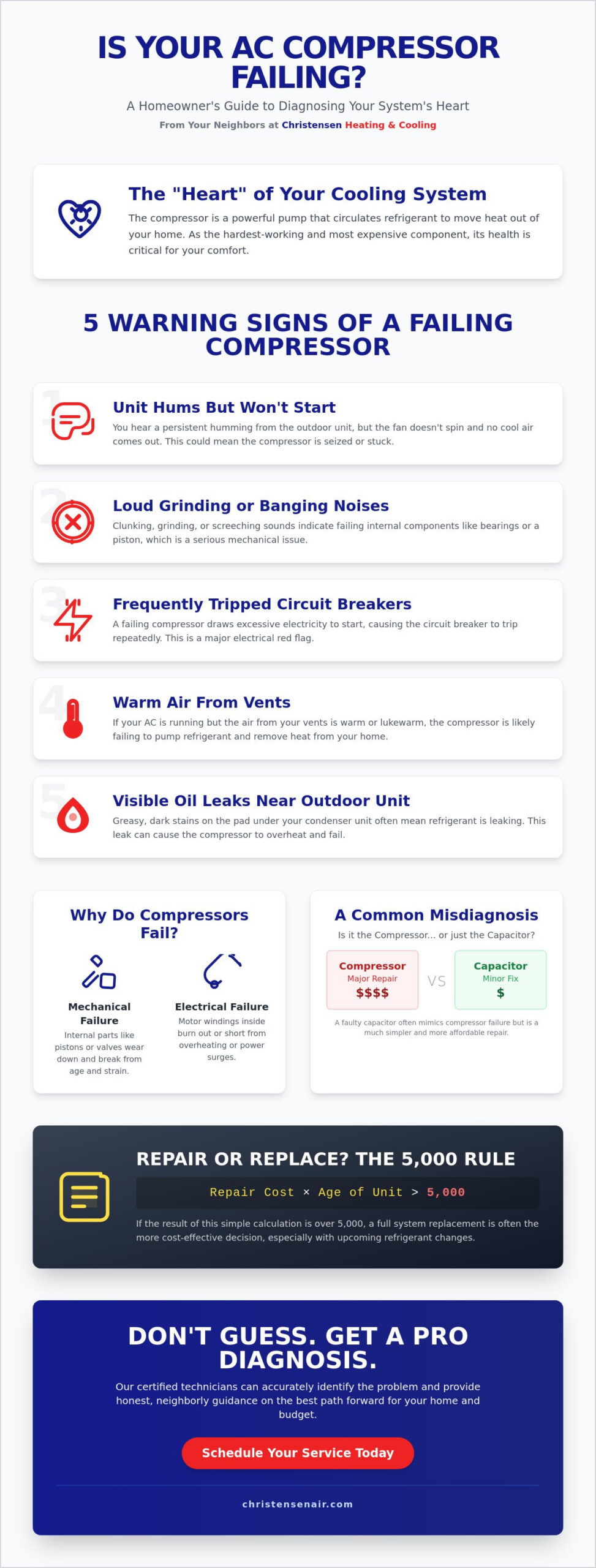
We often call the AC compressor the “heart” of your cooling system, and for good reason. It acts as a powerful pump that circulates refrigerant through your indoor and outdoor coils. This process is essential for What is an AC Compressor to do its job, which is moving heat out of your home. Because it handles high pressure and high temperatures, it’s easily the hardest-working component in your HVAC unit. It’s also the most expensive to replace, which is why understanding how to know if your AC compressor is bad is so important for your peace of mind. Learning how to know if your AC compressor is bad helps you avoid the stress of unexpected breakdowns during a heatwave.
When a compressor fails, it usually falls into one of two categories. Mechanical failure happens when internal parts like valves or pistons wear down or break. Electrical failure involves the motor windings inside the compressor burning out or shorting. Both issues can be triggered by age, but they’re often accelerated by lack of maintenance or sudden electrical surges. We see these problems most frequently in systems that haven’t been serviced in several years.
The Heart of Your Home Comfort System
The compressor sits inside that large metal box in your yard, known as the condenser unit. Its primary job is to squeeze gas refrigerant into a hot, high-pressure state so it can release heat to the outside air. If you’ve upgraded to high-efficiency inverter heat pumps, your system uses even more advanced technology. These compressors don’t just turn on and off; they vary their speed to match your home’s exact needs. This provides a steady stream of comfort rather than a sudden blast of cold air.
Why Roseville Summers Stress Your Compressor
Living in the Central Valley means our cooling systems face extreme conditions. When the thermometer hits triple digits, the pressure inside your compressor climbs significantly. This forces the motor to work harder and run much hotter. In our dusty environment, dirt accumulates on your outdoor coils quickly. This buildup prevents heat from escaping, which can lead to “slugging.” This is a dangerous situation where liquid refrigerant enters the compressor and causes immediate mechanical damage. Consistent 100-degree days in Sacramento can shorten a compressor’s lifespan without proper maintenance. We take pride in helping our neighbors keep their systems clean to prevent these costly issues before the peak of summer hits.
The Bad AC Compressor Checklist: 5 Warning Signs
When your home’s sanctuary starts feeling like a sauna, you need answers fast. Learning how to know if your AC compressor is bad allows you to act before a minor hiccup becomes a total system failure. We’ve compiled the most common red flags our technicians see in the field. These symptoms often signal that the mechanical “heart” of your unit is struggling to keep up with the demands of a California summer.
- The Unit Hums but Won’t Start: If you hear a persistent humming sound from the outdoor unit but the fan isn’t spinning and your house isn’t cooling, the compressor might be stuck or “seized.”
- Loud Metallic Noises: Grinding, clunking, or banging sounds are never normal. These often indicate that internal components have come loose or the motor bearings are failing.
- Tripped Circuit Breakers: A failing compressor often draws too much power as it struggles to start. If your outdoor unit frequently trips the breaker in your electrical panel, it’s a major warning sign.
- Warm Air from Vents: When the compressor can’t pump refrigerant effectively, your system will blow lukewarm air even if the thermostat is set to “cool.”
- Visible Oil Leaks: Look around the base of your outdoor unit. If you see dark, greasy stains on the pad or around the refrigerant lines, it could be a sign of a critical leak.
Audible Red Flags: What Your AC is Telling You
Your air conditioner has its own way of communicating. Grinding or screeching usually points toward worn-out internal bearings or a motor nearing its end. If you hear rapid clicking or chattering, the unit is likely “hard starting,” which means it’s fighting to turn on but can’t quite make the leap. However, not every noise is a death sentence. A squealing air conditioner might actually be a simpler issue with a belt or a fan motor rather than the compressor itself. Distinguishing between these sounds is a key part of the Repair vs. Replace debate.
Electrical and Performance Symptoms
Beyond the noises, watch how the system behaves. “Hard starting” occurs when the compressor takes several seconds or multiple attempts to kick in. You might notice your lights flicker slightly when it finally starts. Another common issue is “short cycling,” where the unit turns on and off every few minutes without ever cooling the house. This puts immense strain on the motor. As the compressor loses its pumping power, you’ll also notice reduced airflow and rising humidity levels inside. If these signs sound familiar, our team can provide a professional Air Conditioning Repair assessment to pinpoint the exact cause and restore your home’s comfort.
Is It a Bad Compressor or Just a Bad Capacitor?
We often see homeowners panicking when their cooling stops on a sweltering afternoon. They search for how to know if your AC compressor is bad and prepare for the worst. There is a frequent silver lining in these situations. Many times, the compressor is perfectly healthy, and the real culprit is a failed capacitor. Think of the capacitor as a small battery or a “starter” that provides the high-voltage jolt your compressor needs to kick into gear. Without that initial push, the compressor simply cannot start.
The difference in cost between these two parts is massive. A capacitor fix typically ranges from $200 to $400, yet it is frequently misdiagnosed as a $3,000 compressor failure by less experienced or less honest contractors. We believe in transparency and neighborly care, which means we always look for the simplest solution first. If your unit is making a persistent humming sound but the fan refuses to spin, the capacitor is our first suspect. You can sometimes see the damage yourself; a bad capacitor often appears bulged at the top, rusted, or may even be leaking a bit of oil.
The Most Common AC Misdiagnosis
A weak capacitor doesn’t always fail all at once. It might still have enough “juice” to start the unit but forces the compressor to run much hotter than intended. This extra heat puts immense strain on the motor. We always recommend checking the capacitor and the contactor before ever condemning the compressor itself. A “dead” AC unit often just needs a fresh start-run capacitor to restore cooling. This simple step can save you from an unnecessary and expensive system replacement.
When the Breaker Keeps Tripping
If your circuit breaker trips, it is acting as a vital safety shield for your home. A “grounded” compressor is a major mechanical failure where internal wiring has touched the metal shell, creating a dangerous situation. However, a simple electrical short in the capacitor can also cause your breaker to flip. Never flip the breaker back on more than once if it trips immediately. Doing so can cause permanent damage to a system that might have been easily repaired. Our technicians use a multimeter to “ohm out” the compressor, which is a precise way to find the truth about its electrical health. This Professional Diagnosis and Next Steps approach ensures we are protecting your home’s sanctuary while providing the most reliable cooling possible. Learning how to know if your AC compressor is bad often starts with ruling out these smaller, manageable electrical issues.
Repair vs. Replace: Making the Right Call in 2026
Once you’ve walked through our checklist on how to know if your AC compressor is bad, you’re left with a big decision. A compressor is one of the most expensive parts to fix. In 2026, this choice involves more than just the immediate bill. We want you to feel confident and secure in your home’s comfort, so we use the “5,000 Rule” as a helpful guide. Simply multiply the age of your unit by the repair cost. If the total is over 5,000, we generally recommend a new Air Conditioning Installation to protect your long-term budget.
Your system’s warranty and refrigerant type are also major factors. Most modern units come with a 10-year manufacturer’s parts warranty. If your compressor fails within this window, a repair is often the smartest path. However, if you have an older system running on R-22 refrigerant, we almost always suggest a replacement. R-22 is obsolete and extremely expensive to source. Even with the current phase-down of R-410A, moving to a 2026-compliant system using A2L refrigerants like R-454B or R-32 is a much safer investment for your family’s future comfort.
Evaluating the Age and Health of Your System
The Sacramento Valley heat is legendary, and it takes a toll on equipment. While some units can last longer, the typical lifespan of an HVAC system here is 12 to 15 years. Replacing just the compressor in a unit that is already a decade old is often a temporary fix. We frequently see evaporator coils fail shortly after a compressor swap because the new part puts higher pressure on the older components. To get the most out of a high-efficiency upgrade, you might also consider a duct system replacement to ensure your home has the proper airflow to support a modern unit.
The Cost-Benefit Analysis of New Technology
Modern cooling technology has leaped forward. When comparing a compressor swap to a comprehensive residential AC repair Carmichael solution, look at the energy savings. New SEER2 compliant systems can significantly lower your SMUD or PG&E bills. In 2026, there are also various tax credits and local rebates available for homeowners who choose high-efficiency upgrades. Modern inverter technology is a game changer; it avoids the “hard starts” that eventually kill traditional compressors. This ensures a quieter, more reliable sanctuary for your household. If you’re unsure which path is right for you, our team is here to provide an honest assessment of your system’s health.
Professional Diagnosis and Next Steps with Christensen
While our checklist helps you understand how to know if your AC compressor is bad, a professional evaluation provides the final certainty you need to protect your home. We approach every diagnostic visit with a commitment to clarity and technical precision. When we arrive at your property, our technicians don’t just look for a quick fix. We perform a comprehensive system check to identify the root cause of the failure. This includes a critical refrigerant acid test to check for system burnout. If a compressor motor burns out, it can release acid into the refrigerant lines. This acid must be neutralized or removed; otherwise, it will destroy a new compressor shortly after installation.
We take personal pride in our “neighbor-first” philosophy. This means we prioritize honesty over high-pressure sales tactics. We’ve built our legacy in the community by treating every household with the same care we would apply to our own. If a simple electrical repair can safely restore your cooling, we will tell you. If a full system replacement is the only way to ensure your family’s safety and comfort, we will provide clear, upfront options with no hidden fees. Our goal is to build a long-term relationship based on trust rather than a one-time transaction.
Our “Neighbor-First” Diagnostic Process
Our local expertise across Roseville and Sacramento allows us to understand the specific strains our regional climate puts on HVAC equipment. We know that a system in the Central Valley works harder than almost anywhere else. Because we are a part of this community, we understand the urgency of a cooling failure. We provide reliable AC repair in Roseville to get your sanctuary back to a safe, comfortable temperature as quickly as possible. We focus on direct communication so you always know exactly what is happening with your home’s most vital equipment.
Preventing the Next Breakdown
The best way to handle a bad compressor is to prevent the failure from happening in the first place. Routine maintenance is the primary shield for your system’s motor. We’ve seen that clean coils and proper airflow significantly reduce the internal pressures that lead to mechanical wear. Our Comfort Club Maintenance Plan is designed to catch small issues like weak capacitors or minor refrigerant leaks before they force your compressor to “work itself to death.” Checking your system annually ensures it remains a dependable source of comfort for years to come. If you’re currently dealing with cooling issues, Schedule your professional AC diagnostic with Christensen Heating and Cooling today. We’ll help you navigate how to know if your AC compressor is bad with the expert guidance you deserve.
Restoring Your Home’s Peace and Comfort
We believe your home should be a sanctuary of cool air and relaxation, even during the peak of a Sacramento summer. Understanding how to know if your AC compressor is bad doesn’t have to be a source of stress when you have the right checklist in hand. By distinguishing between a simple capacitor failure and a true mechanical breakdown, you’ve already taken the first step toward a smarter, more cost-effective decision. Whether you choose a strategic repair or a high-efficiency upgrade to navigate the 2026 refrigerant changes, your family’s long-term comfort is the ultimate goal.
Since 2009, our family-owned team has specialized in high-efficiency inverter technology to keep our neighbors in Roseville, Rocklin, and the Greater Sacramento area comfortable. We take personal pride in every task and treat your home with the same care we would apply to our own. You don’t have to face technical HVAC decisions alone. Get a Honest, Professional AC Diagnosis in Roseville Today. We look forward to helping you restore your home’s sanctuary and keeping your system running reliably for years to come.
Frequently Asked Questions
Can I run my AC if the compressor is making a loud noise?
You should turn off your system immediately if you hear loud, unusual noises. Running a distressed compressor can lead to a “burnout,” where the motor windings fail and release acidic contaminants into your refrigerant lines. This acid can ruin the entire system, turning a repair into a much larger problem. Shutting it down now protects your home’s sanctuary and your budget.
How much does it typically cost to replace a residential AC compressor?
Industry reports show that replacing a residential compressor is a significant investment. While we don’t provide flat pricing here, it is widely considered the most expensive individual repair in an HVAC system. When faced with this cost, many neighbors find that learning how to know if your AC compressor is bad helps them decide if it’s time for a more efficient, modern installation instead.
Is it worth replacing just the compressor on a 10-year-old AC unit?
It is rarely cost-effective to replace a compressor in a unit that has reached the decade mark. In our intense regional heat, a 10-year-old system is often reaching its twilight years. Installing a new compressor into an old system can cause the aging evaporator coil to leak shortly after. We usually recommend looking at high-efficiency options that provide better reliability for your household.
How do I know if my AC compressor is under warranty?
You can find your warranty status by locating the serial number on your outdoor unit’s nameplate and entering it into the manufacturer’s online portal. Most residential systems carry a 5 to 10-year limited parts warranty. If you’re unsure, we can assist you in verifying this information during a service call to ensure you receive any coverage you’re entitled to.
What happens if a technician puts too much refrigerant in my compressor?
Putting too much refrigerant in a system is a serious error called overcharging. This often leads to “liquid slugging,” where liquid refrigerant enters the compressor and causes immediate mechanical damage to the internal valves. It also increases the workload on the motor, leading to overheating. Proper levels are essential for the safety and efficiency of your home’s cooling.
Can a dirty air filter actually cause my compressor to fail?
A dirty air filter is one of the most common reasons a compressor fails prematurely. When airflow is blocked, the refrigerant doesn’t evaporate correctly and can return to the compressor as a liquid. This causes “slugging” and washes away the oil that lubricates the motor. Keeping your filters clean is a simple way to avoid the stress of a major breakdown.
Why does my AC compressor turn on but the fan doesn’t?
If the compressor is running but the fan isn’t, you likely have a failed fan motor or a faulty dual-run capacitor. The capacitor provides the electrical jolt for both parts to start. If the fan stays still, the compressor will overheat within minutes. This is a critical situation where understanding how to know if your AC compressor is bad can help you spot a simpler electrical fix.
How long does an AC compressor replacement take to complete?
A professional compressor replacement typically takes between four and six hours to complete. Our technicians must carefully recover the old refrigerant, install the new component, and perform a thorough vacuum to remove all moisture and air. This meticulous process ensures your system operates at peak performance and provides the dependable comfort your family relies on during our hot summers.