






Could you be overpaying for a high-efficiency system that your home’s ductwork can’t actually support? With SMUD and PG&E rates continuing to climb in 2026, we know how stressful it is to choose the right equipment without getting lost in a sea of technical jargon. Understanding HSPF2 ratings for heat pumps is the first step toward protecting your family’s sanctuary and your monthly budget. Unlike the older standards used years ago, these ratings provide a more honest reflection of how your system handles real-world air pressure in our local California climate.
We believe you deserve a home that stays perfectly cozy without a shocking utility bill at the end of the month. You’re likely looking for a way to stay comfortable while making sure you don’t miss out on available savings. In this guide, we’ll show you exactly how HSPF2 ratings impact your home comfort and energy bills in the Greater Sacramento area. We’ll explain why a rating of 9.0 or higher is the sweet spot for our winters and how you can qualify for up to $3,000 in SMUD rebates even though federal tax credits have expired. We are committed to providing the clear, neighborly guidance you need to make the best choice for your household.
Key Takeaways
- Learn why the industry shifted to the HSPF2 standard and how this rigorous testing provides a truer picture of your heat pump’s real-world performance.
- Discover the “Sacramento Sweet Spot” for efficiency to ensure you aren’t overpaying for high-end technology your specific home may not need.
- By understanding HSPF2 ratings for heat pumps, you can better navigate the transition to modern inverter technology and avoid the energy spikes of older units.
- Find out how to maximize your savings with local SMUD rebates and lower your monthly bills by selecting the right efficiency tier for our Northern California climate.
- See why professional sizing and quality ductwork are essential to reaching your unit’s advertised efficiency and protecting your family’s year-round comfort.
The Shift to HSPF2: Why Your Heat Pump Ratings Changed
We’ve noticed a lot of confusion lately when families look at the efficiency stickers on new HVAC equipment. Since January 1, 2023, the Department of Energy has required all new residential heat pumps to meet a stricter testing standard known as HSPF2. This change was a significant milestone for our industry because the old testing methods didn’t always reflect how a system actually performs inside a real house. Understanding HSPF2 ratings for heat pumps helps you see through the marketing and understand how a unit will handle the specific conditions of your home’s ductwork.
We’ve found that a visual explanation can help clear up the technical details, so we’ve included this short video to break down the basics of these new standards:
The Science of Heating Efficiency
Heat pumps are remarkable machines because they don’t burn fuel to create heat; instead, they act like a reversible air conditioner to move heat from the outside air into your living room. To measure how well they do this, we use the Heating Seasonal Performance Factor (HSPF) metric. Specifically, HSPF2 is the ratio of the total heat output provided over the entire heating season to the total electricity consumed during that same period. The updated ‘M1’ testing standard simulates higher external static pressure. This is a technical way of saying it accounts for the resistance your air feels as it moves through your vents, which is much more representative of a typical Sacramento home.
Why the ‘2’ Matters for Homeowners
You might notice that a system rated under the new rules has a lower number than an older model, even if the equipment is technically the same. This happens because the original ratings often overestimated efficiency by assuming your ductwork was perfectly designed and wide open. In reality, most homes have bends, filters, and slightly undersized ducts that create pressure. HSPF2 gives us a more honest number that you can trust when planning for your family’s future. Whether you are looking at a Roseville AC repair or considering a full system replacement, these updated ratings ensure you’re comparing options based on real-world performance. This transparency gives our neighbors peace of mind. You can rest easy knowing your new system won’t struggle or wear out prematurely because it was poorly matched to your home’s needs. Understanding HSPF2 ratings for heat pumps is truly about ensuring your investment lasts as long as possible.
HSPF vs. HSPF2: Comparing the Old and New Standards
When you look at a heat pump today, you might see a number that looks lower than what you remember from five years ago. It’s natural to feel concerned that equipment is becoming less efficient, but the reality is actually the opposite. The Department of Energy updated the new national standards to ensure that manufacturers are held to a higher level of accountability. Understanding HSPF2 ratings for heat pumps requires looking past the raw number and focusing on how the test itself has evolved to protect homeowners from misleading efficiency claims.
The Testing Pressure Revolution
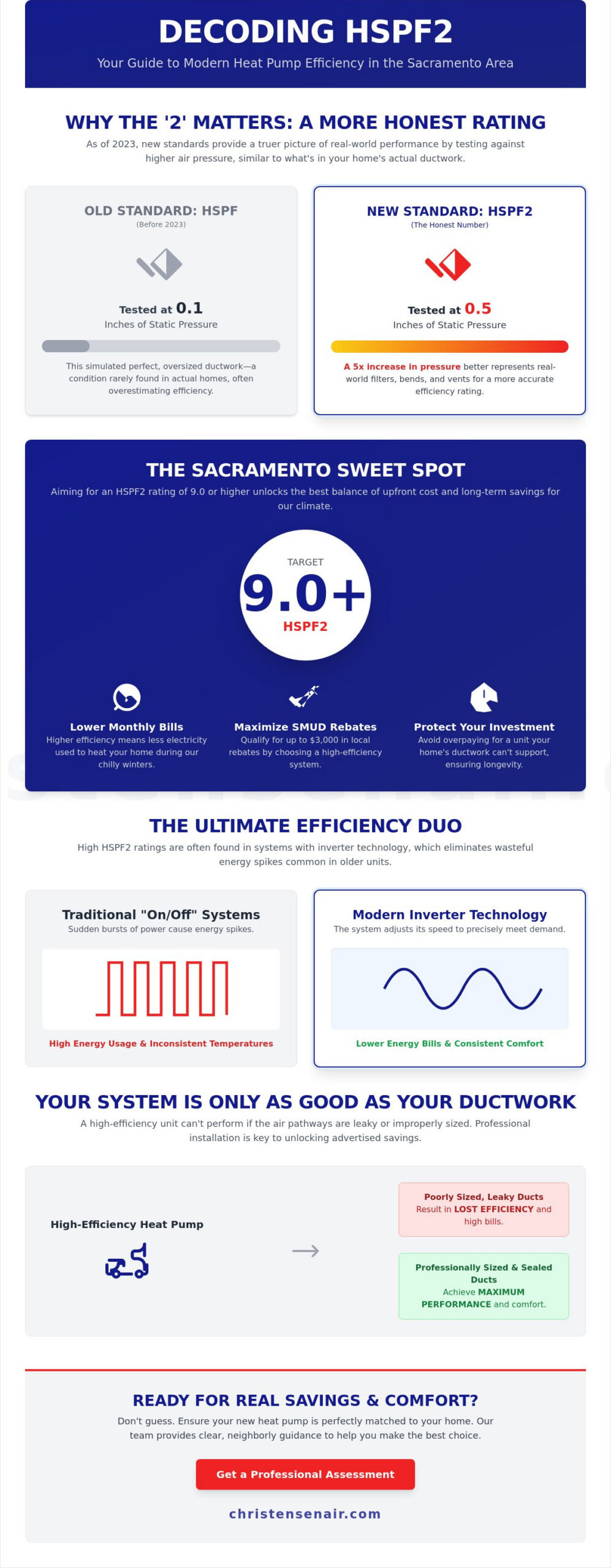
The biggest difference between the old and new standards is something we call “static pressure.” In the old HSPF tests, units were evaluated with very little resistance, simulating a home with massive, perfectly straight ducts. This rarely exists in the real world. The old test used 0.1 inches of water column, while the new HSPF2 test uses 0.5 inches. This fivefold increase in pressure better represents the actual conditions in your Sacramento attic or crawlspace. If your current ducts are leaky or restricted, your system has to work much harder than the old ratings suggested. This is why we often recommend a duct system replacement when upgrading to a modern heat pump; it ensures you actually get the efficiency you’re paying for.
Conversion Cheat Sheet for Homeowners
You cannot directly compare an old HSPF brochure to a new HSPF2 sticker. Because the new test is so much harder, the resulting numbers are naturally lower. As a general rule of thumb, HSPF2 ratings are roughly 15% lower than their HSPF predecessors for the exact same piece of equipment. For example, an older unit with an 8.8 HSPF rating is roughly equivalent to a 7.5 HSPF2 rating. This means a 7.5 HSPF2 unit is actually more efficient and robust than a legacy 8.2 HSPF model. By 2026, most “legacy” equipment has been phased out, but you should still check the labels carefully.
We want you to feel confident that your investment is doing its job. If you are comparing two different quotes and the numbers don’t seem to add up, we’re always happy to help you with our professional Heat Pump Services to ensure you’re getting a 2026-compliant system. Understanding HSPF2 ratings for heat pumps is about more than just math; it’s about making sure your family stays comfortable without overpaying for energy because of an outdated testing standard.
What is a ‘Good’ HSPF2 Rating for the Sacramento Climate?
Sacramento sits in DOE Climate Zone 4, which means we experience a unique mix of mild days and damp, chilly nights. Unlike the frozen winters in the Northeast, our local lows typically hover between 30°F and 45°F. This specific weather pattern is why understanding HSPF2 ratings for heat pumps is so important for your wallet. While a high-efficiency unit is always a great choice, we often find the “Sacramento Sweet Spot” for many families is between 7.5 and 8.5 HSPF2. This range offers a solid balance of reliability and lower monthly bills without the much higher price tag of ultra-premium models.
Understanding Heat Pump Ratings helps you see how these numbers translate to actual performance in our Northern California valley. We want you to feel confident that you aren’t overpaying for efficiency you don’t need, but also that you aren’t leaving money on the table through high utility bills.
Minimum Requirements vs. Optimal Performance
The current federal minimum for California is 7.5 HSPF2. While just “meeting the code” gets the job done, it may not provide the deep energy savings you’re looking for as utility rates rise. According to current research, a “good” HSPF2 rating for our region is actually 9.0 or higher to maximize your long-term ROI. Units with higher heating efficiency usually come with better SEER2 ratings, which is a lifesaver during our triple-digit summer heatwaves. Choosing a slightly more efficient system can protect your family’s sanctuary while keeping those SMUD bills manageable year-round.
Microclimates: Roseville vs. El Dorado Hills
We always tell our neighbors that elevation matters. If you live in Roseville, you’re in a different boat than someone in Auburn or Placerville. Higher elevation homes face more overnight frost and colder average temperatures, making a 9.0+ HSPF2 rating much more valuable. These systems are better at managing defrost cycles; this keeps your home cozy even when the unit has to clear ice from its coils. It’s a small detail that makes a big difference in your peace of mind during a cold snap. It is also helpful to remember that an HSPF2 rating measures efficiency across the entire heating season, not just the coldest night, so it reflects the total comfort your family enjoys from November through March.
HSPF2 and Inverter Technology: The Ultimate Efficiency Duo
When you are looking for the absolute best in home heating, the conversation naturally turns to inverter technology. We often tell our neighbors that understanding HSPF2 ratings for heat pumps is much easier once you see how the compressor actually works. Traditional heat pumps are either “all on” or “all off,” which creates massive energy spikes every time the system kicks in to reach your thermostat setting. Inverter-driven systems, however, are the gold standard because they can modulate their speed. This ability to run at varied levels is exactly why inverter models consistently reach the elite HSPF2 tiers of 9.0 or higher.
Variable Speed vs. Single-Stage Systems
Think of an inverter heat pump like the cruise control on your car. A traditional single-stage system is like driving in heavy traffic where you are constantly flooring the gas and then slamming on the brakes. It’s exhausting for the machine and wastes a lot of fuel. An inverter system gently adjusts its output to maintain a steady temperature. This is vital when Sacramento temperatures drop into those chilly 30-degree nights. By running at a consistent, lower speed, the system avoids the wear and tear of high-torque starts. This steady operation ensures your family enjoys a sanctuary of constant warmth without the “cold blows” often associated with older technology. If you want a deeper dive into how this technology works, our guide on what is an inverter heat pump and how does it work explains the mechanics in plain language for Sacramento homeowners.
Why Christensen Air Prioritizes Inverter Solutions
Our team has seen firsthand how these systems transform homes in Folsom and Rocklin. Beyond just the lower utility bills, inverter systems are incredibly quiet. Because they don’t have to run at full blast most of the time, you can actually enjoy your backyard without the roar of a loud fan in the background. We believe that what is hvac truly comes down to the balance of efficiency and domestic peace. High HSPF2 ratings are a great technical marker, but the real-world benefit is a home that feels and sounds better every single day.
To keep these high-tech systems performing at their peak, we recommend our Comfort Club Maintenance Plan. Even the most efficient inverter needs a professional eye to ensure the sensors and electronics are calibrated correctly. Regular care protects your investment and ensures you continue understanding HSPF2 ratings for heat pumps through the lens of actual monthly savings. If you are ready to upgrade your home’s comfort, we invite you to explore our Inverter Heat Pumps and see how we can help your family save.
Maximizing Your ROI: Rebates, Savings, and Installation
Investing in a high-efficiency system is about more than just the sticker price. We help our neighbors calculate the true payback period by weighing the upfront investment against the steady drop in monthly utility costs. Understanding HSPF2 ratings for heat pumps is the key to this math. A system with a 9.0 HSPF2 rating might cost more today, but it often pays for itself through lower energy bills over the next several years. While the federal 25C tax credits expired at the end of 2025, the local incentives available in 2026 remain a powerful way to offset your costs.
Local Utility Incentives in 2026
As of February 2026, SMUD offers substantial rebates to help you make the switch to cleaner, more efficient heating. If you are converting from a gas furnace to an electric heat pump, you can qualify for a $3,000 rebate for a variable-stage system. Two-stage systems with a minimum of 15.2 SEER2 qualify for a $2,000 rebate. For those already using electric heat and looking to upgrade, a $1,000 rebate is available. If your home requires a panel upgrade to support these new standards, you may also qualify for an additional $2,000 “Go Electric Bonus.” Variable-stage systems that qualify for the top rebate tier are almost exclusively inverter-driven models; our detailed breakdown of what is an inverter heat pump and how does it work can help you understand exactly why these units command both higher rebates and lower long-term operating costs.
PG&E also continues to support electrification throughout the Sacramento Valley. We make sure our customers don’t have to worry about the paperwork. Whether we are providing a heat pump repair service Rancho Cordova families trust or installing a brand-new unit, we help ensure your contractor files the correct documentation. This ensures you receive every dollar you’re entitled to. Understanding HSPF2 ratings for heat pumps helps you choose a unit that meets these specific rebate thresholds, maximizing your return on investment from day one. If you currently rely on a gas furnace and are weighing the financial case for making the switch, our complete guide on converting from gas furnace to electric heat pump in Citrus Heights walks through the current SMUD rebates and Go Electric bonuses in detail.
The Christensen Air Approach to Efficiency
We are a family-owned and operated business, and we treat your home like our own. We don’t believe in high-pressure sales or recommending equipment you don’t need. Instead, we focus on “sizing it right” the first time. We use precise Manual J load calculations to ensure your heat pump is perfectly matched to your home’s square footage and insulation levels. A system that is too large will cycle on and off too frequently, which ruins its efficiency and wears out the parts. A system that is too small will struggle to keep you warm on those damp Sacramento nights.
The final “rating” that truly matters is the quality of the installation. We take personal pride in every job because we know we are protecting the sanctuary and well-being of your household. If you’re ready to lower your bills and enjoy year-round comfort, we invite you to take the next step. Contact us today to schedule a comfort consultation for your Roseville or Sacramento home. We’ll help you find the perfect HSPF2 level for your budget and your family’s needs.
Secure Your Home’s Comfort and Savings for the Future
We’ve explored how the shift to HSPF2 provides a more honest look at your system’s performance and why finding the right efficiency tier is vital for our unique Sacramento climate. By focusing on modern inverter technology and taking advantage of local SMUD rebates, you can protect your family’s sanctuary while keeping energy costs under control. Understanding HSPF2 ratings for heat pumps is the first step toward a more comfortable and energy-efficient home that stands the test of time.
At Christensen Air, we’ve been family-owned and operated since 2009. As specialists in inverter heat pump technology, we take personal pride in serving our neighbors across Roseville, Sacramento, and the surrounding foothills. We treat every home as if it were our own, ensuring your new system is sized perfectly for your needs and your budget. Ready to upgrade to a high-efficiency heat pump? Contact our family at Christensen Air for a personalized quote today! We look forward to helping you achieve lasting peace of mind and year-round comfort.
Frequently Asked Questions
What is a good HSPF2 rating for a heat pump in California?
A rating of 9.0 or higher is generally considered excellent for California homeowners looking to maximize their long-term energy savings. While the law requires a minimum of 7.5, investing in a higher tier ensures your system operates efficiently during our damp winter nights. We often recommend these higher ratings to provide your family with the best balance of year-round comfort and lower monthly utility costs.
Is HSPF2 higher or lower than the old HSPF rating?
HSPF2 ratings appear lower than the old HSPF numbers because the new testing standards are significantly more rigorous. Manufacturers now have to test equipment against higher air pressure, which better reflects how air moves through your home’s actual vents. Even though the number on the sticker looks smaller, the equipment is actually just as efficient, if not more so, than older models.
Does a higher HSPF2 rating really save money on SMUD bills?
Yes, a higher rating directly translates to lower electricity consumption for every unit of heat your system provides. Since SMUD and PG&E rates continue to rise, choosing a more efficient unit reduces the amount of power your household pulls from the grid during the winter months. Understanding HSPF2 ratings for heat pumps helps you predict these savings and ensures you aren’t surprised by your winter heating costs.
Can I upgrade my current heat pump to a higher HSPF2 rating?
You cannot technically upgrade the rating of an existing unit, as the HSPF2 value is determined by the manufacturer’s design and testing. However, you can replace an older, inefficient system with a new model that meets or exceeds 2026 standards. We can help you evaluate your current equipment to see if a full system replacement would provide the financial return and peace of mind you’re looking for.
What is the minimum HSPF2 rating required by law in 2026?
The federal minimum efficiency standard for new residential split-system heat pumps is currently 7.5 HSPF2. For single-packaged heat pumps, the requirement is 6.7 HSPF2. These regulations ensure that any new equipment installed in your home meets a baseline level of performance, protecting you from outdated and expensive-to-run technology that can drive up your monthly expenses.
Do Inverter heat pumps always have higher HSPF2 ratings?
Inverter heat pumps almost always carry higher ratings because their variable-speed compressors don’t waste energy by constantly starting and stopping. By modulating their output to match your home’s exact needs, they maintain a much higher level of efficiency over the course of a season. This technology is the most reliable way to reach the elite tiers of efficiency that qualify for the best local rebates.
How does HSPF2 differ from SEER2?
HSPF2 measures heating efficiency over a season, while SEER2 measures cooling efficiency during the summer. Since heat pumps provide both heating and cooling, they carry both ratings on their EnergyGuide label. We look at both numbers to ensure your system can handle our triple-digit Sacramento summers just as well as our chilly winter mornings, protecting your family’s comfort in every season.
Will a high HSPF2 rating help my heat pump work better in freezing temperatures?
A high rating often indicates that a system is better equipped to handle lower temperatures without relying on expensive backup heat strips. Modern units with high HSPF2 values are designed to extract heat efficiently even when it’s freezing outside, ensuring your home stays cozy. Understanding HSPF2 ratings for heat pumps allows you to choose a system that remains reliable even during an unexpected Northern California cold snap.