






What if your brand new master suite addition actually makes the rest of your home feel like a sauna? Many homeowners assume they can simply tack on a few extra feet of ductwork, but a renovation fundamentally changes your home’s “thermal breath.” When you don’t account for these changes early, you risk creating permanent hot spots or overworking your expensive equipment. Understanding the right HVAC considerations for home remodels is the only way to ensure your beautiful new space stays as comfortable as the rest of your house.
We know how much heart you’re putting into this project, and we believe your climate control should be just as seamless as your new flooring. We’ve put together this guide to help you protect your investment and avoid the stress of skyrocketing energy bills or construction dust damage. You’ll learn how to navigate the 2026 A2L refrigerant transition, how to claim up to $2,000 in federal tax credits for high-efficiency heat pumps, and whether a ductless mini-split is a better fit for your floor plan than extending your current system.
Key Takeaways
- Understand how structural changes shift your home’s heating and cooling loads and why a Manual J calculation is the gold standard for comfort.
- Master the essential HVAC considerations for home remodels to determine if your current system can handle the extra square footage or if it’s time for an upgrade.
- Evaluate the pros and cons of extending your existing ductwork versus installing a versatile ductless mini-split system for your new space.
- Learn the critical steps to protect your blower motor and evaporator coils from permanent damage caused by construction dust and debris.
- Find out why modern inverter heat pumps are the “remodel gold standard” for maintaining efficiency and quiet comfort in variable-sized rooms.
Why HVAC Planning Must Happen Before the First Sledgehammer Swings
When you start envisioning your dream home, you likely focus on open floor plans and modern finishes. However, we’ve seen many beautiful renovations become unusable because the climate control was an afterthought. Structural changes, like removing a wall to create a great room or adding large windows, completely change how your home breathes. These shifts alter the load requirements for your Heating, ventilation, and air conditioning (HVAC) system. If you wait until the drywall is up to think about air, you might find yourself stuck with a room that’s ten degrees warmer than the rest of the house.
Proactive planning during the framing stage is much more affordable than retrofitting later. We always recommend that your HVAC contractor speaks with your architect before permits are finalized. This ensures that essential HVAC considerations for home remodels, like duct pathways and equipment sizing, are baked into the blueprints. It prevents costly change orders and ensures your home remains a sanctuary for your family. By addressing these HVAC considerations for home remodels early, you protect your budget and your peace of mind.
To better understand your options for a new room, watch this helpful video:
The Concept of the Thermal Envelope
The thermal envelope is the physical barrier between your family’s comfort and the intense Roseville heat. When you upgrade insulation or replace windows in one section of your home, you change the air pressure for the entire building. Simply buying a unit with more power isn’t the solution. A system that’s too large will cycle on and off too quickly, leaving the air humid and uncomfortable. We look at the whole house as a single ecosystem. Our goal is to make sure every room feels just right, regardless of what the weather is doing outside.
Avoiding the “Add-a-Vent” Trap
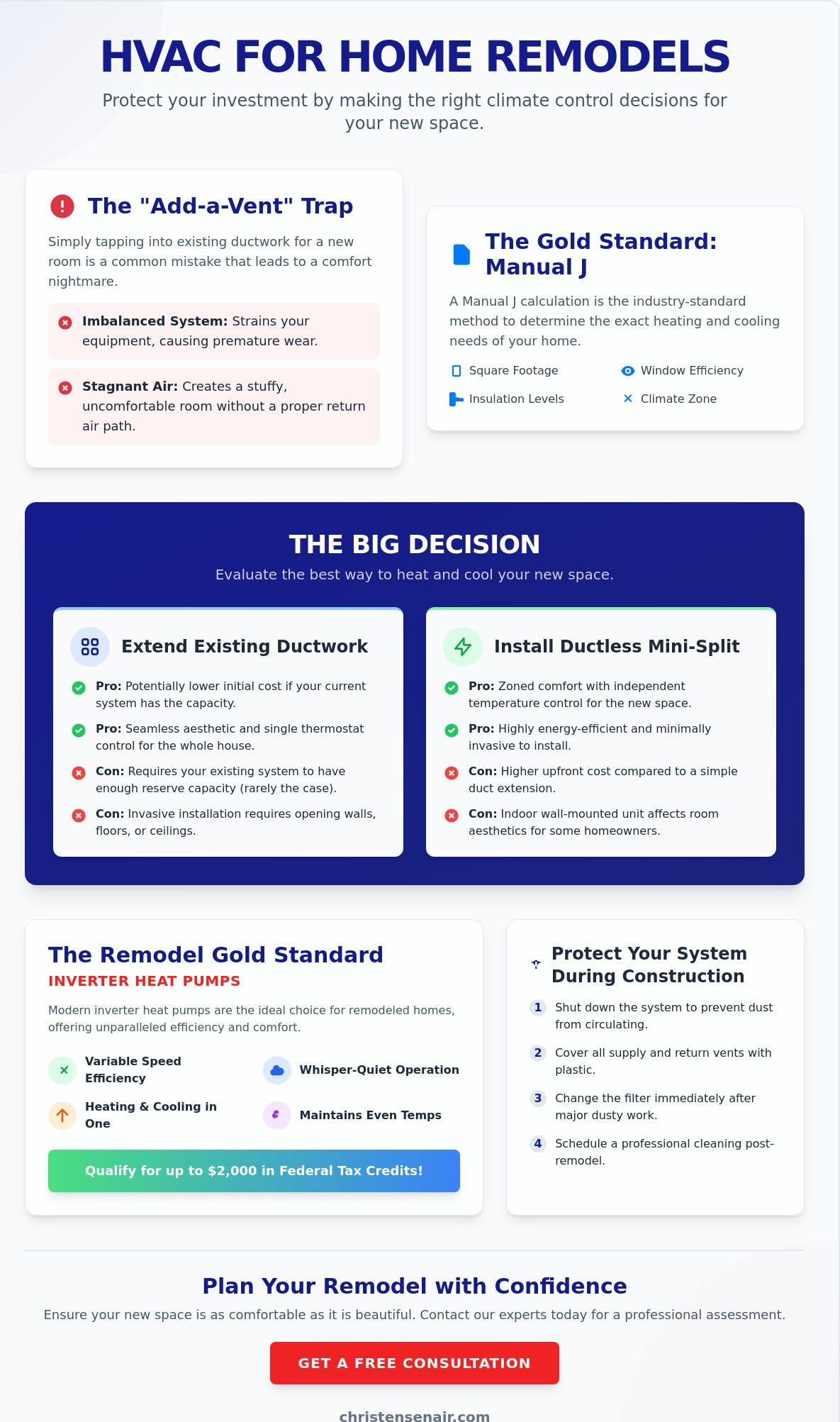
It’s tempting to think you can just tap into an existing duct to cool a new room. This is a common mistake that leads to a comfort nightmare. HVAC physics rely on a delicate balance of supply and return air. Adding a vent without increasing the system’s capacity often leads to short cycling, which wears down your blower motor prematurely. Without a dedicated return air path, the new space can’t breathe. This leaves the air stagnant and stuffy. We take personal pride in designing systems that move air efficiently, ensuring your new addition is a place where you actually want to spend time.
Assessing Capacity: Will Your Current System Survive the Expansion?
Before you commit to your new floor plan, we need to look at the heart of your home’s comfort. Your existing air conditioner or furnace was likely sized specifically for your home’s original footprint. Asking it to cool an extra five hundred square feet isn’t just a big request; it might be an impossible one. In our local Sacramento climate, where summer days regularly spike above 100°F, your system relies on “reserve capacity” to keep your family cool during heat waves. If your unit already runs for hours without a break or leaves certain rooms feeling stuffy, it’s already at its limit. Adding more space without a plan is one of the most overlooked HVAC considerations for home remodels.
We believe in being honest about the health of your equipment. A system that’s ten to fifteen years old might technically still work, but the added strain of a remodel often leads to a mid-summer breakdown. This is why we perform a detailed assessment of your unit’s current performance and age. We want to ensure that your investment in a beautiful new master suite isn’t ruined by a loud, struggling AC unit that can’t keep up. If you’re unsure where your system stands, our team can help you evaluate your current setup with a professional performance assessment to give you total peace of mind.
What is a Manual J Calculation?
Manual J is the industry-standard method used to determine the exact BTU heating and cooling needs of a specific living space. Rather than using outdated “rules of thumb” based solely on square footage, this calculation accounts for your home’s orientation to the sun, the specific R-values of your new insulation, and the types of windows you’ve chosen. We use this data to ensure your system is perfectly balanced. Over-sizing a unit is just as bad as under-sizing it, as it leads to short cycling and high humidity. Getting the math right is the only way to avoid a comfort nightmare once the project is finished.
The Tipping Point: When to Replace vs. Extend
Deciding whether to extend your current ductwork or invest in a new system is a major financial decision. Understanding what is HVAC and how its components work together helps you see the long-term ROI. For many 2026 remodels, switching to all-electric Heat Pump Systems is the smartest move. These modern units meet California’s evolving energy standards and provide both heating and cooling from a single, highly efficient source. Sometimes, adding a secondary unit for the new addition is more cost-effective than replacing a perfectly good central system. We’ll walk you through these options to find the roadmap that fits your budget and your home’s unique needs.
Ductwork Design vs. Ductless Solutions for New Spaces
Once you’ve assessed your system’s capacity, the next big question is how to actually get that air into your new rooms. This is where the debate between traditional ductwork and modern ductless solutions begins. We often see homeowners try to stretch their existing central AC too far. The physics of air pressure means that the further air has to travel through a pipe, the more energy it loses. This results in far-flung additions that never quite feel as cool as the kitchen. Proper HVAC planning for remodels involves calculating these pressure drops before you close up the walls.
Zoning systems are another fantastic tool for larger renovations. They allow us to install dampers in your ducts that direct air only where it’s needed. This means you can keep the baby’s nursery at a perfect 72 degrees without wasting energy freezing the guest room you only use on weekends. It’s about giving your family precise control over every corner of your home. These technical choices are some of the most vital HVAC considerations for home remodels because they impact your daily comfort for years to come.
When to Choose Ductless Mini-Splits
Ductless mini-splits have become our secret weapon for specific remodel projects. If you’re converting a garage into an office or building a sunroom, these systems are often the most efficient choice. They don’t require any invasive ductwork, which saves you money on construction costs. Each unit operates independently, providing dedicated temperature control for that specific space. For Rocklin homeowners planning this type of project, our complete guide to mini split installation for a garage conversion in Rocklin walks you through every step of the process under the 2026 California Energy Code. To fully understand why so many homeowners are making the switch, explore the benefits of a ductless mini split system before making your final decision. While some worry about the look of wall-mounted units, modern recessed ceiling cassettes offer a sleek, nearly invisible alternative that blends into your new decor perfectly.
The Vital Role of Duct Integrity
If you decide to stick with a central system, we can’t stress enough how much duct health matters. A remodel is the perfect opportunity for a duct system replacement. Many older homes in our area have leaky, undersized, or poorly routed flex-duct that wastes up to 30% of your conditioned air before it even reaches the vent. By sealing and properly sizing your ducts during the framing stage, we ensure your new remodel gets the airflow it deserves. We take pride in making sure your ductwork is as solid as the rest of your home’s foundation.
Protecting Your Investment: HVAC Care During and After Construction
Your remodel is a major investment in your family’s future, but the dust generated during construction can be a silent killer for your mechanical systems. The single biggest mistake we see homeowners make is running the central air while workers are sanding drywall or cutting lumber. Drywall dust is incredibly fine and abrasive. It easily bypasses standard filters and coats your evaporator coils and blower motor. This creates a layer of “gray insulation” that causes your system to overheat, leading to expensive repairs just as you’re finishing your beautiful new space. Protecting your equipment is one of the most critical HVAC considerations for home remodels.
We want to ensure your system stays as healthy as your new home. To keep your unit safe, follow this simple protection checklist before the first bag of mortar is opened:
- Turn the system off: Never run the HVAC while active dusty work is happening.
- Seal the vents: Use plastic sheeting and painters tape to completely cover all supply and return registers in the construction zone.
- Isolate the unit: If your furnace or air handler is in a closet or basement near the work, keep the doors closed and seal the gaps.
- Use temporary cooling: If workers need climate control, suggest portable fans or a temporary window unit rather than your central system.
Once the dust settles, a professional inspection is non-negotiable. We’ve seen brand new systems fail within months because construction debris was left to fester inside the sensitive components. If your remodel is nearing completion, schedule a post-construction system audit to ensure everything is clean and running at peak efficiency.
Indoor Air Quality During Construction
Protecting the machinery is vital, but protecting your family’s lungs is our top priority. We recommend using temporary air scrubbers during the messiest phases of your project. As you move into the finishing stages, upgrading to high-MERV filtration can help catch the remaining airborne particles. For a deeper dive into maintaining a healthy home environment, check out our how to improve indoor air quality guide. These steps ensure the air in your new room is just as fresh as it looks.
The Local Factor: Fire Season and Construction
In the Sacramento and Roseville area, we face the unique challenge of wildfire season overlapping with home improvement projects. If your remodel happens during a smoke event, you must manage your fresh air intake carefully. This is an excellent time to consider a UV light installation. These systems work inside your HVAC to kill bacteria and mold that can thrive in the humid, dusty conditions of a construction site. Our “Construction Dust Audit” includes a thorough check of your heat exchanger and blower wheel to ensure that high SMUD or PG&E rates don’t hit your wallet due to a clogged, inefficient system.
Modern Solutions: Why Inverter Heat Pumps Are the Remodel Gold Standard
As you finalize your renovation plans, choosing the right equipment is the final piece of the comfort puzzle. In 2026, inverter heat pumps have become the preferred choice for homeowners who want to maximize both efficiency and quiet operation. Unlike older single-stage systems that only run at full blast or not at all, inverter technology allows the system to adjust its speed precisely. It ramps up or down based on the exact cooling or heating needs of your home at any given moment. This is one of the most vital HVAC considerations for home remodels because it effortlessly handles the variable loads of a new addition without wasting energy.
One of the most noticeable benefits of these modern units is the “soft-start” operation. We’ve all lived in homes where the lights flicker for a split second when the air conditioner kicks on. Inverter heat pumps eliminate this surge by gradually increasing power. This puts significantly less strain on your home’s electrical system and extends the lifespan of your expensive components. When we pair these systems with a smart thermostat, you can effectively manage SMUD and PG&E time-of-use rates. By shifting your system’s heaviest work to off-peak hours, you can keep your monthly bills manageable even after adding extra square footage.
The Efficiency Advantage
Inverter systems maintain a perfect 72°F by running at lower, more consistent speeds. This prevents the uncomfortable “blast and stop” cycles that leave rooms feeling alternately freezing or stuffy. This steady operation also makes modern heat pumps incredibly quiet. This is a huge advantage if your remodel includes a new outdoor living space or a bedroom located near the outdoor condenser. While many local families have traditionally relied on a gas furnace for winter warmth, more neighbors are choosing all-electric heat pumps during their renovations. This shift allows them to claim the $2,000 federal tax credit while meeting California’s 2026 energy standards. For those in Southern California, HVAC Inspections Los Angeles offers specialized expertise in diagnosing and maintaining these advanced heat pump systems.
The Christensen Commitment to Your Remodel
At Christensen Heating and Cooling, we treat every remodel project with the same neighborly care we’d give our own family. We know that construction is a big commitment, and our goal is to provide a reliable, whisper-quiet climate control system that lets you enjoy your new space from day one. We take personal pride in ensuring your HVAC considerations for home remodels are handled with technical proficiency and honesty. To protect your new investment, we also offer our Comfort Club maintenance plan to keep your system running efficiently for years to come. If you’re ready to bring your dream home to life, Schedule a remodel HVAC consultation with the Christensen family today.
Building a More Comfortable Future for Your Home
Your home renovation is an exciting journey toward a more beautiful and functional living space. By focusing on early planning, system capacity, and the protection of your equipment from construction debris, you’ve set a solid foundation for long-term comfort. Taking the time to understand these HVAC considerations for home remodels ensures your new addition remains energy-efficient and perfectly climate-controlled for years to come.
Since 2009, we’ve operated as a family-owned business dedicated to serving our neighbors in Roseville, Rocklin, and the greater Sacramento area. We specialize in high-efficiency inverter heat pumps and take personal pride in every project we touch. We believe that professional guidance shouldn’t be high-pressure; it should be a partnership that puts your family’s peace of mind first. If you’re ready to ensure your dream home stays cool and cozy, we’re here to help you every step of the way.
Plan your remodel HVAC strategy with Christensen Heating and Cooling today. Let’s make sure your new space feels as good as it looks.
Frequently Asked Questions
Do I need to permit my HVAC changes during a remodel in Roseville?
Yes, the City of Roseville requires permits for most HVAC modifications or replacements to ensure the work meets current safety and efficiency codes. This process protects your family by verifying that the installation is handled correctly and safely. We take care of the paperwork and coordinate the inspections for you, so you can focus on the more exciting parts of your home renovation project.
Can I just add a ductless mini-split to my new room instead of upgrading my main AC?
Yes, adding a ductless mini-split is often the smartest and most cost-effective solution for a new room addition. It provides independent temperature control for that specific space without the need to tear into your existing walls for new ductwork. This is a perfect choice for master suites or garage conversions where your main central system might already be working at its maximum capacity. Learn more about the benefits of a ductless mini split system to see if it’s the right fit for your project.
How much does construction dust actually affect my HVAC system?
Construction dust can cause permanent, expensive damage to your system’s blower motor and evaporator coils if the unit runs during the dusty phases of work. These fine particles act like sandpaper on moving parts and can quickly clog your filtration system. We always recommend keeping your system off and sealing all vents with plastic until the drywall sanding and heavy sawing are completely finished.
Will adding square footage to my home automatically void my HVAC warranty?
Adding square footage doesn’t automatically void your warranty, but overworking an undersized system can lead to mechanical failures that manufacturers might not cover. Most warranties require that the equipment is used within its designed capacity. Addressing the right HVAC considerations for home remodels with a professional ensures your equipment stays within its operating limits, which keeps your manufacturer protection fully intact and valid.
What is a Manual J calculation and why is it necessary for my remodel?
A Manual J calculation is the industry-standard method we use to determine the exact heating and cooling needs of your home’s new layout. It accounts for your insulation levels, window types, and even the direction your new addition faces. This is necessary because it prevents the common mistake of installing a system that is too large or too small, ensuring perfect comfort for your family.
How do I know if my current ductwork is large enough for my new addition?
We determine if your ductwork is sufficient by performing a Manual D calculation to evaluate the airflow capacity of your current pipes. Simply adding more vents to an existing duct often drops the air pressure, which leaves your new room feeling stuffy. If your ducts are undersized, you might hear whistling or notice that the air doesn’t reach the furthest corners of your home.
Should I replace my furnace and AC at the same time during a renovation?
We generally recommend replacing both units together during a remodel to ensure the components are perfectly matched for peak performance. Modern inverter heat pumps often replace both the furnace and AC with a single, highly efficient system that meets the latest energy standards. Doing this during construction saves you money on labor and ensures your entire home comfort system starts with a fresh warranty.
How can I keep my energy bills low after adding a new room to my house?
You can keep your bills manageable by choosing high-efficiency inverter technology and ensuring your new space is properly sealed. These systems are one of the most important HVAC considerations for home remodels because they adjust their power use based on your actual needs. Using a smart thermostat to manage time-of-use rates with SMUD or PG&E also helps keep your monthly costs under control.