





With California electricity rates currently sitting at nearly double the national average, every degree on your thermostat feels like a direct hit to your monthly budget. We understand the frustration of opening a SMUD or PG&E bill only to realize you’re paying a premium for a system that leaves the upstairs sweltering while the kitchen stays freezing. If you’re tired of dealing with dusty ductwork and inconsistent comfort, you’re likely wondering: are ductless mini splits worth it for your Northern California home?
We agree that choosing a new HVAC system is a significant decision that deserves clear, honest guidance rather than a high-pressure sales pitch. In this 2026 guide, we promise to show you exactly how the energy savings and precise zoning of a mini-split can transform your home’s environment. We’ll preview the latest local utility rebates, explain why inverter technology is a game changer for your comfort, and help you determine if this investment will provide the 15 plus years of reliability your family deserves.
Key Takeaways
- Learn how high SEER2 ratings and inverter technology can significantly lower your monthly utility bills compared to traditional central air.
- Discover how precise zone control answers the question of are ductless mini splits worth it by allowing you to heat or cool only the rooms you actually use.
- Understand why bypassing expensive ductwork installations can help offset the higher upfront hardware costs of a mini-split system.
- Identify the best use cases for these systems in Northern California, from garage conversions to creating a temperature-perfect master suite.
- Find out why professional installation and ongoing care through our Comfort Club are essential for protecting your investment for 15 plus years.
What is a Ductless Mini-Split and Why is the Hype Growing?
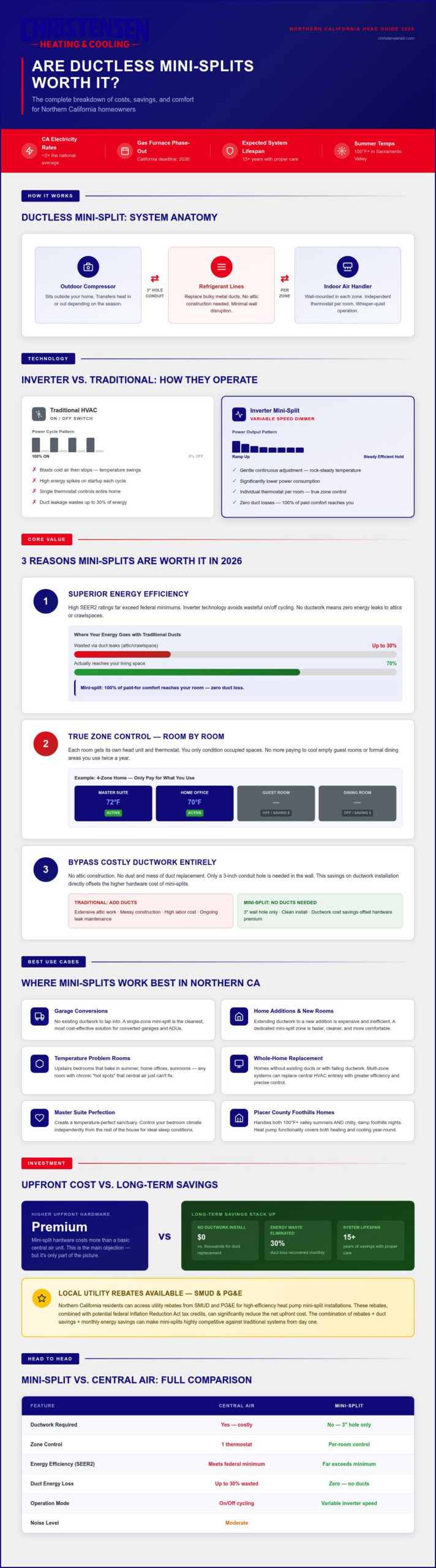
A ductless mini-split system is a modern solution to an old problem: how to keep your home comfortable without wasting energy on empty rooms. At its core, the system consists of a slim outdoor compressor unit linked to one or more indoor air handlers. These components connect through a small conduit that only requires a three inch hole in your wall. When homeowners ask us What is a Ductless Mini-Split, we describe it as a surgical approach to climate control. Instead of pushing air through a massive network of tubes, these systems deliver comfort exactly where you stand. It is simple. It is effective.
The hype around these systems is growing for a very specific reason in 2026. California is moving aggressively toward all-electric homes, and the state has already set a timeline to phase out gas-powered furnaces by 2030. This shift makes high-efficiency heat pumps the new standard for local households. While some people worry about the initial cost, we often find that the real question is whether the superior comfort and precision are ductless mini splits worth it compared to traditional setups. For many in our community, the answer lies in the total control they gain over their sanctuary.
One of the biggest hurdles in home renovation is the attic. Traditional ducts are prone to leaks, dust buildup, and thermal loss. By choosing a ductless setup, you completely bypass the need for a costly duct system replacement. This saves you from the mess of construction and ensures that the air you pay to cool actually reaches your living space. You stop paying for air that escapes into your crawlspace or attic. It’s a smarter way to manage your home.
How Mini-Splits Differ from Central Air
Traditional central air relies on a single thermostat to dictate the temperature for every room in the house. This often leads to “hot spots” or rooms that never quite feel right. Mini-splits change the game by providing multiple thermostats, or zones, throughout the home. You gain the ability to turn off the air in the guest room while keeping your home office perfectly chilled. Mini-splits use refrigerant lines instead of bulky metal ducts to move heat. This design results in a whisper-quiet operation that you’ll barely notice while you’re sleeping or watching a movie.
The Role of Inverter Technology
Most older HVAC systems operate like a light switch; they are either 100% on or completely off. This creates a cycle where you get a blast of cold air followed by a warm, humid lull. Inverter technology works more like a dimmer switch. It allows the system to speed up or slow down based on the actual needs of the room. This constant, gentle adjustment maintains a steady temperature and uses significantly less power. If you want to dive deeper into the mechanics, you can read our guide on what is an inverter heat pump and how does it work. It explains why this technology is the secret to lower utility bills.
The 3 Core Reasons a Mini-Split is Worth the Investment in 2026
We’ve seen many neighbors in Roseville and Sacramento struggle with systems that just can’t keep up with our local climate. When you ask are ductless mini splits worth it, you have to look at the specific challenges of our region. From the scorching 100 degree days in the Sacramento Valley to the chilly, damp nights in the Placer County foothills, the flexibility of these systems is unmatched. They provide a level of reliability that traditional central air often lacks when the weather turns extreme. We believe every homeowner deserves a system that works for them, not against them.
Mini-splits offer energy efficiency that traditional central units simply cannot match. Many models achieve SEER2 ratings that far exceed the federal minimum requirements. This isn’t just a technical win; it’s a financial one. Because there are no ducts to leak air into your attic, you eliminate the energy loss common in older homes. Most industry data suggests that duct leakage can account for up to 30% of energy waste. By removing the ducts, you keep that 30% of paid-for comfort exactly where it belongs.
Think about your guest room or that formal dining area you only use for holidays. With a central system, you’re paying to cool those empty spaces just to keep your bedroom comfortable. Mini-splits provide true zone control. Each room has its own head unit and thermostat. You gain the freedom to customize comfort room by room. It’s about personalizing your sanctuary while being mindful of your budget. If you’re looking to protect your household budget, our Ductless Mini Split Installations offer a reliable way to gain control over your monthly spending.
Winning the Battle Against High Utility Rates
Local utility providers like SMUD and PG&E have implemented complex time-of-use rates. This means the power you use during the hottest part of the day costs significantly more. High-efficiency mini-splits help mitigate these costs by using less power overall. Traditional systems often have a “vampire load,” drawing excessive energy every time the compressor cycles on. Inverter-driven mini-splits avoid this by maintaining a low, steady speed. This keeps your home at a constant temperature without those expensive spikes in electricity usage.
Breathe Easier in Northern California
Air quality is a primary concern for our families, especially during wildfire season. Since mini-splits don’t rely on leaky attic ducts, they don’t pull in dust, insulation fibers, or smoke from unconditioned spaces. Instead, they use multi-stage filtration to clean the air directly inside the room. Learning how to improve indoor air quality is much simpler when your HVAC system isn’t actively working against you. These systems trap allergens and pollutants before they can circulate, providing a safer environment for your loved ones. It’s a quiet, clean, and dependable way to live.
Comparing the Upfront Cost vs. Long-Term Savings
It’s common to feel a bit of sticker shock when looking at the initial price of a high-quality mini-split. The advanced inverter hardware and individual air handlers represent a higher upfront investment than a standard central unit. However, determining if are ductless mini splits worth it requires looking at the total project cost. Because these systems don’t require you to tear open walls or install expensive ducting, you often save thousands on labor and materials during the installation phase. We see this as a strategic trade-off: you’re paying for technology that works for you, rather than for metal tubes hidden in your attic.
In 2026, the financial landscape for HVAC incentives has shifted. While statewide HEEHRA rebates are fully reserved as of February 24, 2026, local utility programs remain a strong source of support. For our neighbors in the Sacramento Municipal Utility District (SMUD), you can still access up to $3,000 in rebates for qualifying heat pump systems. PG&E customers also have opportunities for rebates up to $2,500. When you combine these local incentives with the fact that mini-splits use approximately 40% less energy than window units or older central systems, the operational ROI becomes clear. With California electricity rates nearly double the national average, those monthly savings add up quickly.
Installation Complexity and Labor
The complexity of your project depends on whether you need a single-zone unit for a home office or a multi-zone system for the entire house. Professional sizing is the most critical factor in your long-term satisfaction. An oversized unit will cycle too often, while an undersized one will never keep you comfortable. Some homeowners are tempted by DIY kits, but these often lack the warranty protection and specialized support of a professional installation. If things go wrong, the cost of an emergency ac repair roseville can quickly erase any initial “savings” from a self-installed unit. We prioritize doing it right the first time to protect your peace of mind.
Home Value and Resale Appeal
In the competitive Sacramento real estate market, buyers are increasingly looking for energy-efficient “modern homes.” A mini-split system signals that the property is updated and well-maintained. These systems also allow you to condition spaces like garages or sunrooms, effectively adding livable square footage to your home without a full-scale addition. High-efficiency HVAC upgrades consistently rank as top-tier home improvements for resale value. You aren’t just buying a heater or an air conditioner; you’re investing in the equity of your sanctuary. It’s a choice that pays dividends both in daily comfort and future marketability.
Where is a Mini-Split System Most Effective? (Best Use Cases)
Every home has that one room that never quite feels right. Maybe it’s a sunroom that turns into a greenhouse by noon or a master suite that stays five degrees warmer than the rest of the house. In these specific scenarios, the question of are ductless mini splits worth it becomes an easy “yes” because they solve problems that central air simply can’t reach. Instead of trying to force a single system to behave perfectly across different levels and exposures, we use mini-splits to provide targeted relief exactly where the architecture of the home creates a struggle. It’s about providing a reliable solution for those stubborn spaces.
Master suite sanctuaries are a prime example of this technology in action. Many of our neighbors prefer to sleep in a cool 68 degree environment but don’t want to pay to freeze the entire house all night. A single-zone mini-split allows you to maintain that perfect sleeping temperature while the rest of your home remains at a more energy-efficient setting. This localized approach protects your comfort and your utility bill at the same time. You gain the freedom to customize your sanctuary without compromise.
The Historic Home Solution (Placerville & Auburn)
If you live in a beautiful 100-year-old home in Placerville or Auburn, you know that adding modern ductwork is a logistical nightmare. Tearing into original lath and plaster or original wood ceilings to hide bulky metal ducts can destroy the character of your property. Mini-splits are the ideal alternative because they require only a tiny three inch opening for the conduit. You can enjoy 2026 technology while preserving every bit of your home’s historic integrity. The indoor units have a small footprint and can be placed discreetly to blend into your classic decor. It’s the most respectful way to bring modern cooling to a legacy structure.
Garage Conversions and ADUs
We’ve seen a massive rise in garage-to-office conversions across Roseville and the surrounding areas. A window unit is often too noisy for professional video calls, and portable ACs are rarely efficient enough for our summer heat. A mini-split provides whisper-quiet operation and precise climate control that makes a workspace actually usable year-round. This is also the standard choice for Accessory Dwelling Units (ADUs), providing independent heating and cooling for guests or tenants. You can explore more about the benefits of a ductless mini split system to see how they fit these unique builds. If you’re ready to reclaim your garage or fix that freezing bedroom, contact us for expert Ductless Mini Split Installations today.
The Christensen Approach: Making Your Investment Last
Investing in a high-efficiency system is only half the battle. To truly determine if are ductless mini splits worth it for your household, you have to look at the lifespan of the equipment. A premium system that is poorly installed will fail years before its time, leaving you with repair bills rather than energy savings. We take personal pride in every installation because we know that our neighbors in the Greater Sacramento area rely on us to protect their homes. Professional installation isn’t just about getting the unit on the wall; it’s about ensuring the refrigerant lines are perfectly sealed and the system is balanced for our specific climate.
One concern we often hear involves the appearance of indoor units. Some homeowners worry a “white box” might disrupt the aesthetic of their sanctuary. In 2026, we have more options than ever before. We offer slim-profile units and creative placement strategies that keep your home looking beautiful while feeling incredible. Whether it’s a recessed ceiling cassette or a low-wall unit that mimics a traditional radiator, we find solutions that blend into your decor. We prioritize your visual comfort just as much as your physical comfort.
The Comfort Club Maintenance Advantage
Mini-splits are precision instruments. Because they don’t have large ducts, they rely on clean, internal components to move air effectively. The number one cause of system failure we see is a clogged condensate line, which can lead to water damage if not caught early. Regular filter cleanings are also vital for maintaining that 40% energy efficiency advantage we discussed earlier. Our Comfort Club is designed to take the stress out of this process. We provide consistent checkups that align with our guide on how to make my HVAC system last longer. It’s a proactive way to ensure your investment pays for itself over the next 15 plus years.
Your Local Partner in Roseville & Beyond
We’ve been family-owned and operated since 2009. From Roseville to Placerville, we’ve built our reputation on honesty and the value of long-term relationships. Unlike big-box contractors who might prioritize a quick sale, we focus on “right-sizing” your system. We won’t sell you a multi-zone setup if a single-zone unit is all you need for your home office. Our goal is to be the reliable experts you can call whenever you need help. We treat your environment with the same care we would apply to our own. If you’re ready to see if are ductless mini splits worth it for your specific budget and floor plan, Contact Christensen Heating and Cooling for a custom quote today. We look forward to helping you find your perfect comfort zone.
Invest in Your Home’s Future Comfort
Choosing the right HVAC system is about more than just numbers on a page; it’s about protecting the peace and safety of your household. We’ve explored how these systems eliminate energy waste by bypassing leaky ducts and how they provide surgical precision for those stubborn hot spots in your home. Ultimately, deciding if are ductless mini splits worth it comes down to your personal goals for monthly savings and localized control. When you combine the energy efficiency gains over window units with the long-term reliability of our Comfort Club Priority Service, the investment becomes a clear path toward successful home electrification.
Since 2009, we’ve focused on being the regional experts in inverter heat pumps for families across Roseville and Placer County. We don’t believe in high-pressure sales, only honest guidance that prioritizes your needs. If you’re ready to transform a specific room or your entire home into a sanctuary of quiet, efficient comfort, we are here to help. Schedule Your Custom Mini-Split Consultation Today and let our family take care of yours. We look forward to building a lasting relationship based on trust and quality service.
Frequently Asked Questions
How much does a ductless mini-split cost to install in Roseville?
Installation costs for a mini-split system vary significantly based on the number of indoor zones you need and the heating capacity required for your space. While we cannot provide a specific dollar amount without seeing your home, a single-zone setup for a home office is a different investment than a whole-home multi-zone system. We recommend a professional assessment to get an accurate quote that accounts for your home’s unique layout and electrical requirements.
Do mini-splits work in 100-degree Sacramento heat?
Yes, modern mini-splits are specifically engineered to maintain high performance during extreme Northern California heatwaves. These systems use advanced inverter technology to adjust their cooling output as the temperature rises outside. Unlike window units that might struggle when it hits triple digits, a properly sized mini-split keeps your sanctuary perfectly chilled even during the hottest July afternoons in the Sacramento Valley.
How long do ductless mini-split systems typically last?
A well-maintained ductless mini-split system can reliably serve your home for 15 to 20 years. This longevity depends heavily on regular professional care and keeping the indoor filters clean. We focus on system health through our Comfort Club maintenance plan to ensure your equipment reaches its maximum lifespan. Consistent checkups prevent the small issues that typically lead to premature system failure in our dusty climate.
Are mini-splits more efficient than central air conditioning?
Mini-splits are generally more efficient than central air because they eliminate the energy loss associated with ductwork. Traditional ducts can lose up to 30% of conditioned air through leaks or thermal transfer in a hot attic. When homeowners ask are ductless mini splits worth it, the answer often lies in these efficiency gains. You only pay to cool the rooms you are actually using, which significantly lowers your monthly utility bills.
Do I need a separate mini-split unit for every room in my house?
You don’t necessarily need a unit in every single room to enjoy whole-home comfort. Multi-zone systems allow one outdoor compressor to power several indoor air handlers placed in your primary living areas. We work with you to identify the most important zones, such as bedrooms and main living spaces, to create a custom layout. This approach provides the precise control you need without overcomplicating the installation.
Can a mini-split system both heat and cool my home?
Yes, ductless mini-splits are heat pumps that provide both high-efficiency cooling and powerful heating. They use a reversing valve to move heat into your home during the winter and pull it out during the summer. This makes them a versatile year-round solution for our local climate. They are an excellent choice for families looking to transition away from gas furnaces toward a more sustainable, all-electric heating and cooling option.
How often do mini-split filters need to be cleaned in Northern California?
We recommend checking and cleaning your mini-split filters every one to three months. In Northern California, dust and wildfire smoke can clog filters faster than in other regions. Keeping these filters clear is essential for maintaining air quality and system efficiency. It’s a simple task that you can do yourself, but we also include deep cleanings as part of our regular professional maintenance visits to protect your investment.
Is there a tax credit for installing a mini-split in 2026?
The federal tax credit for heat pump installations is not available for systems installed after December 31, 2025. However, you can still find significant savings through local utility programs. SMUD and PG&E continue to offer rebates for qualifying energy-efficient systems in 2026. We encourage you to check with your specific utility provider for the most current rebate amounts and eligibility requirements before starting your project.