






Can a single system that warms your home in December really keep your family cool when Roseville hits a blistering 105°F in July? Many of our neighbors find themselves stuck in the heat pump vs hvac debate, feeling more than a little confused by technical jargon and conflicting advice. It’s completely normal to worry about whether an electric system can handle the Central Valley’s extreme heat or if it’s just another way to see your monthly utility bills climb.
We understand that your home is your sanctuary, and choosing the right equipment is about more than just mechanical specs; it’s about long-term peace of mind. In this guide, we’ll break down the real differences between these technologies to help you find the most efficient solution for our specific Northern California climate. We’ll explore how modern inverter technology works, compare the potential for lower energy costs, and look at the local rebates available through Roseville Electric and SMUD to ensure you feel confident and secure in your next home investment.
Key Takeaways
- Learn why HVAC is an umbrella term and how a heat pump acts as a specialized, all-in-one solution for your home’s sanctuary.
- End the confusion over heat pump vs hvac systems by understanding how a single unit provides both high-performance cooling and efficient heating.
- Discover why Roseville’s specific climate makes inverter heat pumps an ideal choice for maintaining comfort even when temperatures climb past 100°F.
- Understand the importance of evaluating your home’s ductwork and insulation to ensure your new system operates at peak efficiency for years to come.
- Find out how local expertise and dedicated maintenance can protect your family’s investment and lower your monthly energy costs.
What is the Difference Between Heat Pump and HVAC?
When you start researching how to keep your home comfortable, you’ll likely see the phrase heat pump vs hvac pop up in articles and local advertisements. It sounds like a choice between two entirely different technologies, but that’s actually a bit of a misunderstanding. Think of it like comparing a specific model of truck to the category of “motor vehicles” in general. One is a specific tool, while the other is the name for the entire industry. We want to help you clear up this confusion so you can make the best choice for your family’s sanctuary.
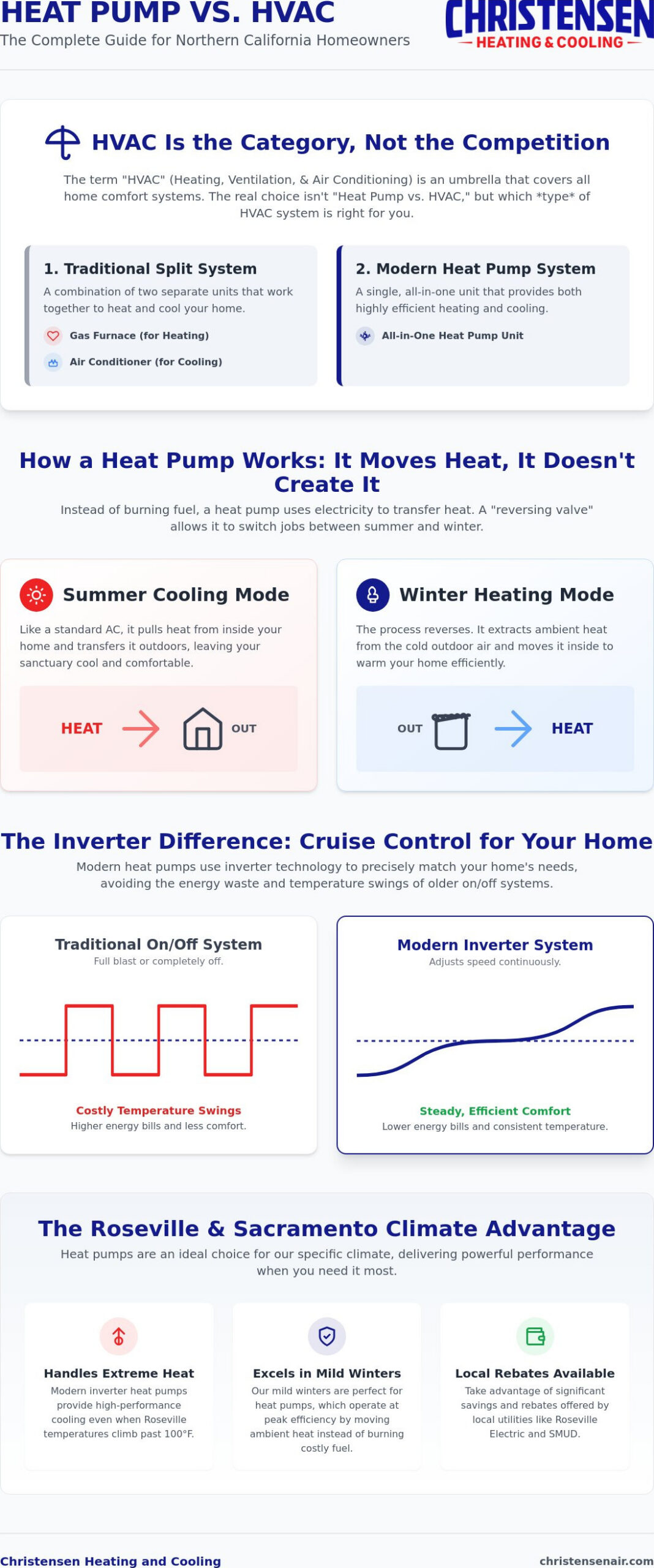
HVAC stands for Heating, Ventilation, and Air Conditioning. It’s the broad term we use to describe the systems that manage the air quality and temperature inside your home. A Heat pump is simply one type of equipment that falls under that big HVAC umbrella. It’s a versatile, all-in-one machine that handles both the “H” and the “AC” parts of the acronym. We often hear these terms used interchangeably because, for decades, the standard choice was a gas furnace and an AC unit. Today, choosing a heat pump isn’t moving away from HVAC; it’s choosing a more modern, streamlined way to achieve it.
To better understand this concept, watch this helpful video:
Understanding the HVAC Umbrella
In our local Roseville neighborhoods, most homes traditionally use a split system. This usually means a gas furnace tucked away in the attic or a closet for heating, paired with an air conditioning unit sitting outside for cooling. The ventilation is the “V” in the middle, which involves the ductwork and filtration that keeps your air fresh and moving. When people ask about heat pump vs hvac, they’re often actually asking if they should stick with that traditional two-part setup or switch to a single-unit heat pump. Every HVAC system includes three core components:
- Heating: Provided by a furnace or the heat pump’s heating cycle.
- Ventilation: The ducts and filters that clean and circulate air.
- Air Conditioning: The cooling process that removes humidity and heat.
What Makes a Heat Pump Unique?
The biggest difference lies in how the system creates comfort. Traditional furnaces burn fuel, like natural gas, to generate heat. In contrast, a heat pump uses electricity to move existing heat from one place to another. During a hot Sacramento summer, it pulls heat out of your house and dumps it outside. In the winter, it reverses the process, pulling warmth from the outdoor air and bringing it indoors. A heat pump acts as a heat transfer system rather than a heat generator. This all-in-one approach simplifies your home’s mechanical needs while often providing much higher efficiency than burning gas in our mild California winters.
How Heat Pumps Work: The Science of Heat Transfer
Understanding the science behind your home’s comfort shouldn’t feel like a physics exam. While the heat pump vs hvac debate often focuses on costs, the real magic happens inside a small but mighty component called the reversing valve. This valve is what allows a heat pump to change directions, acting as a high-performance air conditioner in the summer and an efficient heater in the winter. It’s the reason you don’t need two separate pieces of equipment to maintain your sanctuary year-round. We see this as a simpler, more elegant way to protect your family’s comfort.
The most significant advancement in modern home comfort is the introduction of inverter technology. Traditional systems operate like a light switch; they’re either “all on” at full blast or “all off.” This leads to those annoying temperature swings where you’re too hot one minute and too cold the next. Inverters act more like cruise control for your home. They speed up or slow down the compressor precisely to match your needs, keeping the temperature steady and your energy bills lower. We’ve put together a detailed look at what is an inverter heat pump and how does it work to help you understand why this is the new standard for Northern California homes.
Cooling Mode: Moving Heat Out
During a scorching Roseville afternoon, your system works in cooling mode. This process is identical to a traditional central air conditioner. Refrigerant circulates between an indoor evaporator coil and an outdoor condenser unit. The refrigerant absorbs the heat from your indoor air, carries it outside, and releases it into the environment. You can learn more about the technical details of How Heat Pumps Work through educational resources that explain this refrigerant cycle. It’s a proven, reliable method that we’ve used for decades to keep homes cool and dry.
Heating Mode: Moving Heat In
When the sun goes down and the Delta breeze brings a chill, the reversing valve flips. Instead of dumping heat outside, the system gathers warmth from the outdoor air to bring it inside. It might seem impossible to find heat in 40°F air, but modern systems are incredibly capable. In fact, many high-performance units can extract heat even when temperatures drop as low as 5°F. Because this process moves existing heat rather than burning gas, it’s a cleaner and safer way to keep your family cozy. If you’re curious about upgrading your current setup, our team provides expert Heat Pump Services tailored to our local climate, ensuring your home remains a reliable haven no matter the season.
Heat Pump vs. Traditional HVAC: A Performance Comparison
Choosing between a new system involves looking at how it performs under daily pressure. When we look at the heat pump vs hvac comparison, the biggest difference starts with the fuel source. A traditional split system relies on a combination of natural gas for the furnace and electricity for the air conditioner. An inverter heat pump runs entirely on electricity. This shift simplifies your home’s energy needs; you no longer have to worry about gas line safety or fluctuating fuel prices. It’s a cleaner approach that aligns with the way modern California homes are evolving.
Most well-maintained systems share a similar lifespan of about 15 years. However, because heat pumps often utilize variable-speed motors, they circulate air more consistently. This leads to better indoor air quality because your filters are constantly capturing dust and allergens rather than sitting idle between cycles. To make either system truly effective, we often recommend a duct system replacement if your current vents are older than 20 years. Leaky ducts can waste up to 30% of your conditioned air before it even reaches your living room, which puts unnecessary strain on your investment.
Efficiency Ratings: SEER2 and HSPF2
Efficiency isn’t just a technical buzzword; it’s the key to protecting your family’s budget. We measure cooling efficiency with SEER2 and heating with HSPF2. These updated 2026 standards help you compare how much comfort you get for every dollar spent on power. High-efficiency units often pay for themselves through energy savings within just a few years. Put simply, a higher rating equals lower monthly utility bills for your household. We take pride in helping you crunch these numbers so you can choose a system that fits your long-term financial goals.
Installation and Long-Term Costs
The upfront investment for a heat pump can sometimes be higher than a standard AC replacement, but remember that it replaces two separate units with one sophisticated machine. Long-term costs depend heavily on how you treat the equipment. Regular checkups through our Christensen Comfort Club ensure your system doesn’t have to work harder than necessary, which prevents early breakdowns. While we specialize in air-source units, some homeowners even look into geothermal heat pump technology for the ultimate in long-term stability. Our goal is to ensure your choice provides a reliable sanctuary for your family for many years to come.
Is a Heat Pump Right for the Roseville & Sacramento Climate?
Living in the Sacramento Valley means preparing for extremes. When the mercury hits 105°F in Roseville, your cooling system becomes your home’s most vital protector. Many of our neighbors hesitate when looking at the heat pump vs hvac debate because they fear an electric system will buckle under the pressure of a California summer. However, modern inverter systems are specifically designed to handle these long, hot spells without the constant cycling that wears down older equipment. Our mild winters actually make this technology even more effective; since we rarely see prolonged freezing temperatures, a heat pump operates at peak efficiency for nearly the entire year.
The move toward “All-Electric” living isn’t just a trend; it’s becoming the standard in Northern California. With the state planning to phase out the sale of new gas furnaces by 2030, many families in Rocklin and Citrus Heights are choosing to get ahead of the curve now. This transition helps you avoid future regulatory headaches while improving your home’s safety by removing gas combustion from the equation. We’ve seen a significant shift in local building codes that prioritize these high-efficiency electric solutions to meet California’s long-term carbon neutrality goals. For inspiration on how other regions are approaching this transition through integrated energy systems, you can learn more about Nature Carer Environmental Solutions and their insights on sustainable home upgrades.
Handling the Sacramento Heat
A common myth is that heat pumps only work in “moderate” climates. In reality, the high-efficiency inverter units we install thrive in our dry heat. They provide a steady, dehumidified stream of cool air that keeps your sanctuary comfortable even during a week-long heat wave. Proper sizing is critical for homes in Placer County to ensure the unit isn’t overworking. If your current system is struggling to keep up, you might need reliable AC repair in Roseville to bridge the gap while you evaluate your long-term replacement options.
Local Energy Rates and Rebates
Financial peace of mind is just as important as physical comfort. As of January 5, 2026, Roseville Electric offers a rebate of up to $2,500 for customers who switch from gas heating to an electric heat pump. For those in Sacramento County, SMUD provides rebates up to $2,400 for similar installations. Income-qualified households may even qualify for HEEHRA rebates of up to $8,000. These incentives make the switch much more accessible for homeowners in Granite Bay and Folsom. We can help you navigate these programs to ensure you’re getting every dollar you deserve. If you’re ready to see how these savings apply to your home, contact our friendly team today for a personalized evaluation.
Choosing Your System: The Christensen Approach
We believe that every home is a unique sanctuary, and there is no one-size-fits-all answer to the heat pump vs hvac debate. Deciding on the right configuration for your family isn’t about following a trend; it’s about finding the specific balance of efficiency and comfort that works for your lifestyle. Our process begins with a comprehensive home evaluation. We don’t just look at the old unit; we inspect your insulation levels, the integrity of your ductwork, and the exact square footage of your living space. This thorough approach ensures your new system is sized perfectly to handle a 105°F Roseville afternoon without wasting a drop of energy.
Professional installation is the most critical factor in how long your equipment will last. Even the most expensive high-efficiency unit will underperform if it isn’t calibrated correctly for your home’s specific airflow needs. We prioritize high-efficiency inverter technology because it offers the most consistent comfort for our Northern California climate. These systems don’t just turn on and off; they adjust their output in tiny increments to maintain the exact temperature you desire. This steady performance reduces wear and tear on the components, helping you avoid the stress of unexpected breakdowns during the peak of summer or the chill of winter.
Why Local Expertise Matters
As a family-owned and operated business since 2009, we’ve spent nearly two decades serving our neighbors in Placer and Sacramento counties. We treat your home with the same care and respect we’d give our own, focusing on honesty and long-term relationships rather than short-term sales. Our deep roots in the community mean we understand the local environmental factors that affect your equipment. Whether we’re providing residential ac repair in carmichael or installing a new system in Rocklin, our goal is to provide clear, informative guidance that puts your needs first. We take personal pride in every task, ensuring that our technical proficiency always supports your domestic comfort.
Your Path to Home Comfort
When you schedule a consultation with us, you can expect a partner who is dedicated to your long-term satisfaction. We’ll walk you through the differences between heat pump vs hvac traditional setups, explaining how each choice impacts your monthly utility bills and your home’s air quality. Once your system is in place, our Comfort Club maintenance plan provides the steady, dependable care needed to protect your investment for years to come. We handle the routine checkups and technical details so you can enjoy the peace of mind that comes with a reliable, efficient home. If you’re ready to find the perfect cooling and heating solution for your household, schedule your heat pump or HVAC consultation today and let our family take care of yours.
Investing in Your Home’s Long-Term Comfort
Deciding between a heat pump vs hvac traditional setup is a big step toward protecting your family’s sanctuary. We’ve looked at how modern inverter technology keeps you cool even when Roseville temperatures soar, and how moving heat is often much more efficient than burning gas. By taking advantage of local rebates from SMUD or Roseville Electric, you can make this transition while keeping your budget secure. It’s about more than just equipment; it’s about the peace of mind that comes with a reliable, all-in-one system.
Our family has been serving the Roseville and Sacramento communities since 2009. We specialize in high-efficiency inverter heat pumps and take pride in providing the neighborly care you deserve from a local, family-owned business. We don’t believe in high-pressure sales; we believe in building long-term relationships through honest advice and quality service. Ready for a more efficient home? Contact Christensen Heating and Cooling for a personalized HVAC consultation today. We look forward to helping you create the perfect environment for your household.
Frequently Asked Questions
Can a heat pump really replace my furnace and AC?
Yes, a heat pump is designed to replace both your furnace and air conditioner by providing year-round climate control in a single outdoor unit. It eliminates the need for a separate gas-burning appliance, simplifying your home’s mechanical systems. This all-in-one approach is the primary reason many of our neighbors weigh the benefits of a heat pump vs hvac traditional split systems.
How much more efficient is a heat pump compared to a traditional HVAC system?
Heat pumps are significantly more efficient because they transfer existing heat rather than creating it through combustion. While a high-efficiency gas furnace might reach 98% efficiency, a heat pump can achieve over 300% efficiency during a mild Sacramento winter. This means you receive three units of heat for every single unit of electricity the system consumes.
Do heat pumps work when it’s below freezing in Northern California?
Modern heat pumps are highly effective in freezing temperatures and can extract warmth from the outdoor air even when it drops to 5°F. Since Roseville rarely sees temperatures dip below the mid-20s, you don’t have to worry about losing comfort during our coldest nights. Inverter technology ensures the system maintains a steady flow of warmth without needing expensive backup heat strips.
What is the average lifespan of a heat pump in the Sacramento area?
The average lifespan of a well-maintained heat pump in our region is approximately 15 years. Because these units work year-round for both heating and cooling, regular professional care is essential to reach this milestone. Joining a program like our Comfort Club helps ensure your system stays in peak condition, protecting your investment from the wear and tear of our intense 100°F plus summers.
Are there tax credits or rebates for installing a heat pump in 2026?
Several local incentives remain available in 2026, even though the federal 25C tax credit expired on December 31, 2025. Roseville Electric provides rebates up to $2,500 for gas-to-electric conversions, and SMUD offers up to $2,400 for similar installations. Additionally, income-qualified households in California may access HEEHRA rebates of up to $8,000 to help cover the transition to a high-efficiency system.
Is a heat pump louder than a traditional air conditioner?
No, a modern inverter heat pump is typically quieter than a traditional air conditioner. Because the inverter allows the compressor to ramp up and down gradually, you won’t hear the loud “clunk” and roar associated with older systems starting at full power. Most of the time, the unit runs at a lower, whisper-quiet speed that maintains your home’s sanctuary without the noise.
How do I know if my current home’s ductwork can handle a heat pump?
We determine compatibility by performing a static pressure test and a visual inspection of your entire ventilation system. Heat pumps often require more precise airflow than older furnaces, so we look for leaks, undersized vents, or restricted sections that might hinder performance. If your ducts are over 20 years old, we may suggest a duct system replacement to ensure your new unit operates at peak efficiency.
What happens if a heat pump breaks down—is it harder to repair?
Repairing a heat pump isn’t harder, but it does require a technician with specialized training in refrigerant cycles and inverter electronics. Our team specializes in the technical differences of a heat pump vs hvac traditional repairs, so we’re well-equipped to handle any issue that arises. We focus on getting your system back online quickly to restore the comfort and safety of your household.