






Your furnace probably isn’t the reason your back bedroom feels like an icebox. It’s incredibly frustrating to crank up the thermostat only to watch your heating bill climb while you’re still shivering under three blankets. We know that feeling of dread when you walk from a cozy living room into a master suite that feels ten degrees colder. You’ve likely spent nights wondering why is one room colder than the rest in winter, especially when the rest of the house feels just fine. In our experience serving the Roseville area, we’ve found that these “dead zones” are rarely about the heater itself and more about how heat is delivered or lost before it reaches you.
We’re here to help you reclaim your home’s sanctuary. This guide will help you discover the exact reasons specific rooms stay chilly and provide the professional steps needed to achieve balanced, cozy warmth in every corner. We’ll preview simple troubleshooting steps, explain how updated 2026 insulation standards affect your comfort, and help you determine if the fix is a quick adjustment or requires a professional duct system replacement to ensure your family’s well-being all season long.
Key Takeaways
- Learn to identify the “cold room” threshold and how simple obstructions like furniture or heavy drapes can block essential airflow.
- Uncover the hidden ductwork issues that explain why is one room colder than the rest in winter, including how leaks in the attic can waste up to 30% of your heated air.
- Understand how your home’s “thermal envelope,” such as north-facing walls or corner room exposure, impacts heat retention in Roseville homes.
- Explore how HVAC performance issues, like short cycling or improper system sizing, prevent warmth from reaching the furthest rooms in your house.
- Discover professional solutions like air balancing and zoning systems that provide targeted comfort and help lower your monthly energy consumption.
Why is One Room Colder? Common Culprits and Quick Checks
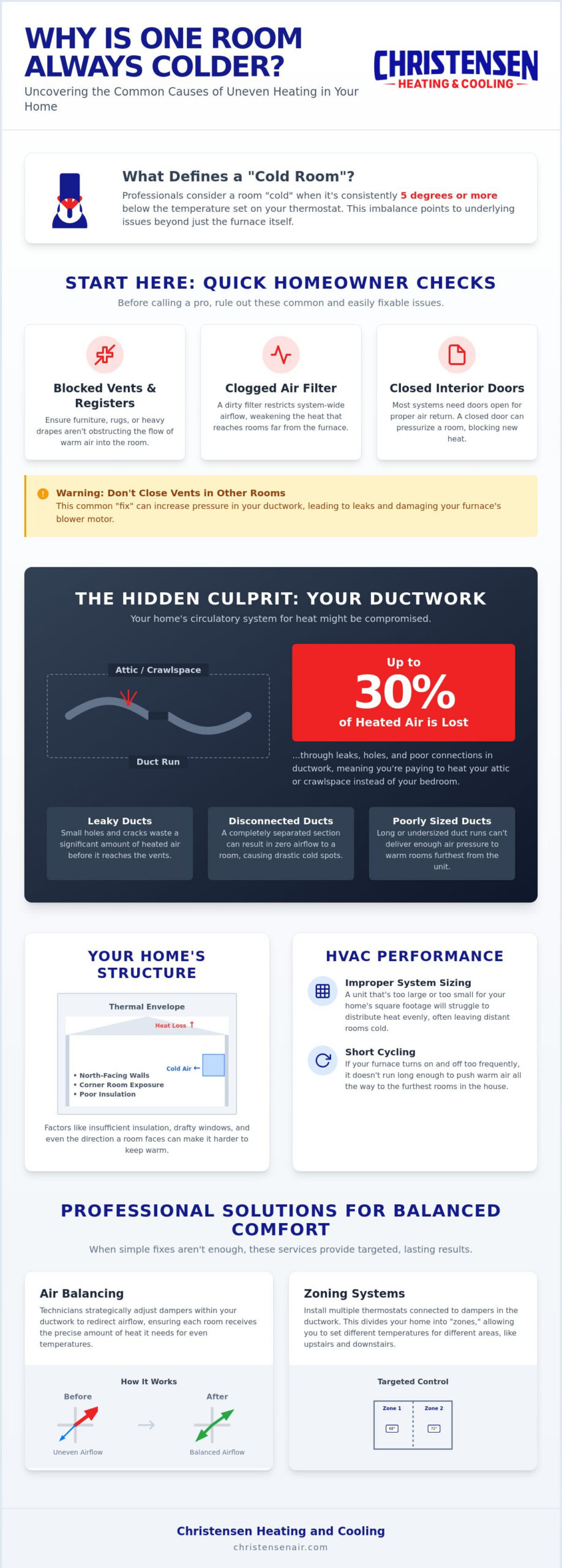
When we visit homes in Roseville, we often find that “cold” is a relative term. To provide a professional baseline, we define a cold room as any space that stays consistently five degrees or more below the temperature set on your thermostat. If you’ve spent the last few weeks asking why is one room colder than the rest in winter, you aren’t alone. Achieving true thermal comfort requires a delicate balance of airflow, insulation, and mechanical precision. Before assuming your furnace is failing, we recommend starting with a few simple observations to see if the heat is simply being blocked from entering the space.
To better understand why these temperature imbalances happen, watch this helpful video from our industry peers:
The most common culprit is often the simplest: restricted airflow. We frequently see supply vents tucked behind heavy drapes or blocked by large sectional sofas. If the warm air can’t circulate, the room will never reach the target temperature. Similarly, a clogged air filter acts like a wall for your HVAC system. It reduces the “push” your blower motor provides, meaning the rooms furthest from the furnace receive the weakest stream of air. We suggest checking your filter every 30 days during peak winter months to ensure your system can breathe freely.
Many homeowners try to solve this by closing vents in “warm” rooms, thinking it will force more air into the cold one. We strongly advise against this. Your HVAC system is designed to move a specific volume of air. Closing vents increases the internal pressure within your ductwork, which can lead to leaks and significant stress on your blower motor. Instead of fixing the cold room, you might end up with a costly repair bill for a burnt-out motor.
The Quick Homeowner Walkthrough
Start by feeling for “ghost” drafts. Run your hand along window frames and electrical outlets on exterior walls; even a small gap can let in enough Placer County chill to drop the temperature. Check your thermostat’s location too. If it’s located in a sun-drenched hallway or near a kitchen, it may shut off the furnace before the back bedrooms have a chance to warm up. Finally, keep your interior doors open. Most homes rely on the gap under the door to return air to the furnace. If the door is shut tight, the “loop” is broken, and the room becomes a pressurized box that resists incoming heat.
Understanding Airflow Basics
Your heating system works on a continuous loop. It pulls cold air in, warms it up, and pushes it back out. If the return air grilles are blocked or undersized, the system can’t pull enough air in to push a strong supply back out. This balance is critical for maintaining even pressure throughout the house. Static pressure is the measurement of resistance your blower motor must overcome to move air through the ducts; if this resistance is too high, the furthest rooms in your home will always be the first to lose their warmth.
Airflow and Ductwork: The Hidden Reasons for Uneven Heating
While checking your vents is a great first step, the real reason why is one room colder than the rest in winter often hides behind your drywall or up in the attic. Your ductwork acts as the circulatory system for your home. If that system is compromised, even the most powerful furnace can’t deliver warmth where it’s needed most. In many Roseville homes, we find that leaky ducts are the primary culprit. Industry data indicates that up to 30% of conditioned air escapes through holes and cracks before it ever reaches a register. This means you’re effectively paying to heat your attic while your bedroom stays chilly.
Sometimes the issue is more than just a small leak. We occasionally find completely disconnected ducts where a section has slipped off its mounting. If a room feels like it has zero airflow, this is usually why. Additionally, the “duct run” itself plays a major role. The furthest room from your furnace naturally receives less air pressure. If the ductwork is undersized, which we often see in older local builds, the air loses its velocity and heat long before it reaches the end of the line. This physical distance creates a struggle for your HVAC system that no amount of thermostat cranking can fix.
Signs Your Ducts are Failing Your Comfort
You don’t always need to climb into the attic to spot trouble. Listen for whistling or rattling sounds when your heater kicks on; these are clear indicators of air escaping through narrow gaps. You might also notice that the cold room is significantly dustier than the rest of the house. This happens because leaky return ducts pull in fiberglass particles and dust from the crawlspace or attic. If you do peek upstairs, look for “dark” spots on your insulation. This isn’t just dirt. It’s a sign that your insulation is acting as a filter for leaking air from your ducts.
The Permanent Fix: Duct System Replacement
For many households, a duct system replacement in Roseville is the only way to eliminate “dead zones” for good. Modern ductwork is engineered for better airflow and sealed to meet current 2026 energy standards. Beyond fixing the temperature, a professional replacement improves your indoor air quality and makes your home much quieter. If you’re tired of uneven temperatures, we can perform a thorough inspection to see if your system is a candidate for an upgrade. You can contact our team to schedule a diagnostic visit and start planning for a more balanced, comfortable home.
The Thermal Envelope: How Your Home’s Structure Fights the Furnace
Sometimes the mechanical system isn’t the only culprit. If you’ve addressed the vents and checked the filters but still wonder why is one room colder than the rest in winter, the building itself might be the problem. We call this the thermal envelope. In Placer County, north-facing rooms are notorious for being chilly because they never see direct sunlight. While south-facing rooms get a natural boost from solar gain, those on the north side rely entirely on your furnace to maintain warmth. Without that extra help from the sun, these rooms can feel like they belong to a completely different house.
Then there’s the “Corner Room Curse.” If a bedroom has two or three exterior walls, it has much more surface area exposed to the elements. This creates a massive heat sink where warmth is constantly pulled away from the interior. In older neighborhoods across Sacramento or Citrus Heights, we often find that wall insulation has settled over the decades. This leaves empty pockets at the top of the wall where heat escapes freely. When you combine settled insulation with original single-pane windows or worn-out weatherstripping, you’re essentially fighting a losing battle against the outdoor air. These structural flaws act as a drain on your comfort, making it nearly impossible for a standard heating cycle to keep up.
The ‘Stack Effect’ in Two-Story Homes
Local Climate Factors for Roseville & Rocklin
Our local weather plays a unique role in your home’s comfort. The damp, heavy Tule fog that settles over the Sacramento Valley makes a 45-degree morning feel much more piercing than a dry cold would. During our specific winter wind patterns, micro-drafts become aggressive. These winds find every imperfection in your home’s seal, from window tracks to door sweeps. A quick, neighborly tip: try using heavy cellular shades in your coldest rooms. They create a pocket of air that acts as a buffer, trapping heat inside those exposed rooms before it hits the cold glass and dissipates.
HVAC System Performance: When Your Heater Can’t Keep Up
If your home’s structure is solid and your ducts are sealed, the issue might lie within the furnace itself. We often find that mechanical limitations are the reason why is one room colder than the rest in winter. Traditional furnaces operate on a simple “on or off” basis. They blast hot air at full capacity until the thermostat in your hallway reaches the target temperature, then they shut down completely. This sudden stop often happens before the warm air has a chance to reach the furthest corners of your home, leaving distant bedrooms feeling neglected.
System sizing is another critical factor. You might think a larger furnace would solve the problem, but an oversized unit actually makes it worse. This leads to “short cycling,” where the heater warms the area around the thermostat so quickly that it turns off almost immediately. The result is a home full of hot and cold spots. Proper maintenance calibration is essential here. During a professional tune-up, we ensure your blower motor is pushing air at its peak designed capacity. If the motor is sluggish, it won’t have the strength to force heat into those stubborn cold rooms.
Furnaces vs. Inverter Heat Pumps
For families looking for a permanent solution to uneven heating, understanding what is an inverter heat pump can be a game changer. Unlike traditional furnaces that blast air, inverter technology uses variable speeds to provide a steady, gentle whisper of heat. This constant movement ensures that air is always circulating, which prevents cold pockets from forming. These systems also manage humidity much better than old furnaces. When the air has the right moisture level, it actually feels warmer on your skin, allowing you to stay cozy without cranking the thermostat to the max.
Thermostat and Sensor Placement
Your thermostat might be lying to you. If it’s located in a central, warm hallway, it doesn’t know your master bedroom is freezing. We often recommend adding remote sensors to those problematic rooms. These sensors talk to your main thermostat and tell the system to keep running until the cold room is actually comfortable. In some cases, moving the thermostat to a more representative location is a simpler fix than replacing equipment. Smart thermostats can even be programmed to prioritize the bedrooms at night and the living areas during the day, ensuring the heat is always where you need it most.
If you’re tired of shivering in your own home, our team can help you find the right mechanical solution. We invite you to schedule a furnace repair or performance assessment with our experts to get your system back in balance.
Professional Solutions for Balanced Comfort in Roseville Homes
When simple fixes like changing filters or moving furniture don’t solve the problem, it’s time to look at professional mechanical adjustments. If you’ve tried the DIY tips and still find yourself asking why is one room colder than the rest in winter, it’s often because your system needs air balancing. This is a technical process where we use specialized tools to measure the cubic feet per minute (CFM) of air coming out of every vent. By adjusting the internal dampers within your ductwork, we can “choke” the airflow to rooms that get too much heat and redirect that energy to your coldest spaces. It’s a precision task that transforms a drafty house into a balanced sanctuary.
For larger homes in Rocklin or Folsom, a zoning system might be the most effective answer. Zoning involves installing motorized dampers and multiple thermostats that allow you to control different areas of your home independently. This means your chilly master bedroom can call for heat without overheating the rest of the house. If the problem room is a unique space, such as a converted garage or a finished attic office, we often recommend ductless mini-split installations. These systems provide dedicated heating and cooling to a single room, bypassing the main ductwork entirely to ensure perfect comfort regardless of what the rest of the house is doing.
We also encourage our neighbors to join the Comfort Club Maintenance Plan. Regular calibration ensures your blower motor and heat exchanger are working in harmony before the first Sacramento frost arrives. A well-tuned system has the “push” necessary to reach those distant rooms, saving you from high energy bills caused by a struggling furnace. Our team takes personal pride in these fine-tuned adjustments because we know that a balanced home is a happy, healthy home.
The Christensen ‘Neighborly Care’ Diagnostic
Our approach to your home goes far beyond just checking if the heater turns on. We evaluate what is HVAC health from a holistic perspective, looking at everything from duct integrity to equipment efficiency. As a family-owned business, we treat your household with the same care we would our own. We don’t believe in high-pressure sales; instead, we focus on clear, informative guidance that helps you understand exactly how your air moves. This regional expertise allows us to troubleshoot complex airflow issues that larger, impersonal corporations might overlook.
Next Steps for a Warmer Winter
Don’t spend another season shivering in your favorite room. Booking a professional airflow audit is the first step toward a more comfortable and efficient home. We’ve found that learning how to make my HVAC system last longer almost always starts with fixing these small imbalances today. When your system doesn’t have to fight against itself to heat a “dead zone,” it runs smoother and lasts years longer. If you’re ready to achieve balanced, cozy warmth everywhere in your house, reach out to Christensen Heating and Cooling for a neighborly consultation.
Reclaim Your Home’s Total Comfort This Winter
You shouldn’t have to shiver in your own bedroom while the rest of the house stays warm. We’ve looked at the technical and structural reasons why is one room colder than the rest in winter, from leaky ductwork in the attic to the lack of solar gain in north-facing rooms. Fixing these imbalances doesn’t just improve your sleep; it lowers your energy consumption and protects your heating system from unnecessary wear. When your air flows correctly, your furnace doesn’t have to work nearly as hard to keep you cozy.
As a team that is family-owned and operated by the Christensen family, we’ve specialized in Roseville microclimates since 2009. We know exactly how our local valley weather and specific home builds impact your daily comfort. Our Comfort Club members receive priority winter service, which gives them peace of mind and steady performance even when the first frost hits. If you’re ready to stop guessing and start feeling the warmth in every corner of your home, we’re here to help with professional, neighborly guidance.
Schedule your Winter Comfort Audit with Christensen Heating and Cooling today!
We look forward to helping you make every room in your house a true sanctuary this season.
Frequently Asked Questions
Why is my bedroom colder than the rest of the house in winter?
Your bedroom is likely colder because it sits at the end of a long duct run or has more exterior wall exposure than other spaces. When a room is far from the furnace, the air loses velocity and heat before it reaches the vent. We also find that many Roseville master suites have large windows that lose heat faster than the rest of the house, creating a noticeable temperature drop.
Will closing vents in other rooms help heat one cold room?
Closing vents in other rooms is a common mistake that we don’t recommend for our neighbors. Your HVAC system is designed to move a specific volume of air; closing registers increases internal pressure and can lead to blower motor failure or duct leaks. It is much better to keep all vents open to maintain the system’s intended balance and protect your equipment from unnecessary stress.
Can a smart thermostat fix a cold room?
A smart thermostat can help if you use it with remote room sensors. These sensors talk to the main unit and tell the system to keep running until that specific cold room reaches the target temperature. This is a great way to prioritize comfort in a bedroom at night without manually adjusting the main thermostat every few hours, though it doesn’t fix underlying duct issues.
Is it normal for a corner room to be colder than other rooms?
Yes, it is very common for corner rooms to be colder because they have two or three walls exposed to the outside elements. This increased surface area allows heat to escape much faster than in a room with only one exterior wall. This structural reality is often why is one room colder than the rest in winter even when your furnace is working at peak capacity.
How much does it cost to fix uneven heating in a home?
The cost to fix uneven heating depends entirely on the root cause of the imbalance. A simple fix like a professional air balancing or a thermostat calibration is a minor service call. More extensive solutions, such as a professional duct system replacement, are larger investments that provide long term energy savings and total home comfort. We provide clear, honest assessments to help you decide which path fits your budget.
Does dirty ductwork make a room colder?
Dirty ductwork doesn’t usually make a room colder, but leaky or disconnected ducts definitely do. If your ducts have gaps, a significant portion of your heated air can escape into the attic before it reaches you. We focus on the integrity and seal of the duct system to ensure every bit of heat you pay for actually reaches your living space instead of being wasted.
What is ‘air balancing’ and do I need it?
Air balancing is the process of adjusting the internal dampers in your ductwork to ensure every room receives the right amount of air. You might need it if some rooms are sweltering while others stay freezing. We use specialized tools to measure airflow at each vent and make precise adjustments so your whole home feels consistent and comfortable throughout the Sacramento winter.
Could my furnace be too small for my house?
While an undersized furnace can struggle, we often find that “oversized” units are the real problem behind why is one room colder than the rest in winter. An oversized unit heats the area near the thermostat too quickly and shuts off before the warm air reaches distant rooms. We can perform a load calculation to verify if your equipment is correctly sized for your home’s square footage.