






What if that unsettling grinding sound coming from your backyard isn’t just your AC “getting old,” but a signal that your home’s sanctuary is at risk? We understand the anxiety that comes with a struggling cooling system, especially when you’re trying to figure out how to know if your AC compressor is bad without being sold a system you don’t actually need. It’s frustrating to watch your energy bills climb while your Roseville home stays uncomfortably warm, and we believe you deserve honest, clear answers about the heart of your HVAC unit.
Our team is here to provide the same expert guidance we’d give our own neighbors. We’ll help you identify the specific warning signs of a failing compressor and help you weigh the cost-benefit of a repair versus a full replacement before the Sacramento summer heat hits its peak. This 2026 checklist covers everything from diagnostic red flags to how the latest Title 24 standards and new A2L refrigerants like R-454B impact your home’s long-term comfort and safety.
Key Takeaways
- Identify the specific auditory and performance cues, such as metallic clunking or warm air, to help you determine how to know if your AC compressor is bad before a total breakdown occurs.
- Understand how unique Northern California challenges, like triple-digit Roseville heat and wildfire ash, put extra strain on your system’s vital components.
- Master the “50% Rule” to decide whether a repair or a full replacement is the most financially sound choice for your home’s long-term comfort.
- Discover how professional diagnostic tools, such as megohmmeter tests, provide a definitive look at your motor’s health to ensure you aren’t replacing parts unnecessarily.
- Learn how proactive maintenance and regular cleaning can extend the life of your compressor and prevent the stress of emergency summer repairs.
The Heart of Your Home: Understanding the AC Compressor’s Role
We often call the AC compressor the “engine” of your cooling system because it does the heavy lifting. It’s the most vital component in your outdoor unit. Understanding its role is the first step in learning how to know if your AC compressor is bad before a heat wave turns your living room into a sauna. Without a functioning compressor, your air conditioner is just a very expensive fan blowing warm air around your house.
Basically, the compressor is a high-powered pump. It takes low-pressure refrigerant gas from your indoor coils and squeezes it into a high-pressure, hot liquid. This physical transformation allows the system to dump heat outside and cycle cold air back into your rooms. For a deeper dive into the mechanics of these machines, you can read more about What is an AC Compressor and how it functions within larger mechanical systems. In Roseville, our systems face unique pressure. While coastal homes enjoy mild breezes, our units must fight through 100-degree heat waves that force the compressor to run at maximum capacity for hours. This constant strain makes it the “big ticket” item in your HVAC system. It is often the single most expensive part to replace because of the precision engineering required to handle those pressures.
To better understand this concept and see what these components look like in action, watch this helpful video:
Where is Your Compressor Located?
When you look at the large metal box in your side yard, you’re looking at the condenser unit. The compressor lives deep inside this cabinet, usually tucked underneath the large fan you see spinning at the top. It’s important to distinguish between the two. The fan pulls air across the coils to cool the refrigerant, while the compressor actually moves that refrigerant through the lines. We always remind our neighbors to keep at least two feet of clear space around this unit. Proper location and airflow are critical for heat dissipation. If the unit is crowded by shrubs or fences, the compressor will overheat and fail much faster than it should.
How a Healthy Compressor Should Sound and Behave
Learning how to know if your AC compressor is bad often starts with your ears. A healthy unit should start with a single, firm click followed by a steady, low-pitched hum. You shouldn’t hear any rattling, shrieking, or repeated clicking sounds when the thermostat calls for cooling. The compressor is the pump that moves heat out of your Roseville home. If you notice a “startup struggle” where the lights in your house flicker or the unit hums loudly without the fan spinning, the motor is likely under immense stress. Knowing these baseline behaviors helps you spot trouble early, potentially saving the system before a small electrical issue turns into a total mechanical breakdown.
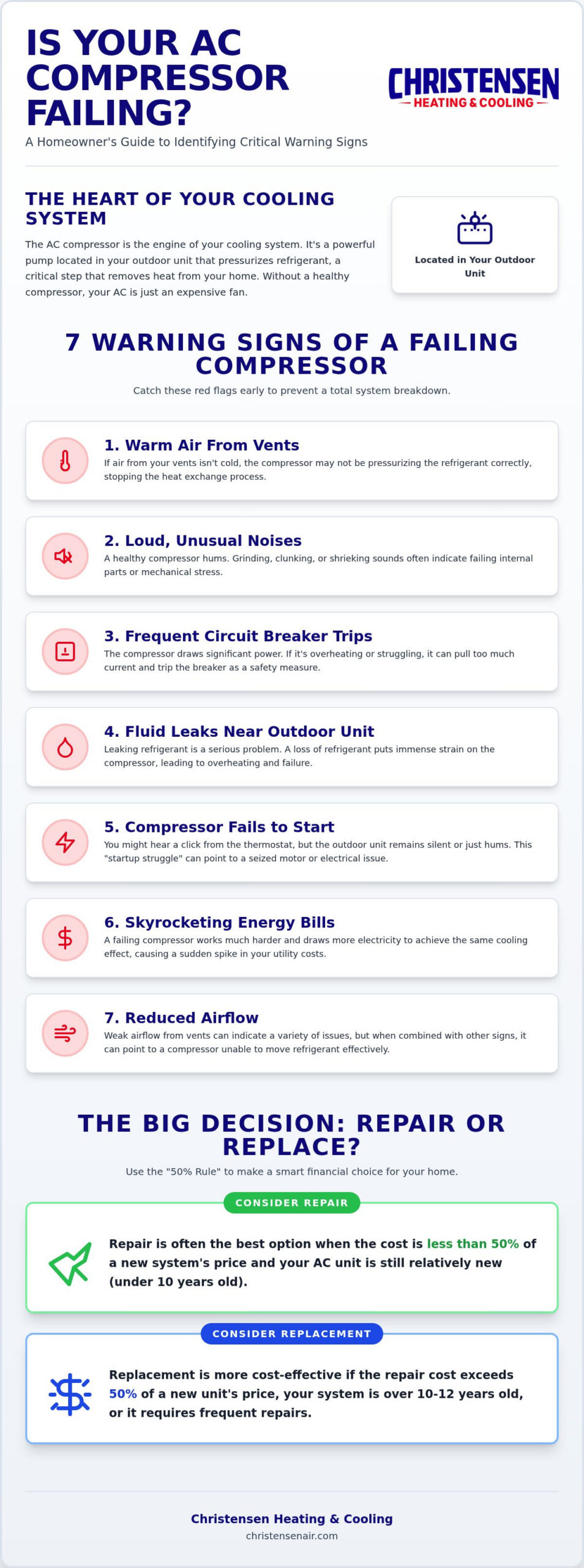
7 Warning Signs Your AC Compressor Is Failing: The Homeowner Checklist
We know how stressful it is when your home starts warming up during a Placer County heatwave. While many HVAC issues are simple fixes, the compressor is a more serious concern that requires a watchful eye. Understanding how to know if your AC compressor is bad allows you to act quickly before small issues lead to total system failure. Since the compressor is responsible for moving refrigerant, any dip in its performance will immediately impact your family’s comfort.
One of the most common signs is warm air blowing through your vents even when the thermostat is set to “cool.” If the compressor isn’t pressurizing the refrigerant, the heat exchange process simply stops. You might also notice your electricity bills skyrocketing. In 2026, with the transition to higher efficiency standards like 14.3 SEER2, a struggling compressor will draw significantly more power as it fights to maintain temperature, leading to a noticeable spike in your Sacramento utility costs. If you notice these symptoms, it’s often best to schedule an ac-repair-roseville diagnostic to prevent further damage.
Listen for loud, metallic banging or clunking noises coming from the outdoor unit. These sounds often indicate that internal components have come loose or that the motor mount is failing. If you notice the unit stutters or shakes when the cooling cycle begins, this “hard starting” is a major red flag. If your circuit breaker trips repeatedly when the AC tries to turn on, the compressor is likely overdrawing current. This is a safety risk that indicates the motor is struggling to turn.
Visual and Auditory Red Flags
Walk outside and look at the base of your unit. Any oily puddles or refrigerant leaks are signs of trouble. With the phase-out of R-410A, leaks in older systems are becoming more expensive to manage because the cost of older refrigerants is rising. You might also hear a high-pitched “screaming” or whistling sound. This usually points to a high-pressure internal valve failure. While you can check for charred or burnt wiring at the contactor yourself, we recommend letting a professional handle the electrical testing to ensure your sanctuary remains safe.
Performance-Based Indicators
Short cycling is another subtle warning. This happens when the compressor overheats and its internal safety switch shuts it down before the house reaches the desired temperature. Eventually, you may encounter a “dead” compressor scenario. This is when the outdoor fan spins normally, but you don’t hear the hum of the compressor or feel any cold air inside. Learning how to know if your AC compressor is bad involves recognizing these performance gaps before the unit stops working entirely. We are always here to help you evaluate these signs and restore your home’s peace and quiet.
Why Compressors Fail: Local Factors in Northern California
While mechanical wear is inevitable, our local environment in the Sacramento Valley presents specific challenges that can cut a compressor’s life short. We see it every summer in Rocklin and Loomis. When temperatures hit triple digits, the oil inside your compressor can thin out, losing its ability to lubricate the moving parts effectively. This leads to increased friction and heat, which eventually burns out the motor windings. Understanding these environmental stressors is a key part of how to know if your AC compressor is bad or simply struggling against the elements.
Wildfire smoke and ash are also significant, yet often overlooked, factors in our region. Ash is incredibly fine and often acidic. When it settles on your outdoor unit, it creates a sticky film that traps heat and restricts airflow. This forces the compressor to work much harder to achieve the same cooling effect. We also deal with electrical surges during peak summer demand. As everyone in Sacramento turns on their AC at once, the grid can experience voltage fluctuations. These “brownouts” or surges put immense stress on the compressor’s electrical components, often leading to a sudden failure that might have been avoided with better protection.
Liquid “slugging” is another silent killer we frequently diagnose. This happens when liquid refrigerant, rather than gas, enters the compressor. Since liquids don’t compress, this can instantly shatter the internal valves. It’s often caused by something as simple as a dirty air filter or an overcharged system, making regular checkups vital for protecting your home’s sanctuary.
The Danger of Dirty Condenser Coils
In Roseville, agricultural dust and pollen act as an insulator when they coat your condenser coils. This layer of grime prevents the heat from escaping the refrigerant. A 10-degree rise in outdoor temperature exponentially increases compressor head pressure. When your coils are dirty, that pressure stays trapped, forcing the compressor to run at dangerously high temperatures. This constant overheating is the primary reason for premature mechanical failure in our area.
Electrical Issues and Capacitor Failure
Sometimes, what looks like a terminal mechanical failure is actually a simple electrical part. A bad capacitor is often mistaken for a bad compressor because both can cause the unit to hum without starting. Our Comfort Club maintenance plan is designed to catch these weak capacitors before they fail and take the compressor with them. If you want to keep your system running through the hottest months, check out our guide on how to make my HVAC system last longer for more regional prevention tips. Knowing how to know if your AC compressor is bad often starts with ruling out these smaller, more affordable electrical issues first.
The Crossroads: Repairing vs. Replacing Your Compressor
Deciding whether to sink money into an old unit or invest in a new one is the most common dilemma we help our neighbors solve. We use a simple guideline called the 50% Rule. If the cost of the repair exceeds half the value of a brand-new unit, we generally recommend a replacement. This is especially true when you are trying to figure out how to know if your AC compressor is bad and realize the mechanical failure is terminal. Since the compressor is the most expensive component in your outdoor unit, paying for a replacement part on a system that is already out of warranty often doesn’t make long-term financial sense.
Age is the next big factor. If you have a 10-year-old system in Folsom, it has survived a decade of brutal Sacramento summers. At this point, the metal is fatigued and the internal seals are often brittle. The 2025 Building Energy Efficiency Standards (Title 24), which took full effect on January 1, 2026, mean any new installation must meet higher efficiency benchmarks. While older units might be 10 or 14 SEER, the current California standard is 14.3 SEER2. This shift translates to immediate monthly savings on your utility bills that a simple repair just can’t provide. Refrigerant transitions also play a role. If your system still uses R-22, which was phased out years ago, or even R-410A, which is currently becoming more expensive, a modern system using A2L refrigerants like R-454B is a much more sustainable choice.
When a Repair Makes Sense
We will always look for the most honest, cost-effective solution for your home. If your unit is still under its manufacturer warranty, a repair is almost always the right call. We also find that many symptoms of a failing system are actually caused by a failed capacitor or contactor. These are minor electrical parts that we can swap out quickly to restore your comfort. If the rest of your system, including the furnace and ductwork, is in excellent shape, a targeted repair can give your AC several more years of reliable life.
The Case for System Replacement
Sometimes, replacing the entire unit is the only way to protect your sanctuary and stop the “domino effect” of old parts failing one after another. Many of our clients are choosing to upgrade and learn what is an inverter heat pump and how does it work. These systems provide incredibly precise temperature control and are much quieter than traditional units. You can also take this opportunity to improve your indoor air quality by integrating UV light installations to combat wildfire smoke and allergens. If you are ready to explore your options, we invite you to contact our team for an honest evaluation of your system’s health.
Christensen’s Professional Diagnostic: Restoring Your Home’s Comfort
While the homeowner checklist is a great starting point for how to know if your AC compressor is bad, a professional diagnostic provides the certainty you need before making a major financial decision. We understand that a failing AC is a major source of stress, especially when the forecast shows a week of triple-digit temperatures. Our goal is to provide immediate reassurance and restore your sanctuary as quickly as possible. We don’t just look at the outdoor unit; we evaluate how your entire system is interacting with your home’s unique environment.
We use advanced tools to peek inside the sealed mechanical system without performing invasive or unnecessary work. Our technicians test the electrical resistance of the compressor windings to ensure they haven’t burned out or developed an internal short to ground. A key part of our high-level diagnostic is the megohmmeter test. This specialized tool checks the motor’s internal insulation health. If the insulation is breaking down, the compressor is likely failing. This data-driven approach ensures we aren’t just treating symptoms, but finding the root cause of your cooling struggles so you don’t spend money on parts you don’t need.
As a family-owned business since 2009, we prioritize honesty over high-pressure sales tactics. When we finish our inspection, we’ll sit down with you and explain our findings in plain English. We’ll show you the actual readings from our tools and help you apply the 50% Rule we discussed in the previous section. You’ll know exactly what’s happening with your system and what your best options are for long-term reliability and energy efficiency. We treat every home with the same care we would apply to our own, focusing on your family’s safety and well-being.
The Comfort Club Advantage
We highly recommend our Comfort Club Maintenance Plan as your first line of defense against unexpected breakdowns. Members receive priority service when the Sacramento Valley heat is at its worst, ensuring you aren’t left waiting in a hot house. More importantly, our annual cleanings prevent the dust and ash buildup that causes compressors to overheat and fail in the first place. It’s the easiest way to ensure your system is Roseville-ready every single year and gives you peace of mind that your home’s comfort is protected by experts who care.
Contact Your Local Roseville HVAC Experts
From Sacramento to Placerville, we take personal pride in every task we perform for our neighbors. Whether you need a simple capacitor swap or a full system upgrade to a modern inverter heat pump, we are here to provide the reliable service you deserve. We believe in building long-term relationships through transparency and professional excellence. Schedule your AC diagnostic with Christensen Heating and Cooling today and let our family help yours stay cool and comfortable all summer long.
Secure Your Home’s Cooling Before the Next Heat Wave
Your home should be a sanctuary from the intense Sacramento Valley sun. Understanding the warning signs is the first step in protecting that comfort. We’ve explored the sounds, performance drops, and financial logic that help you determine how to know if your AC compressor is bad. Whether your unit is struggling with regional dust or just showing its age, you don’t have to face these technical decisions alone.
Since 2009, our family-owned team has specialized in high-efficiency inverter systems and reliable repairs for our neighbors across Roseville, Rocklin, and the greater Sacramento area. We are committed to providing the honest guidance you need to choose between a targeted fix or a modern, efficient upgrade. Our technicians take personal pride in every task, treating your environment with the same care they would apply to their own. We believe in building long-term relationships based on trust and dependable service.
Let’s work together to restore your home’s peace and keep your family cool all season long.
Frequently Asked Questions
How much does it cost to replace an AC compressor in Roseville?
The total cost depends on the unit’s size, the type of refrigerant it uses, and current labor rates in Placer County. Industry data for California suggests that out-of-warranty replacements typically range between $1,200 and $3,500. Factors like the transition to R-454B and the rising cost of phased-out R-410A also impact the final total. We always provide a clear, written estimate after a diagnostic visit to your home.
Can I run my AC with a bad compressor?
You should turn off your system immediately if you suspect the compressor is failing. Running a damaged unit can lead to expensive “domino effect” repairs, such as burning out the outdoor fan motor or causing an electrical short. In some cases, a seized compressor can even cause your circuit breaker to trip repeatedly, which creates a safety hazard for your home’s electrical panel and sanctuary.
What does a dying AC compressor sound like?
A failing unit often produces loud grinding, clunking, or high-pitched “screaming” noises. These sounds indicate that internal mechanical parts are loose or that valves have failed. If you’re trying to figure out how to know if your AC compressor is bad, listen for a heavy humming sound followed by a thud. This often means the motor is trying to start but is mechanically stuck or “seized.”
Is it worth replacing a compressor on a 12-year-old unit?
It is generally more cost-effective to replace the entire system once it passes the 10-year mark in our climate. By 12 years, the evaporator coils and other components are also nearing the end of their lifespan. Investing in a new 14.3 SEER2 system ensures you’re compliant with 2026 Title 24 standards and provides much higher energy efficiency than a decade-old model struggling with Sacramento heat.
Will a bad capacitor cause a compressor to fail?
A weak or “blown” capacitor is a leading cause of premature compressor failure. The capacitor provides the electrical “jolt” needed to start the motor. When it fails, the compressor may hum and overheat as it struggles to turn. This repetitive stress eventually burns out the internal windings. We check these small electrical parts during every Comfort Club visit to prevent this exact issue from happening.
How long does an AC compressor typically last in Northern California?
Most compressors in the Roseville and Sacramento area last between 10 and 15 years. Our local heat waves and occasional wildfire smoke put more strain on these units than in cooler coastal regions. Regular maintenance, such as cleaning the condenser coils and checking refrigerant levels, is the best way to ensure your system reaches the upper end of that lifespan despite our challenging valley environment.
Can a dirty air filter cause compressor failure?
Yes, a clogged air filter can lead to a terminal failure known as “liquid slugging.” When airflow is restricted, the refrigerant doesn’t evaporate properly and enters the compressor as a liquid. Since liquids don’t compress, this can instantly shatter the internal mechanical components. We recommend changing your filters every 1 to 3 months to protect the heart of your HVAC system and maintain your home’s comfort.
What is the warranty on a typical replacement compressor?
Most manufacturers provide a 5 to 10-year limited warranty on the compressor part itself, while labor warranties vary by contractor. It’s important to keep up with annual professional maintenance to keep these warranties valid. If your current unit is still under its original 10-year parts warranty, a repair is often the most sensible path for how to know if your AC compressor is bad and what to do next.