





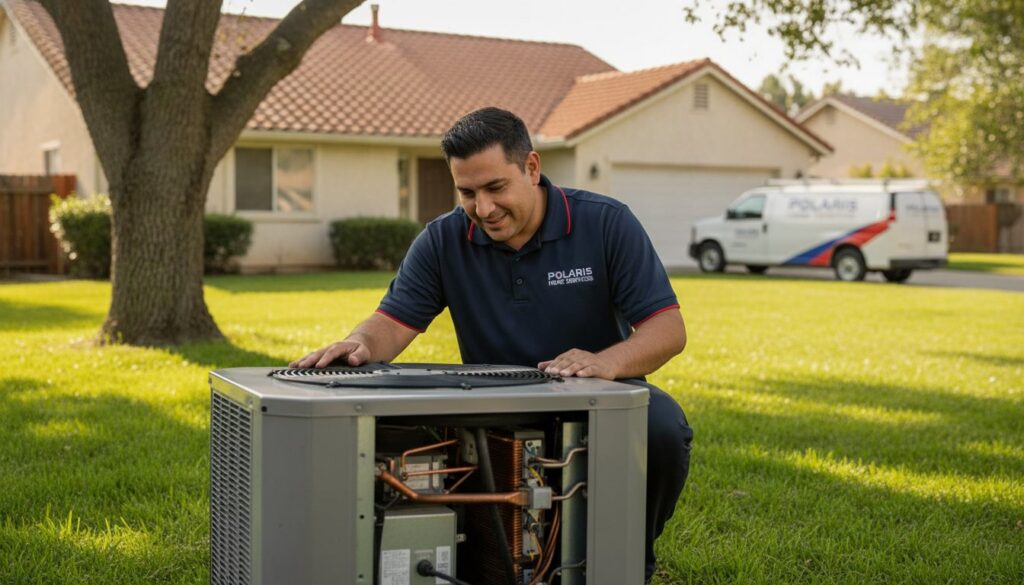
What if the reason your home feels like an oven has nothing to do with a broken motor and everything to do with how your system breathes? We understand that realizing your air con not blowing cold during a Roseville heatwave is an immediate source of stress. It is more than just a technical glitch; it is a threat to your family’s comfort and your peace of mind. Many homeowners naturally worry that a lack of chilly air automatically means a total system replacement or a massive repair bill.
We’ve created this 2026 troubleshooting guide to help you navigate these frustrations with confidence and clarity. You will learn how to identify common airflow restrictions and understand how recent industry shifts, like the transition to SEER2 standards and new A2L refrigerants, impact your specific equipment. We are here to show you which quick fixes you can safely manage yourself today and when it is best to let a local expert step in to protect your home’s sanctuary. By the end of this guide, you will have a clear path toward restoring a cool, breathable environment for your household.
Key Takeaways
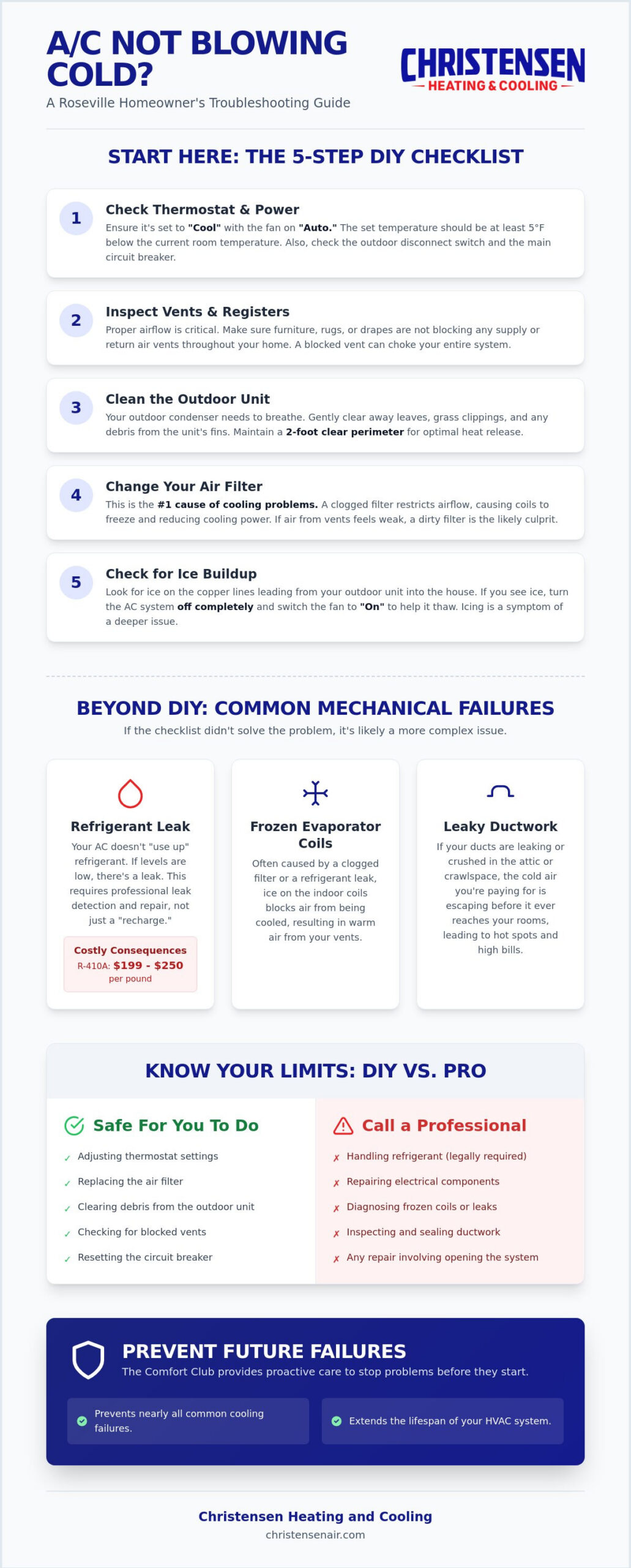
- Follow our 5-step DIY checklist to address simple issues like thermostat settings and clogged filters before calling for help.
- Learn why an air con not blowing cold is often a symptom of frozen coils or refrigerant leaks that require specific technical solutions.
- Uncover the role of leaky or crushed ductwork in creating uncomfortable hot spots throughout your Roseville home.
- Identify the “safe zones” for homeowner maintenance versus the complex repairs where calling in our team protects your system and safety.
- Discover how proactive care through the Comfort Club can prevent nearly all common cooling failures while extending your system’s lifespan.
Troubleshooting Your Air Con Not Blowing Cold: The 5-Step DIY Checklist
We’ve all been there: it’s a scorching July afternoon in Roseville, and your home feels more like a sauna than a sanctuary. When you realize your air con not blowing cold, it’s easy to panic about repair costs. However, many cooling issues stem from simple, fixable problems that don’t require a service call. Understanding How Your HVAC System Works helps you pinpoint exactly where the cycle is breaking down before you call in the pros.
To better understand these common issues, watch this helpful video walkthrough:
Before you reach for the phone, walk through your home and check your supply and return registers. It sounds simple, but a sofa pushed against a return vent or heavy drapes blocking a supply register can choke your system. Your air conditioner needs to move a specific volume of air to function; if it can’t, the cooling cycle fails. Next, head outside to your condenser unit. In our region, wind and summer storms can easily blow leaves, grass clippings, or debris against the delicate fins. Use a soft broom to clear a two-foot perimeter around the unit so it can properly release heat into the outside air. Finally, check your main electrical panel. A sudden power surge or heavy grid demand can trip the AC breaker, leaving the indoor fan running while the outdoor compressor sits idle. Resetting the switch may be all you need to restore your home’s comfort.
Thermostat and Power Settings
Your thermostat is the brain of your home’s comfort. Verify the display is active and replace the batteries immediately if it’s blank. Ensure the system is set to “Cool” and the fan is on “Auto” rather than “On.” If the fan stays on constantly, it may just circulate warm air throughout the house. Check that your cooling setpoint is at least 5 degrees below the current room temperature. Finally, confirm the outdoor disconnect switch hasn’t been accidentally flipped off during yard work.
Airflow and Filter Maintenance
In Roseville, air filters work harder than most. Northern California wildfire seasons introduce heavy particulates that can clog filters in just a few weeks. A clogged filter is the top reason for air con not blowing cold because restricted airflow causes the evaporator coils to freeze. Perform a “hand test” at a vent; if the air feels weak or lukewarm, change the filter. Learn more in our guide on how to improve indoor air quality.
Mechanical Culprits: Why Your AC Runs But Isn’t Cooling
If you’ve gone through our initial checklist and your air con not blowing cold still persists, the issue likely lies within the mechanical heart of the machine. It is incredibly frustrating to hear the unit humming outside while the vents only puff out lukewarm air. This scenario usually indicates that while the system has power, it has lost its vital ability to transfer heat out of your living space. We see this often in Placer County, where the mechanical strain of triple-digit summers can push aging components to their breaking point.
The Refrigerant Myth: It’s Not ‘Fuel’
Refrigerant is a specialized heat-transfer medium that cycles through a closed loop to move warmth from inside your home to the outdoors, rather than a consumable fuel that your system burns off over time. Unlike the gasoline in your car, your AC should never “run out” of refrigerant. If your levels are low, you have a physical leak in the copper lines or the coils. You might notice a faint hissing sound near the unit or see ice forming on the lines leading into the house. Simply “recharging” the system without finding and sealing the leak is a temporary fix that leads to higher costs down the road. In 2026, with R-410A prices ranging from $199 to $250 per pound and newer A2L refrigerants starting even higher, fixing a leak early is the best way to protect your household budget and your home’s sanctuary.
Frozen Coils and Restricted Heat Exchange
It sounds counterintuitive, but your air conditioner can actually turn into a block of ice when it is 100 degrees in Roseville. When airflow is restricted or refrigerant is low, the evaporator coil inside your home drops below freezing. Moisture in the air hits that sub-zero metal and instantly turns to ice. This ice layer acts as an insulator, preventing the system from absorbing any more heat. If you suspect a freeze-up, follow these steps to protect your equipment:
- Turn the thermostat to “Off” immediately to stop the cooling cycle.
- Set the fan switch to “On” to circulate warm air over the coils and speed up the thawing process.
- Check the condensate drain line for clogs, as melting ice can cause an overflow.
- Wait at least three to four hours for the ice to completely disappear before attempting to restart the system.
Warning: Never attempt to pick at the ice on the coils with a screwdriver, knife, or any sharp tools. Those copper fins and tubes are extremely fragile; a single puncture will lead to a major refrigerant leak and a much more expensive repair. While you wait for the system to thaw, our team can help diagnose the root cause with a professional air conditioning repair visit to ensure your family stays cool for the rest of the season.
The ‘Starter’ and the ‘Heart’
Sometimes the outdoor fan spins, but the compressor—the heavy pump that moves the refrigerant—won’t start. This is often due to a failed capacitor. Think of the capacitor as a giant battery that gives the motor the high-voltage “kick” it needs to start up. If you hear a humming or clicking sound from the outdoor unit but the air stays warm, a capacitor may have reached the end of its life. If the compressor itself fails, it is a more serious concern, as this is the most vital component of your system. We prioritize these repairs to restore your home’s comfort as quickly as possible, treating your family’s safety with the same care we would our own.
The Hidden Role of Leaky Ductwork in Your Home’s Comfort
Imagine your compressor is humming perfectly and your coils are icy, yet your living room remains a stifling 80 degrees. This is a common mystery for many neighbors in our community. When you experience your air con not blowing cold, the culprit isn’t always a mechanical failure under the hood. Frequently, the issue is the “vascular system” of your home: the ductwork. While many resources focus solely on the cooling unit, we’ve found that even the most efficient SEER2 system is useless if the delivery path is compromised.
In a typical house, roughly 20 to 30 percent of the air moving through the system is lost due to leaks, holes, and poorly connected joints. In Roseville, where attic temperatures can easily soar past 130 degrees during a July heatwave, a single disconnected duct means you are essentially paying to cool your insulation while your family swelters. This inefficiency shows up directly on your monthly SMUD or PG&E statements. It forces your air conditioner to run significantly longer cycles to reach your thermostat’s setpoint, which places unnecessary strain on every component.
Signs of Duct System Failure
One of the most obvious signs of a duct issue is the presence of “hot spots.” If your master bedroom is freezing but the nursery feels like a greenhouse, you likely have a crushed or disconnected duct in the attic. You should also look for excessive dust accumulation around your supply vents. This often indicates that a leak in the return ducting is pulling unfiltered, hot attic air into the system and blowing it back into your living spaces. For those dealing with aging systems, a professional duct system replacement in Roseville can often do more for your comfort than a new AC unit alone.
The Pressure Balance Problem
Ductwork is the most overlooked part of the air con not blowing cold puzzle. Your system relies on a delicate balance of pressure to move air effectively. When return ducts have leaks, they don’t just lose cold air; they actively suck in superheated air from your attic or crawlspace. This forces the evaporator coil to work twice as hard to remove heat that shouldn’t have been there in the first place. Over time, this constant battle shortens the lifespan of your compressor. Ensuring your ductwork is sealed and intact is a vital step in protecting your household sanctuary and keeping your utility bills under control.
When to Call a Professional vs. When to Keep Troubleshooting
Deciding whether to continue tinkering with your unit or to call for backup is a vital step in restoring your home’s comfort. While we encourage homeowners to handle basic maintenance, there is a clear line where DIY efforts become dangerous or counterproductive. If you have already cycled through the basic checks and your air con not blowing cold persists, it is time to consider the complexity of modern HVAC systems. Pushing beyond your comfort zone can lead to accidental damage that turns a simple fix into a total system replacement, a task that requires the technical precision offered by installation experts like Essex Home Air Conditioning.
The “Safe DIY” zone is strictly limited to non-invasive tasks. Changing your air filters, replacing thermostat batteries, and clearing away dry brush or leaves from your outdoor condenser are all helpful tasks. However, once you need to open the electrical panel or touch the refrigerant lines, you have entered the “Danger Zone.” Unlike some online forums suggest, you cannot simply “top off” your own refrigerant; doing so violates EPA regulations and risks exposing you to high-pressure chemicals. Furthermore, the capacitors in your unit store enough electricity to cause a severe shock even when the power is off. We prioritize your safety and the integrity of your home’s sanctuary above all else.
Living in Roseville means facing 105-degree afternoons where the heat is more than just an inconvenience. Attempting to troubleshoot a complex mechanical issue in a sweltering attic or under the direct sun can quickly lead to heatstroke. A professional diagnostic visit saves you money by ending the “part-swapping” guesswork. Instead of buying expensive components you might not need, our team uses calibrated tools to find the root cause immediately. If your system is struggling, reaching out for professional air conditioning repair ensures the job is done right the first time.
Red Flags Requiring Immediate Service
Some symptoms indicate that you should shut your system down and call us immediately to prevent a fire or total mechanical collapse. Watch for these critical warning signs:
- Burning Smells: Any scent of ozone, burning plastic, or smoke coming from your vents or the outdoor unit.
- Rapid Short-Cycling: The unit turns on and off every few minutes without ever cooling the home.
- Alarming Noises: Loud banging, metal-on-metal screeching, or persistent buzzing that suggests a motor or compressor failure.
Local Expertise Matters
Every neighborhood has its own unique challenges. For example, residential AC repair in Carmichael often involves navigating the specific needs of older ductwork and established housing designs. As a family-owned contractor serving Placer County since 2009, we understand how our local climate and housing ages affect system performance. We treat every environment with the same care we would apply to our own homes, ensuring that your air con not blowing cold becomes a distant memory through honest, neighborly service.
Preventing Future Failures: The Christensen Comfort Club Advantage
Most homeowners only think about their HVAC system when it stops working. We’ve found that the vast majority of emergency calls regarding an air con not blowing cold are entirely preventable with consistent, professional care. Our Comfort Club Maintenance Plan is designed to take the guesswork out of home ownership. It moves you from a reactive mindset to a proactive strategy that protects your equipment and your household budget. By partnering with a family-owned team that has served Roseville since 2009, you ensure your system is handled with personal pride and deep regional expertise.
When the Sacramento Valley hits triple digits in July, every HVAC company in the county receives a surge of calls. You don’t want to be at the bottom of a long waiting list when your indoor temperature is climbing and your family is miserable. Comfort Club members receive priority service, meaning we prioritize your sanctuary when you need us most. This isn’t just a business transaction; it’s a commitment to protecting your home’s comfort through a legacy-driven approach that values long-term relationships over short-term fixes.
What Happens During a Professional Tune-Up?
During a professional visit, our technicians go far beyond the basic DIY steps we discussed earlier. We deep-clean the evaporator and condenser coils to maintain the peak heat exchange efficiency required for SEER2 standards. We also clear the condensate drain lines to prevent the messy water damage that often follows a system freeze-up. By using specialized meters to test electrical components like capacitors and contactors, we can catch a failing part in May before it leaves you in the heat in August. This thorough process is the secret to how to make my HVAC system last longer in our demanding Northern California climate.
Long-Term Savings and Reliability
Proactive maintenance pays for itself through improved efficiency and lower monthly energy bills. A system that doesn’t have to overwork to overcome dirty coils or restricted airflow uses significantly less power. Beyond the financial savings, there is immense value in having a trusted partnership with a local team that knows your system’s history. You’ll have the peace of mind that comes from knowing your air con not blowing cold is a problem of the past. We treat every environment with the same care we would apply to our own homes. Join the Comfort Club today to secure reliable cooling all summer long and ensure your family stays comfortable regardless of the temperature outside.
Restore Your Home’s Sanctuary Today
We’ve explored how simple airflow checks and a clear understanding of your ductwork can help you pinpoint why your house is heating up. While some fixes are as easy as a battery swap, complex mechanical components require the specialized touch of a local expert to ensure your family’s safety. Dealing with an air con not blowing cold is stressful during a California summer, but you don’t have to navigate it alone. Our team provides expert diagnostics for all major brands, ensuring your system is optimized for the local climate.
Since 2009, we’ve been family-owned and operated, dedicated to serving Roseville, Rocklin, and the greater Sacramento area with neighborly care. We treat every home with the same attention we give our own, focusing on long-term reliability rather than quick, temporary fixes. If your DIY checks didn’t restore the breeze, let us step in to protect your household’s comfort. Get Your AC Blowing Cold Again—Schedule Your Roseville Repair Now. We look forward to helping you reclaim your cool, comfortable home.
Frequently Asked Questions
Why is my AC running but not cooling the house?
This issue usually happens because of restricted airflow or a mechanical failure in the outdoor unit. Common culprits include a heavily soiled air filter, a tripped breaker for the condenser, or a failed capacitor. We often find that while the indoor fan is moving air, the compressor isn’t engaged to actually remove heat from your home. This prevents the refrigeration cycle from completing its task of cooling your living space.
Can a dirty filter really stop my AC from blowing cold air?
Yes, a clogged filter is the most frequent reason for an air con not blowing cold. When air can’t pass through the filter, the evaporator coil gets too cold and eventually freezes into a block of ice. This ice acts as a barrier that prevents the system from absorbing heat, effectively stalling the cooling process and leaving your home warm even while the unit runs constantly.
How do I reset my air conditioner when it’s not cooling?
You can reset your system by turning it off at the thermostat and then flipping the dedicated AC breaker in your main electrical panel to the “off” position for about 60 seconds. After flipping the breaker back on, wait five minutes before turning the thermostat back to “cool.” This delay allows the internal sensors and the compressor to reset their safety cycles properly before the system attempts to start again.
Is it okay to run my AC if it’s not blowing cold air?
No, you should turn the system off immediately if the air coming from the vents is warm. Continuing to run a malfunctioning unit can cause the compressor to overheat or lead to liquid refrigerant flooding back into the motor. Shutting it down protects your equipment from expensive, permanent damage while you wait for a professional to arrive and diagnose the root cause of the failure.
How much does it cost to fix an AC that’s not blowing cold in Roseville?
The cost of repairs in 2026 varies significantly based on the specific component that has failed. Minor issues like a failed capacitor or a clogged condensate line are generally straightforward fixes. However, more complex problems involving refrigerant leaks or compressor replacements involve higher material costs and labor. We recommend a professional diagnostic to provide an accurate assessment of what your specific system requires to restore your home’s sanctuary.
What does it mean if my AC vents are blowing warm air?
Warm air from the vents typically indicates that your indoor fan is working, but the outdoor cooling cycle has failed. This could be due to a loss of refrigerant, a broken fan motor in the condenser, or a thermostat that is set to “fan on” instead of “auto.” It is a clear sign that the heat exchange process has been interrupted and needs expert attention to fix the underlying mechanical issue.
Why is there ice on my air conditioner lines in the middle of summer?
Ice buildup usually points to either a severe airflow restriction or a refrigerant leak. When the pressure in the system drops or the air isn’t moving fast enough to warm the coils, the temperature falls below freezing. This causes moisture in the air to turn into ice on the copper lines. You must thaw the system completely by turning off the cooling and running the fan before any repairs can be performed.
How often should I change my AC filter during Northern California wildfire season?
During active wildfire seasons, you should check your filter every two weeks and replace it at least once a month. The heavy smoke and ash particles in the Roseville air can clog a standard filter much faster than normal dust. Keeping a fresh filter in place ensures your air con not blowing cold doesn’t become an issue due to preventable airflow blockages that strain your entire system.