





Did you know that heating and cooling account for a staggering 52% of the average household energy bill? In our corner of Northern California, where summer afternoons regularly climb past 100 degrees, finding the best thermostat settings for energy savings is about more than just picking a comfortable number. It’s about outsmarting the 2026 utility rate changes that have many of our neighbors feeling stressed when they open their monthly statements from PG&E or SMUD.
We understand the frustration of trying to keep a two-story home cool without watching your expenses skyrocket during peak hours. You deserve a sanctuary that stays refreshing even when the Roseville heat is at its worst. This guide provides the exact thermostat schedules and settings you need to slash your energy bills while protecting your HVAC system’s lifespan. We will show you how to navigate Time-of-Use periods effectively and finally master those smart thermostat features so your home works for you, not against your budget.
Key Takeaways
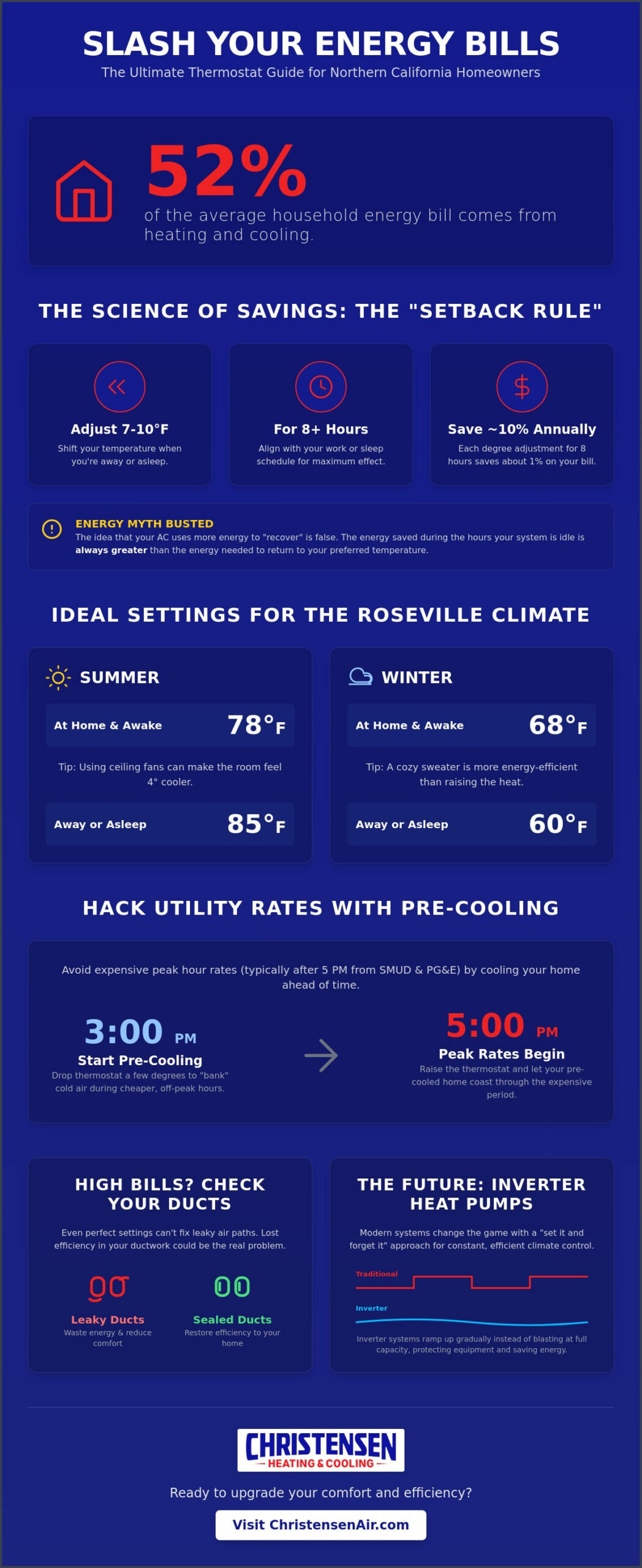
- Master the “Setback Rule” to reduce your annual energy consumption by shifting your home’s temperature by 7 to 10 degrees during the hours you’re away or sleeping.
- Identify the best thermostat settings for energy savings during Roseville’s extreme 100-degree summers and cold winter nights to maintain comfort without overspending.
- Use the “Pre-Cooling” strategy to bank cold air at 3:00 PM, allowing you to stay cool while avoiding the expensive 5:00 PM peak rates from SMUD and PG&E.
- Understand why high bills might be caused by leaky air paths rather than your settings, and how duct system replacement can restore efficiency to your entire home.
- Discover why modern inverter heat pumps change the game for Northern California homeowners by providing constant, efficient climate control with a “set it and forget it” approach.
The Science of Savings: Why Thermostat Setbacks Work
Many of our Roseville neighbors worry that letting their home warm up while they are at work is a mistake. We often hear the concern that the air conditioner will have to “work harder” to cool the house back down, potentially canceling out any benefit. Science tells a different story. Finding the best thermostat settings for energy savings actually relies on a principle called the “Setback Rule.” This rule suggests that adjusting your temperature by 7 to 10 degrees for at least 8 hours a day can lead to significant reductions in your monthly utility costs.
The core of this strategy involves the use of programmable thermostats to automate these shifts. By scheduling these setbacks, you ensure your home isn’t wasting energy when nobody is there to enjoy the comfort. It isn’t just about running the system less; it’s about changing how heat moves into your living space.
To better understand how these settings impact your home’s efficiency, watch this helpful video:
The idea that your AC uses more energy to “recover” than it saved while it was off is a persistent myth. In reality, modern high-efficiency systems, particularly Inverter Heat Pumps, are designed to handle temperature recovery with incredible precision. These 2026-era systems ramp up gradually rather than blasting at full capacity, which protects your equipment and keeps your energy usage predictable. The energy saved during the hours the system was idle is always greater than the energy required to bring the home back to your preferred temperature.
Understanding Heat Transfer in Your Home
Physics dictates that heat always moves toward colder areas. When you keep your home at a crisp 72 degrees while it is 105 degrees in Roseville, the “pressure” of that outdoor heat trying to get inside is intense. This is known as heat flux. By allowing your home to reach 80 degrees while you’re away, you reduce the temperature difference between the inside and outside. This actually slows down the rate at which heat enters your home, meaning your system has less total heat to remove when you return. Your walls, furniture, and flooring act as thermal mass; once they stay cooler for longer periods, they help stabilize the environment without constant mechanical intervention.
The 8-Hour Rule for Maximum ROI
We recommend the 8-hour window because it represents the “sweet spot” for energy recovery. According to the U.S. Department of Energy, you can save approximately 1% on your bill for every degree you raise your thermostat, provided the change lasts for at least eight hours. We define the setback principle as the reduction of heat transfer through intentional temperature variance. You can easily align these periods with your professional work schedule or your nightly sleep cycle. For example, setting the thermostat to 82°F during a summer workday or 85°F when you’re away on a weekend trip can protect your budget without sacrificing the sanctuary of your home when you finally walk through the door.
Seasonal Guide: Ideal Settings for the Roseville Climate
Living in the Sacramento Valley means preparing for extreme temperature shifts that can tax even the sturdiest HVAC systems. We understand that a 105-degree afternoon in Roseville feels very different from a 35-degree morning in Auburn. To keep your home a sanctuary without overspending, you need a strategy that shifts with the seasons. We’ve found that the best thermostat settings for energy savings are those that respect our local environment while leveraging the latest Department of Energy guidelines for maximum efficiency.
Summer Comfort vs. Cost
During our intense summer heatwaves, every degree matters. We recommend setting your thermostat to 78°F when you are at home. While this might sound high, using ceiling fans can make the room feel 4 degrees cooler through the wind-chill effect. When you head out for the day, move that target to 85°F. This prevents your refrigerator and sensitive electronics from overworking in a sweltering house while still saving a significant amount on your cooling bill. At night, aim for 82°F paired with lightweight, breathable bedding. This setting supports your body’s natural thermoregulation and prevents the AC from running needlessly during the slightly cooler valley nights.
Winter Efficiency in Placer County
When the damp cold settles into Placer County, your heating strategy should focus on heat retention. We suggest a waking-hour target of 68°F. This is warm enough for comfort if you’re active or dressed in layers. For the hours you’re away or tucked under blankets, dropping the temperature to 60°F or 62°F can drastically reduce your fuel consumption. If you use a gas furnace, these setbacks are highly effective. However, if you’ve switched to a modern heat pump, we often recommend more moderate setbacks of only 3 to 5 degrees to keep the system in its most efficient operating range.
The “shoulder seasons” in late spring and early fall present a unique challenge. It’s common to see 30-degree daily temperature swings in Rocklin and Auburn. During these weeks, we suggest turning your system off entirely during the day and using “whole house” ventilation by opening windows in the evening. On the rare occasion we experience muggy weather, running your AC at a slightly lower temperature for a short burst can act as a dehumidifier, pulling moisture from the air to improve your indoor air quality. If you’re unsure if your current system is handling these transitions efficiently, feel free to reach out to our local team for a quick system health check.
Hacking Local Utility Rates: SMUD and PG&E Strategies
In Roseville and Sacramento, the clock is just as important as the thermometer. For those on SMUD, the 2026 summer peak rate between 5:00 PM and 8:00 PM jumps to $0.3765 per kWh. That is more than double the off-peak rate of $0.1550. PG&E customers face even steeper challenges, with average residential rates around 41.46 cents per kWh. To get the best thermostat settings for energy savings, you have to time your cooling around these expensive windows. We recommend programming your thermostat to rise by 3 to 4 degrees the moment those peak rates kick in, ensuring your system stays quiet when electricity is at its priciest.
The difference between living in Sacramento and neighboring areas often comes down to the logo on your bill. SMUD peak hours are strictly 5:00 PM to 8:00 PM on weekdays during the summer. PG&E peak times can vary based on your specific plan, but they often span from 4:00 PM to 9:00 PM. Knowing your specific window is vital. If you miss the mark by even an hour, your AC could be running at the highest possible rate. This is a major reason why the average monthly bill for a PG&E customer using 750 kWh is roughly $290, compared to $149 for a SMUD customer.
The Pre-Cooling Method for Roseville Homeowners
We suggest a “pre-cooling” technique to beat the afternoon price spike. At 3:00 PM, while rates are still in the mid-peak or off-peak range, drop your thermostat to 72°F. This aggressively chills the air and the furniture in your home before the expensive 5:00 PM window begins. Once the peak hits, set the thermostat to 78°F or 80°F. Your home will enter “coast mode,” where the AC stays off while the house slowly warms up from its pre-chilled state. Pre-cooling leverages your home’s thermal mass to avoid peak-hour charges by shifting the heaviest electrical load to cheaper time slots.
Smart Thermostats and Utility Integration
Modern devices like Nest and Ecobee offer features that sync directly with local utilities. They can automatically adjust for SMUD’s “Critical Peak Pricing” events, which are specific days when the grid is under extreme stress. While these programs often offer small bill credits, they give the utility company some control over your home’s temperature. We believe in the power of technology, but we also value your family’s comfort. Our team suggests maintaining manual override authority so you can stay in control if the house gets too warm for your liking. Following Department of Energy thermostat guidelines can save you up to 10% annually, but those savings shouldn’t come at the cost of your peace of mind or household safety during a 100-degree Roseville afternoon.
When Settings Aren’t Enough: Troubleshooting High Bills
Sometimes even the best thermostat settings for energy savings can’t stop a utility bill from climbing. If your thermostat screen displays a comfortable 72°F but your living room feels like a sweltering 78°F, you’re experiencing what we call the “Thermostat Lie.” This mismatch often happens when a system is struggling against mechanical friction or structural flaws in the home. We believe in looking beyond the screen to ensure your cooling equipment isn’t fighting a losing battle against hidden energy drains.
Air filters play a much larger role in your budget than most people realize. A clogged, dusty filter restricts airflow, forcing your air conditioner to run approximately 15% longer just to hit the same temperature target. This extra runtime adds up quickly on a PG&E or SMUD statement. During Northern California’s wildfire season, this becomes even more critical. While we usually focus on efficiency, protecting your indoor air quality becomes the priority when smoke is present. You might need to run your fan more often to scrub the air, even if it slightly increases your energy usage for a few weeks.
Is Your Ductwork Leaking Money?
Roseville attics are notoriously brutal, often reaching temperatures above 140°F in the peak of summer. If your ductwork has small cracks, loose seals, or disconnected joints, your expensive, cooled air escapes into that furnace-like attic space before it ever reaches your vents. This is the number one reason why “perfect” thermostat settings fail to deliver low bills. You might notice that one bedroom stays warm while the rest of the house is cool, or you might hear a faint whistling sound behind your walls. In these cases, a professional duct system replacement can provide more long-term relief than any digital schedule.
The Role of System Maintenance
We often find that high bills are caused by a dirty outdoor condenser coil. When this coil is covered in grass clippings or valley dust, it can’t release heat efficiently. This makes your AC work twice as hard for half the comfort. Our Comfort Club maintenance plan focuses on keeping these components pristine so your system runs at its factory-rated efficiency. If you’re noticing your system cycling constantly, we can help you identify if you need residential AC repair in Carmichael or if your thermostat simply needs a professional recalibration. Don’t let a hidden leak or a dirty coil steal your peace of mind; schedule a system efficiency audit with our team today to ensure your home remains a true sanctuary.
The Future of Efficiency: Inverter Technology and Beyond
While we have spent much of this guide discussing how to time your temperature shifts, the arrival of modern inverter technology is beginning to rewrite the rulebook for Northern California homeowners. Traditional air conditioners are single-stage, meaning they are either 100% on or completely off. This creates a cycle of “gulping” energy to reach a target and then shutting down. In contrast, a high-efficiency inverter heat pump functions like a dimmer switch, constantly adjusting its speed to match the exact cooling needs of your home.
This technology is particularly effective for Roseville’s climate. Because inverter systems can operate at very low speeds for long periods, they maintain a much more stable indoor environment. For those who find whole-house setbacks difficult to manage, ductless mini split systems offer an even more precise solution. By cooling only the rooms you are currently using, you eliminate the need for aggressive whole-house temperature swings. This allows you to save money without ever feeling the heat in the rooms where you spend the most time.
Why Inverters Don’t Need Setbacks
The best thermostat settings for energy savings look different when you own a variable-speed system. While setbacks are vital for older units, frequent 10-degree shifts can actually be less efficient for inverter technology. These systems are designed to “sip” electricity at a low, steady rate. When you force an inverter system to recover from a significant temperature jump, it has to ramp up to its maximum speed. This often uses more power than simply maintaining a steady 74°F or 75°F all day. You get the benefit of consistent comfort without the “blast of cold” air that often comes with traditional systems, all while keeping your utility costs predictable.
Expert Recommendations for 2026
Our team prioritizes inverter technology for our neighbors in the Sacramento Valley because it handles our 100-degree summers with far less strain. To get the most out of these high-performance systems, we recommend integrating them with smart thermostats that can communicate directly with the system’s variable-speed controller. This ensures the equipment never works harder than it needs to, which is the key to maximizing your HVAC system’s lifespan. As you look toward the future of your home’s comfort, remember that the right technology can make energy efficiency feel effortless. We are here to help you navigate these choices, ensuring your household remains a comfortable, cost-effective sanctuary for years to come.
Take Control of Your Home’s Comfort and Costs
Managing a home in the Sacramento Valley requires more than just a digital schedule. It requires a strategy that respects the local climate and the specific nuances of our regional utility providers. By aligning your cooling with SMUD or PG&E Time-of-Use windows and ensuring your ductwork is sealed, you can finally stop overpaying for your comfort. While finding the best thermostat settings for energy savings provides a strong foundation, the ultimate goal is a system that works efficiently on its own, such as a modern inverter heat pump.
As a family-owned and operated team since 2009, we are specialists in high-efficiency inverter heat pumps designed for the unique needs of Roseville, Rocklin, and the greater Sacramento area. We take personal pride in every task and treat your environment with the same care we would apply to our own. Our goal is to protect your household sanctuary through honest guidance and technical excellence.
We look forward to keeping your home refreshing through every Northern California heatwave and cozy through every winter chill.
Frequently Asked Questions
Is it cheaper to leave my AC on all day or turn it off while I’m at work?
It is significantly cheaper to use a setback temperature while you’re away rather than leaving your AC at a constant cool setting. When your home stays warmer in the summer, it actually absorbs heat from the outdoors more slowly. This reduces the total amount of heat your system must remove when you return. Modern units are designed to handle this recovery efficiently, so you won’t lose your savings when the system turns back on.
What is the best thermostat setting for sleeping in the summer?
We recommend setting your thermostat to 82°F for sleeping during our warm Northern California nights. While this may sound high, pairing this setting with a ceiling fan creates a wind-chill effect that makes the room feel much cooler. Using the best thermostat settings for energy savings at night prevents your air conditioner from running needlessly during the hours when the outdoor temperature naturally begins to drop.
How much money can I really save by adjusting my thermostat?
You can typically save about 1% on your cooling or heating bill for every degree you adjust your thermostat for at least eight hours. For most Roseville households, following a consistent setback schedule leads to annual savings of 10% to 12%. According to Energy Star data, this can translate to roughly $100 to $200 back in your pocket every year, depending on your home’s size and insulation quality.
Do smart thermostats actually save money in California?
Smart thermostats are especially valuable in California because they can automate your response to complex Time-of-Use rate schedules. These devices learn your habits and can “pre-cool” your home before the expensive peak hours begin. By shifting your energy usage to off-peak times when rates are lower, a smart thermostat helps you avoid the highest charges from providers like SMUD and PG&E without requiring manual adjustments.
What temperature should I set my thermostat to when I’m on vacation?
We suggest setting your thermostat to 85°F in the summer and 55°F to 60°F in the winter while you are away on vacation. These settings are high or low enough to maximize your savings while still protecting your home’s infrastructure, electronics, and indoor plants. In the summer, 85°F is the sweet spot that prevents your refrigerator from working too hard while ensuring you aren’t paying to cool an empty house.
Why is my energy bill so high even though my thermostat is set to 78?
High bills at a 78°F setting usually indicate a hidden efficiency problem like leaky ductwork or a clogged air filter. If your ducts are leaking into a 140-degree attic, your system has to work much harder to maintain that 78-degree target. Additionally, a dirty outdoor condenser coil can’t release heat properly, which forces your system to run longer cycles and consumes more electricity than a well-maintained unit would.
Should I use ‘Auto’ or ‘On’ for my thermostat fan setting?
You should almost always keep your fan set to “Auto” rather than “On.” The “On” setting runs the fan continuously, which can actually increase the humidity in your home by blowing moisture off the cooling coils back into your living space. “Auto” ensures the fan only operates when the system is actively cooling or heating. This saves electricity and helps your HVAC system manage moisture levels more effectively for better comfort.
How do SMUD Time-of-Use rates affect my thermostat programming?
SMUD rates are highest during the summer peak between 5:00 PM and 8:00 PM, costing $0.3765 per kWh. You should program your thermostat to drop to a lower temperature around 3:00 PM to “bank” cool air while rates are lower. Once 5:00 PM hits, set the thermostat to 78°F or 80°F. This allows your home to slowly warm up during the peak window, helping you avoid the most expensive electricity of the day.