





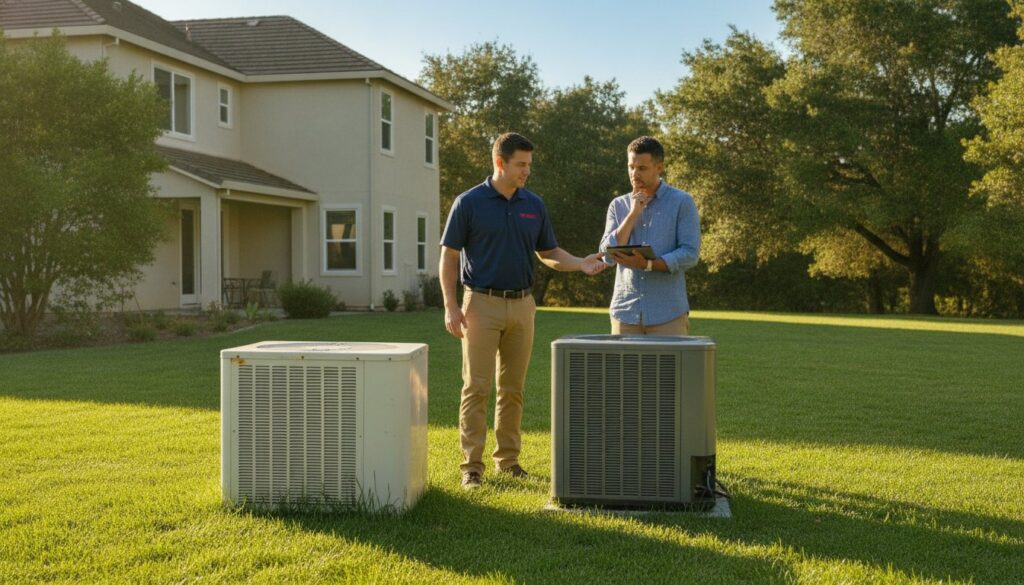
What if spending $800 to fix your aging unit is actually more expensive than investing in a brand new system? It is a question we hear often from our neighbors in the Sacramento Valley, especially when the forecast shows a week of triple-digit heat and the vents start blowing lukewarm air. We know how stressful it feels to face an unexpected breakdown while trying to keep your family comfortable and your utility bills under control. Deciding when to repair vs replace your air conditioner does not have to be a guessing game based on hope and a prayer.
We believe in providing clear, honest guidance that protects your home and your budget. In this guide, we will help you master the “5,000 Rule” and explain how the 2026 refrigerant regulations for R-410A systems impact your long-term costs. You will gain a simple financial framework to decide if a quick fix or a modern upgrade is the best path forward for your sanctuary. By the end, you will have the confidence to choose a solution that ensures lower monthly energy bills and a reliably cool environment for your loved ones, no matter how high the mercury rises.
Key Takeaways
- Learn how to apply the “$5,000 Rule” to determine if a repair is a wise investment or if you’re spending money on a system that’s past its prime.
- Identify why the 10-year mark is the critical tipping point and how to decide when to repair vs replace your air conditioner to protect your family’s comfort.
- Understand how 2026 refrigerant regulations and SEER2 standards impact your future maintenance costs and home energy performance.
- Explore the advantages of inverter heat pumps for achieving reliable, whisper-quiet cooling during the peak of the California summer.
- Discover why a professional load calculation is the most important step in choosing a system that fits your home’s specific needs.
The AC Dilemma: Understanding the “5,000 Rule” and Beyond
Deciding whether to sink more money into an old unit or start fresh is one of the toughest choices a homeowner faces. We see this struggle every summer in Roseville when a family’s cooling system fails during a heatwave. To simplify this choice, professionals often use a standard calculation known as the “$5,000 Rule.” This formula helps determine the financial viability of Heating, ventilation, and air conditioning (HVAC) repairs based on the age of your equipment and the cost of the fix.
Using this rule helps remove the emotion from the decision. It provides a clear threshold that balances the immediate cost of a repair against the decreasing value of an older machine. Understanding when to repair vs replace your air conditioner starts with looking at the total cost of ownership rather than just the price of a single service call. We want to ensure your home remains a sanctuary without draining your savings on a system that’s destined to fail again next month.
To better understand this concept, watch this helpful video:
Calculating the $5,000 Rule for Your Home
To use this rule, simply multiply the age of your unit by the repair estimate. If the total is more than $5,000, we generally recommend a replacement. For example, if your system is 10 years old and needs a $600 repair, the calculation equals $6,000. Since that number exceeds the threshold, you’re likely better off investing that money into a new, more efficient system. This math is a reliable way to gauge when to repair vs replace your air conditioner without the guesswork. You might break this rule for minor electrical issues like a blown fuse or a faulty capacitor, but major refrigerant leaks or compressor failures on an older unit are clear signals that it’s time to move on. We also encourage you to look at the frequency of your service calls. If you have called for help three times in the last two years, that cumulative cost should be part of your decision.
The 15-Year Horizon: Why Age Matters in Roseville
Our local climate in Northern California puts immense pressure on cooling systems. The intense heat cycles of the Sacramento Valley mean your compressor works harder and longer than units in milder regions. This constant stress accelerates wear on internal components, making breakdowns more frequent as the system enters its second decade. In the Sacramento Valley, a well-maintained central air conditioner typically serves a household for 15 to 20 years. Once you pass that 15-year mark, even small repairs can become “throwing good money after bad.” The probability of another major failure increases significantly every season as the mechanical parts reach the end of their reliable life.
Repair vs. Replace: A Side-by-Side Comparison
We know the pressure you feel when the AC stops working right in the middle of a July afternoon. It’s tempting to choose the cheapest fix just to get the air moving again. However, choosing when to repair vs replace your air conditioner requires looking past the immediate price tag. A short-term saving on a repair today might lead to three more service calls before the season ends. We focus on long-term reliability because your home should be a place of rest, not a source of constant mechanical anxiety. We want to help you weigh the cost of a “band-aid” fix against the security of a modern, warrantied system.
Evaluating the “Comfort Factor” means looking at more than just the temperature. Does your system struggle with high humidity? Are some rooms always five degrees warmer than others? While professional AC repair Roseville families rely on can often calibrate a system for better performance, sometimes these issues stem from an aging design that can’t keep up with modern expectations. We want you to have peace of mind that your equipment will last through the next decade, not just the next week. Manufacturer warranties act as a safety net for your wallet. If your unit is under ten years old, the manufacturer often covers the cost of expensive parts. In these cases, paying for the labor of a repair is a smart way to protect your investment. We always check your warranty status first because we believe in saving you money whenever possible.
When Repair is the Right Move
Repair is usually the best path for units under 10 years old that have been well-maintained. If the failure involves a simple mechanical part like a capacitor, fan motor, or contactor, a quick fix will likely restore your system to full health. We see the best results with systems that stay on our Comfort Club plan. Regular maintenance ensures that minor issues don’t turn into catastrophic failures. If your system still has a valid parts warranty and has generally been reliable, sticking with a repair is a sound financial decision.
When Replacement is the Only Logical Choice
Replacement becomes the only logical choice when a major component like a compressor or heat exchanger fails on an older unit. As of January 1, 2025, the manufacture of new equipment using R-410A refrigerant has been prohibited. While we can still service these units, the cost of R-410A will likely rise as it is phased down. Modern units designed for new minimum energy efficiency standards provide much better dehumidification and can reduce cooling costs by 20% to 40% compared to a 15-year-old unit. If you’re tired of high bills and frequent breakdowns, we can provide a thorough inspection to see if a new system is the right fit for your home.
The Hidden Costs: Energy Efficiency and Refrigerant Phase-Outs
Many homeowners focus solely on the immediate price of a service call, but we want to help you look at the “hidden” expenses that quietly drain your bank account. When you’re weighing when to repair vs replace your air conditioner, the efficiency of your system’s “arteries” plays a massive role. Even the most advanced cooling unit will struggle if it’s connected to old, leaky vents. A professional duct system replacement is often the missing piece of the puzzle, ensuring that the cold air you pay for actually reaches your family instead of escaping into the attic. We see too many neighbors invest in repairs for a machine that is fundamentally sabotaged by poor airflow.
Beyond the ductwork, the liquid that keeps your home cool is undergoing a major change. The industry has moved away from older refrigerants that are now expensive and difficult to source. Modern systems utilize newer, more environmentally friendly alternatives, similar to the technology found in ENERGY STAR certified room air conditioners and high-efficiency central units. Choosing a modern upgrade isn’t just about getting a newer machine; it is about opting out of a cycle of rising maintenance costs and high utility bills that plague older technology.
The Refrigerant Trap: R-22 and R-410A
If your system was installed before 2010, it likely uses R-22, which is no longer produced or imported. Even newer systems using R-410A are facing a phase-down that began in earnest in 2025. This means that “topping off” a system with a leak is no longer a viable long-term strategy. The cost of these obsolete refrigerants has skyrocketed, often making a single recharge nearly as expensive as a major mechanical repair. We consider a refrigerant leak in an old system to be a “death sentence” for the unit because the repair rarely offers a lasting return on your investment. The transition to A2L refrigerants in 2026 offers a cleaner, more affordable path forward for your household’s sanctuary.
SEER2 Ratings and Your Monthly ROI
Efficiency standards have recently shifted from SEER to SEER2 to better reflect how systems perform in real-world conditions. A legacy unit with a 10-SEER rating is a far cry from a modern 18+ SEER2 system. A new high-efficiency AC unit can reduce cooling costs by 20% to 40% compared to a 15-year-old unit. This reduction in your monthly SMUD or PG&E bills acts like a monthly rebate, eventually helping the system pay for itself. When we evaluate your home, we also look at proper airflow and static pressure. A system that doesn’t have to fight against restricted air stays healthier longer and keeps your Roseville home consistently comfortable during those brutal 100-degree weeks.

Modern Solutions: Why Inverter Heat Pumps are the 2026 Standard
We’ve noticed a major shift in how our neighbors think about home comfort lately. While traditional air conditioners were the standard for decades, the rise of all-electric homes in Northern California has changed the landscape. If you’re struggling with the choice of when to repair vs replace your air conditioner, it’s time to look at inverter heat pumps. These systems aren’t just for moderate climates anymore. Modern versions are specifically engineered to handle the intense, dry heat of the Sacramento Valley while providing both heating and cooling in a single, highly efficient package. We want to help you transition to a system that isn’t just a fix, but a long-term upgrade for your household’s sanctuary.
California is leading the way in the transition toward all-electric living. Many new developments in Placer County are being built without gas lines entirely. Even in established neighborhoods, we see families moving away from gas furnaces in favor of heat pumps to reduce their carbon footprint and simplify their utility bills. It’s a strategic move that prepares your home for the future of energy in our region. Choosing this technology means you’re investing in a system that meets the highest standards of modern engineering while protecting your family’s comfort during a 100-degree week.
Variable-Speed vs. Single-Stage Cooling
Inverter technology acts like cruise control for your home. Traditional single-stage units are either 100% on or 100% off, which leads to that annoying blast of cold air followed by a slow rise in temperature. Variable-speed compressors adjust their output in tiny increments to maintain a perfectly steady temperature. This constant operation also provides superior dehumidification. Even on those rare, muggy Sacramento nights, your home will feel crisp and dry. Because the system rarely runs at full speed, it’s significantly quieter than an old-fashioned AC unit. You can finally enjoy a quiet evening on your patio without the roar of a compressor nearby. This level of precision is why we recommend these systems for anyone tired of uneven cooling and high noise levels.
Local Rebates and Financial Incentives
Financial incentives make 2026 an ideal year for an upgrade. The federal government, through the Inflation Reduction Act, offers significant tax credits for homeowners who switch to high-efficiency heat pumps. Locally, utilities like SMUD and PG&E often provide additional rebates to encourage electrification and reduce strain on the grid. These combined savings can offset a large portion of the initial investment. We also stand behind these systems with long-term parts and labor warranties, giving you the security that your family’s comfort is protected for years to come. If you want to see how these savings apply to your specific home, read our guide on how inverter technology works to see if it’s the right fit for your next upgrade.
Making the Call: Next Steps with Christensen Heating and Cooling
We have covered the math, the new 2026 regulations, and the advanced technology available to you. Now comes the most important part of the process: the execution. Deciding when to repair vs replace your air conditioner is a significant financial choice that impacts your home’s comfort for the next decade. We believe this decision should never be based on a quick glance at your outdoor unit. Instead, we start every evaluation with a professional Load Calculation. This technical assessment ensures your system is sized perfectly for your home’s square footage, insulation levels, and window placements. An improperly sized unit will either short-cycle and leave your air humid or run constantly and wear out prematurely.
Our team brings deep regional expertise to every job. We understand the specific challenges of the Placer County climate because we live and work here too. We know that a home in Folsom often has different cooling requirements than a shaded property in the foothills. This local knowledge allows us to recommend solutions that actually perform when the Sacramento Valley heat is at its peak. We prioritize honest assessments over high-pressure sales tactics. Our goal is to build a long-term relationship based on trust and the shared goal of protecting your household’s sanctuary.
The Christensen Honest Assessment
We treat your home with the same care and respect we would apply to our own. When we evaluate your current equipment, we look at its “true” health. This includes checking the integrity of the electrical components, the condition of the coils, and the overall history of the unit’s performance. We won’t suggest a full replacement if a reliable repair is the smarter path for your budget. If you live in Roseville, Rocklin, or Folsom, booking a consultation with us is straightforward. We provide clear guidance so you can make an informed choice that fits your family’s needs and financial goals.
Before you make your final decision, consider this checklist of five questions to ask your technician today:
- Does my current system still have a valid manufacturer parts warranty?
- How much could I realistically save on my monthly utility bills with a new SEER2 system?
- Is the cost of this specific repair more than half the current value of the unit?
- Will my existing vents and registers support the airflow of a modern inverter heat pump?
- Are there specific SMUD or PG&E rebates available for the equipment I am considering?
The Comfort Club Advantage
Whether you choose to fix your current unit or invest in a modern upgrade, consistent maintenance is the only way to ensure your system lasts its full lifespan. Our Comfort Club plan is designed to take the stress out of HVAC ownership. We provide priority service for our members during emergency heatwaves, giving you the reassurance that your family won’t be left in the heat. This proactive approach identifies minor wear and tear before it turns into a catastrophic failure. We are ready to help you find the most reliable and cost-effective path toward a cooler home. Schedule your system evaluation with Christensen today!
Secure Your Home Comfort for the Decade Ahead
Deciding when to repair vs replace your air conditioner doesn’t have to be a source of stress for your household. By applying the $5,000 Rule and considering the long-term savings of modern SEER2 standards, you can move from reactive fixing to strategic investing. We have seen how inverter heat pumps have become the gold standard for Roseville and Rocklin homes, offering whisper-quiet cooling even during our most intense Sacramento Valley heatwaves. Whether you choose a precise repair or a full system upgrade, the ultimate goal is a reliable sanctuary for your loved ones.
Since 2009, our family-owned and operated team has provided honest, neighborly guidance to homeowners across the greater Sacramento area. We specialize in high-efficiency inverter heat pumps and are committed to helping you navigate the 2026 refrigerant changes with confidence. Don’t wait for the next triple-digit forecast to make your move. Get a Professional Repair vs. Replace Consultation with our experts today. We look forward to partnering with you to ensure your home remains perfectly cool and efficient for years to come.
Frequently Asked Questions
Is it better to repair or replace an AC unit that is 12 years old?
Deciding when to repair vs replace your air conditioner at the 12-year mark depends on the specific failure and the unit’s maintenance history. If you’re facing a major repair like a compressor failure, we usually recommend replacement because the unit has already reached about 75% of its expected lifespan in our Sacramento heat. Minor fixes like capacitors are often worth repairing to keep the system running for a few more seasons.
What is the $5,000 rule for HVAC replacement?
The $5,000 rule is a simple financial guideline where you multiply the age of your equipment by the repair estimate. If the result exceeds $5,000, it’s generally wiser to invest in a new system rather than fixing the old one. For example, a $500 repair on a 12-year-old unit equals $6,000, suggesting that your money is better spent on a modern upgrade that offers better reliability.
How much can I save on my electric bill by replacing an old AC?
You can typically reduce your monthly cooling costs by 20% to 40% when you upgrade from a 15-year-old unit to a new high-efficiency system. Modern SEER2 standards ensure that newer equipment uses significantly less electricity to provide the same amount of cooling for your home. For many of our neighbors in the Sacramento Valley, these monthly savings help the new system pay for itself over several years.
Can I just replace the outdoor AC unit and keep the old indoor coil?
We strongly advise against replacing only the outdoor unit because modern efficiency standards require matched indoor and outdoor components to function correctly. A mismatched system will likely suffer from reduced performance, higher utility bills, and a voided manufacturer warranty. Additionally, 2026 systems use new A2L refrigerants that are not compatible with older indoor coils designed for R-410A or R-22 refrigerants.
Are there tax credits for installing a new air conditioner in 2026?
While some federal credits were tied to a 2025 deadline, many local utility rebates through SMUD and PG&E remain excellent resources for homeowners in 2026. These local programs often provide substantial incentives for switching to high-efficiency inverter heat pumps or SEER2-compliant air conditioners. We always recommend checking with our team for the most current list of regional rebates available for your specific installation.
What happens if my old AC uses R-22 refrigerant?
If your system uses R-22, it is essentially obsolete because this refrigerant is no longer produced or imported as of 2020. Sourcing R-22 for a repair has become prohibitively expensive and difficult for most homeowners. A refrigerant leak in an R-22 system is often a signal that it’s time to replace the unit, as moving to a modern system eliminates the stress of maintaining banned technology.
How long does a typical AC installation take in Roseville?
A typical air conditioning installation for a residential home in Roseville usually takes between 8 and 12 hours to complete. Our team arrives early in the morning to ensure your new system is up and running before the peak evening heat sets in. We take personal pride in leaving your home exactly as we found it, just with a much cooler and more comfortable atmosphere for your family.
Should I switch to a heat pump instead of a traditional AC?
Switching to an inverter heat pump is often the smartest move for Northern California homeowners in 2026. These systems provide both heating and cooling while offering superior dehumidification and whisper-quiet operation compared to traditional single-stage AC units. With the ongoing regional shift toward electrification and the availability of local utility incentives, a heat pump is a future-proof investment for your home’s long-term comfort.