





Last January, a local family woke up to a foot of fresh snow and a silent furnace, a situation we see all too often when systems aren’t prepared for the Sierra foothills’ demands. We know that pit-in-your-stomach feeling when a strange rattle from the garage makes you wonder if you’re facing a minor fix or a total system failure during a freeze. In our region, the average lifespan of a furnace in Placerville typically ranges from 15 to 30 years, but our local elevation and temperature swings can shorten that window significantly if the system isn’t managed correctly.
We understand the stress of rising PG&E bills and the conflicting advice homeowners often hear about whether to repair or replace aging equipment. Our goal is to provide the clarity you need to protect your household’s sanctuary and budget. In this 2026 guide, we’ll explain how the latest California Title 24 standards impact your choices and show you the specific warning signs of a dangerous cracked heat exchanger. You’ll also discover our professional tips to potentially squeeze five more years out of an older unit, ensuring your family stays warm and secure through every El Dorado County winter.
Key Takeaways
- Understand why the average lifespan of a furnace in Placerville is often shorter than the national average and how our unique mountain climate plays a role.
- Identify the “silent killers” of HVAC equipment in El Dorado County, including improper system sizing and compromised ductwork integrity.
- Learn how to apply the “50% Rule” to determine if it is more cost-effective to repair your aging unit or invest in a modern, high-efficiency system.
- Discover practical steps to extend your furnace’s life by up to five years using foothills-specific filtration strategies and professional pre-season tuning.
- Explore 2026 heating trends, including the transition to high-performance inverter heat pumps and how they meet the latest California energy standards.
What is the Average Lifespan of a Furnace in Placerville?
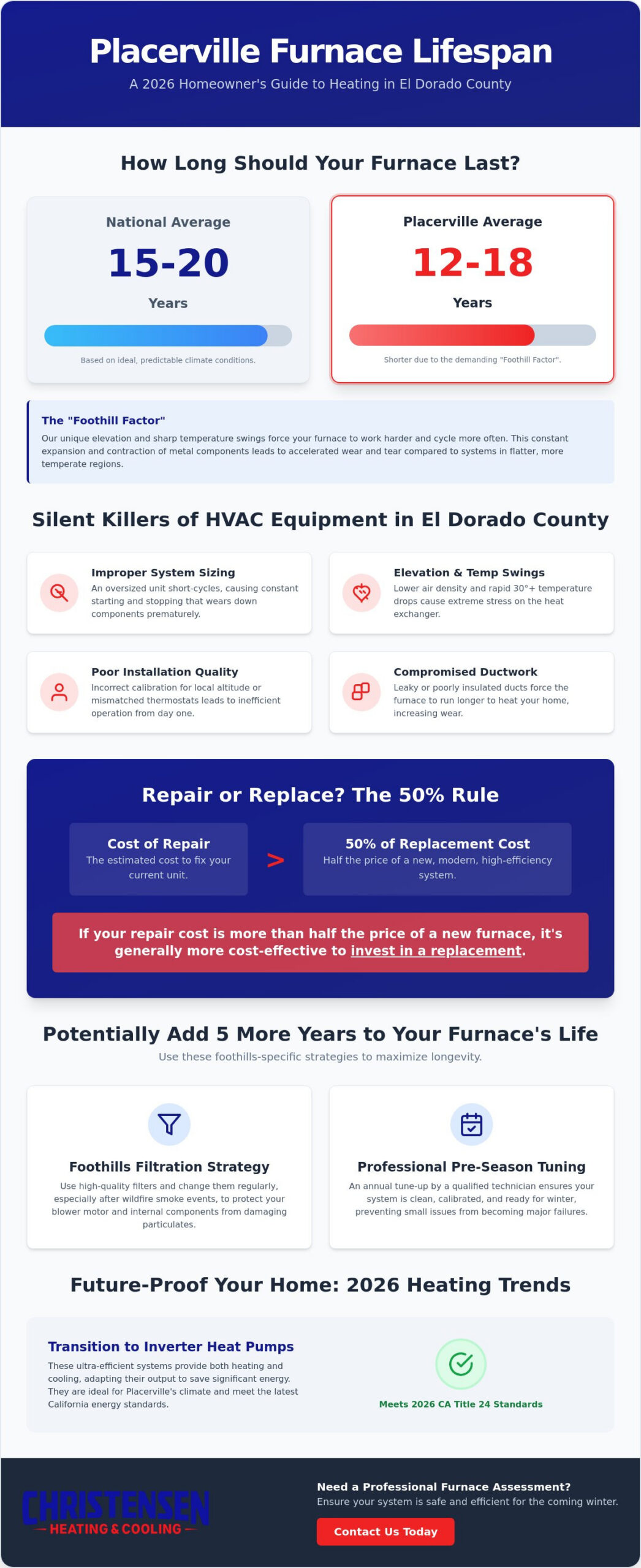
Most industry experts agree that a modern heating system should last between 15 and 20 years under ideal conditions. However, when we look at the average lifespan of a furnace in Placerville, we have to account for our unique local geography. Because our winters in El Dorado County are more demanding than the temperate valley floor, we often see units reaching the end of their reliable life between 12 and 18 years. While a foundational look at What is a Furnace? shows these machines are built for durability, the specific environmental stresses of the foothills change the math for our neighbors.
We’ve found that the “Placerville Factor” is the biggest variable in equipment longevity. Our homes aren’t sitting in a flat, predictable climate. Instead, they’re nestled in a landscape defined by elevation changes and sharp temperature swings. This means your system works harder to maintain the sanctuary of your home, leading to more frequent cycling. This extra workload puts physical pressure on internal components, often resulting in an earlier replacement timeline than a homeowner might expect based on national averages.
To better understand how long your system should realistically last, watch this helpful video:
The Foothill Factor: Why Elevation Matters
Elevation matters more than most people realize when it comes to HVAC health. At the higher altitudes found throughout our region, air density decreases, which can subtly impact combustion efficiency in gas units. When the sun goes down over the Ridge, temperatures in Placerville can drop 30 degrees in just a few hours. These sharp swings force your furnace into long run cycles. This constant heating and cooling causes the metal in your heat exchanger to expand and contract repeatedly. Over a decade, this mechanical stress can lead to hairline fractures that compromise both your safety and your system’s efficiency.
Gas vs. Electric Lifespans in Northern California
While electric furnaces can technically push toward a 20 or 25-year lifespan because they have fewer moving parts, they often become obsolete before they actually break. Rapid gains in energy efficiency mean a 20-year-old electric unit is often a drain on your household budget compared to modern 2026 models. Gas furnaces face more wear due to the combustion process, and they’re also susceptible to the unique quirks of our region. For instance, winter storms in the foothills can cause power surges that damage sensitive electronic igniters or control boards. Gas units remain the standard for Placerville’s colder winters because of their ability to produce high-intensity heat quickly when the snow starts to fall.
Factors That Shorten Furnace Life in El Dorado County
While we’ve discussed the general 15 to 20 year benchmark, several local variables can trim years off the average lifespan of a furnace in Placerville. The most common culprit we see in our community is improper sizing. If a furnace is too large for the square footage of your home, it doesn’t run long enough to heat evenly. Instead, it blasts hot air and shuts off quickly, a process that leads to premature wear on every internal component. It’s like driving a car in stop-and-go traffic versus cruising on the highway. The constant starting and stopping simply wears the machine down faster.
Installation quality also plays a massive role. We often say the first day of your furnace’s life determines its last. If a system isn’t calibrated correctly for our local elevation or paired with the right thermostat, it will struggle from the moment it’s turned on. This is why choosing ENERGY STAR certified furnaces is only half the battle. The other half is ensuring the system is integrated perfectly with your home’s unique footprint. If you suspect your current unit was never quite right, our team can help with a professional furnace repair assessment to get things back on track.
Wildfire Smoke and Your Blower Motor
Our beautiful foothills come with a seasonal challenge: wildfire smoke and heavy foothill dust. During major smoke events, fine particulate matter and microscopic ash can bypass standard filters. This grit acts like sandpaper on your blower motor bearings and can coat sensitive flame sensors. Over time, this abrasive buildup leads to mechanical friction and overheating. We frequently help neighbors understand how to improve indoor air quality to protect both their family’s health and the sensitive electronics inside their heating system.
The Danger of Short-Cycling
Short-cycling happens when your furnace turns on and off too frequently, often due to poor insulation or an oversized unit. In many older Placerville homes, heat escapes through thin attic insulation or leaky windows. This forces the system to kick back on just minutes after finishing a cycle. Every time the burner ignites, the metal in the heat exchanger undergoes intense thermal stress. This constant expansion and contraction accelerate metal fatigue, which is the primary cause of dangerous cracks. Maintaining a steady, consistent run cycle is the best way to ensure your system reaches its full potential.
The “Silent Killer”: Leaky Ductwork
Poor ductwork integrity is the silent killer of HVAC equipment in El Dorado County. When ducts have gaps or tears, your furnace has to work 20% to 30% harder to push warm air into your living spaces. This extra strain forces the blower motor to run at higher speeds for longer periods. We’ve seen many well-maintained furnaces fail early simply because the duct system was pulling in cold crawlspace air, making the furnace fight an uphill battle every single day.
Repair or Replace? The Homeowner’s Decision Matrix
Deciding whether to sink money into an old unit or invest in a new one is one of the toughest calls a homeowner has to make. We use a simple framework called the 50% Rule to help our neighbors find clarity. If a single repair bill exceeds half the value of a new system, it’s usually time to look at a replacement. This is especially true when your unit is already approaching the end of the average lifespan of a furnace in Placerville. Investing in a major repair for a 15-year-old system often just delays the inevitable while you continue to pay higher monthly utility costs.
The math behind efficiency is also a major factor. Many older homes in El Dorado County still use 80% AFUE units, meaning 20 cents of every dollar spent on gas literally goes up the chimney. Under the 2026 California Title 24 standards, the minimum efficiency for new furnaces is now 81%, though many high-efficiency models reach 95% or higher. The U.S. Department of Energy provides excellent resources on maintaining your heating system to help you understand how these efficiency gaps impact your long-term budget. Beyond the numbers, consider the “Comfort Gap.” If your furnace runs constantly but your home still feels drafty, the mechanical components are likely too worn to meet the demands of a Sierra winter.
Warning Signs Your Furnace is Failing
We want you to be able to spot trouble before it becomes a midnight emergency in a snowstorm. Keep a close eye on these three red flags:
- The Flame Color: A healthy burner flame should be a steady, crisp blue. If you see a yellow or flickering pilot light, it indicates improper combustion and the potential presence of carbon monoxide.
- Strange Noises: While every furnace makes some sound, new rattling, popping, or screeching noises shouldn’t be ignored. These often signal a failing blower motor or a cracked component.
- Utility Spikes: If your PG&E bill jumps significantly without a change in your habits, your furnace is likely working twice as hard to produce the same amount of heat.
The Safety Risk of Aging Units
Safety is our primary concern when we evaluate older equipment in our community. As systems age beyond 15 years, the risk of carbon monoxide leaks increases due to the natural wear and tear on the combustion chamber. It’s a hard truth of the industry, but a cracked heat exchanger cannot be repaired; it must be replaced to ensure the safety of your household. We always recommend a professional gas furnace safety inspection to check for these hidden dangers. Protecting your family’s sanctuary is about more than just warmth. It’s about the peace of mind that comes from knowing your equipment is operating safely.
Practical Steps to Extend Your Furnace’s Life
While the average lifespan of a furnace in Placerville often leans toward the shorter side due to our rugged terrain, you aren’t powerless against the clock. We’ve seen well-maintained units in our community reach the 25-year mark simply because the homeowners stayed ahead of the curve. The most effective strategy starts with a “Foothill-Specific” filtration plan. Because we deal with higher levels of pine pollen and seasonal smoke, standard hardware store filters often aren’t enough. We recommend high MERV-rated filters to trap fine particulates, but you must change them every 60 to 90 days to prevent airflow restriction that suffocates your blower motor.
Managing your home’s “envelope” is another critical step. If your attic insulation is thin or your windows are drafty, your furnace is forced to run longer cycles to compensate for the heat loss. By sealing air leaks and ensuring your ductwork is airtight, you significantly reduce the mechanical stress on your system. Under current 2026 regulations, keeping duct leakage below 15% is essential for efficiency, but reaching the 5% mark seen in new installations is the gold standard for longevity. If you want to ensure your system is operating at peak performance, you can schedule a furnace maintenance visit with our team today.
The Christensen Comfort Club Advantage
We designed our maintenance program to take the guesswork out of system care. Our scheduled inspections are focused on catching tiny issues before they turn into mid-winter emergencies. During a visit, we perform professional cleaning of the burners and flame sensors, which are often coated in the fine dust common to El Dorado County. These cleanings ensure efficient combustion and prevent the “short-cycling” we discussed earlier. You can learn more about the Christensen Comfort Club benefits and how they protect your home’s sanctuary year-round.
DIY Maintenance for Placerville Homeowners
There are several tasks you can handle between professional visits to keep your household safe and warm. After a heavy Sierra snowfall, always check your external intake and exhaust vents. High-efficiency furnaces often use PVC pipes that can become blocked by snow drifts or debris, leading to a system shutdown or dangerous pressure imbalances. We also suggest a quick monthly check of your thermostat. Dusting the sensors and ensuring it has fresh batteries prevents inaccurate temperature readings that cause your furnace to run unnecessarily. These simple visual inspections help you stay in tune with your equipment and ensure it reaches the full average lifespan of a furnace in Placerville.
Planning Your Furnace Replacement in Placerville
When the time comes that maintenance can no longer bridge the gap, planning for a new system becomes a priority for your home’s long-term comfort. As of January 1, 2026, California’s updated Title 24 standards have changed how we look at heating replacements. While the average lifespan of a furnace in Placerville might have been your primary focus, the current shift toward electrification means your next system might not even be a traditional gas unit. We’re seeing a massive move toward high-efficiency inverter technology, which offers a level of precision that older single-stage units simply can’t match. These systems adjust their output in small increments, providing steady warmth without the harsh on-and-off cycles that wear out equipment.
We also want to ensure our neighbors take full advantage of current financial incentives. Various local and state programs now offer rebates for upgrading to energy-efficient systems that meet the 2026 standards, such as the new 81% AFUE minimum for gas furnaces or high-efficiency heat pump requirements. At Christensen Heating and Cooling, we focus on what we call a “lifetime” installation. This means we don’t just swap a box; we evaluate your entire home to ensure the new system is sized perfectly for your specific square footage and elevation. By combining modern equipment with mandatory HERS testing to verify duct leakage and airflow, we ensure your new investment lasts as long as possible.
Modern Heating Solutions for Foothill Homes
Placerville’s mix of historic downtown homes and sprawling ranch-style properties requires a customized approach. We’ve seen the rise of inverter heat pumps as a powerful alternative to gas, especially as they now serve as the prescriptive baseline for many California energy codes. These systems are incredibly effective in our mixed-dry climate, providing both heating and cooling from a single unit. To get the most out of this technology, a duct system replacement is often the best companion move. New, sealed ducts ensure that the high-efficiency air actually reaches your living rooms rather than escaping into the crawlspace, effectively doubling the impact of your new equipment.
Next Steps: Get Your System Evaluated
Before you decide on a specific model, it’s vital to have a professional load calculation performed. This technical assessment looks at your home’s insulation, window types, and orientation to determine the exact heating capacity you need. Choosing a local, family-owned contractor like us means you get support from people who live in the same community and understand the average lifespan of a furnace in Placerville firsthand. We take personal pride in every task and treat your home with the same care we would apply to our own. If you’re ready to move from uncertainty to a clear plan for your home’s warmth, schedule your furnace health check with Christensen today!
Protect Your Household Sanctuary Through Every Sierra Winter
We’ve explored how our local elevation and sharp temperature swings influence the average lifespan of a furnace in Placerville, often making proactive care the difference between a system that fails early and one that serves your family for decades. By staying ahead of wildfire ash buildup and ensuring your ductwork remains airtight, you protect both your home’s comfort and your long-term budget. Whether you’re navigating 2026’s new efficiency standards or deciding if it’s finally time to switch to a high-performance heat pump, you don’t have to make those decisions alone.
Our team has been family-owned and operated since 2009, and we take personal pride in our 5-star local reliability as specialists in high-efficiency foothill heating. We’re dedicated to providing the honest guidance you need to keep your home safe and warm. Join the Comfort Club and Protect Your Furnace’s Lifespan today to ensure your heating system is ready for whatever the El Dorado County winter brings. We look forward to serving as your trusted local experts and ensuring your sanctuary stays cozy for years to come.
Frequently Asked Questions
Is it worth replacing a 20-year-old furnace if it still works?
Replacing a 20-year-old furnace is often a wise investment for your home’s safety and monthly budget. Even if it still runs, a unit this age has likely reached the end of the average lifespan of a furnace in Placerville. Modern high-efficiency models can significantly reduce your energy consumption compared to older 80% AFUE units. You’ll also gain peace of mind knowing you won’t face a sudden mechanical breakdown during a foothill freeze.
How much does a new furnace typically cost in Placerville?
Several factors influence the total investment required for a new heating system in our region. The final amount depends on the unit’s efficiency rating, the complexity of your home’s ductwork, and whether you choose a traditional gas furnace or a modern heat pump. California’s 2026 Title 24 standards also require specific testing and sealing that ensure your new system performs at its peak. We recommend a professional evaluation to determine the best fit for your sanctuary.
Can a furnace last 30 years in the Northern California climate?
While some units can reach 30 years, it is extremely uncommon in our specific foothill climate. The elevation and significant temperature drops in El Dorado County force furnaces to work much harder than those in the valley. Most systems in our area begin to show significant mechanical fatigue between 15 and 20 years. Attempting to push a unit to three decades often results in high repair costs and decreased safety for your household.
What are the signs of a cracked heat exchanger I should look for?
You should watch for a flickering yellow burner flame instead of a steady, crisp blue one. Other common indicators include a buildup of soot inside the furnace cabinet or strange rattling sounds when the blower starts. Because a cracked heat exchanger can allow carbon monoxide to enter your living space, these signs require immediate attention. We always prioritize your family’s safety by performing thorough inspections during our regular maintenance visits to catch these hidden dangers.
How often should I change my furnace filter during wildfire season?
We recommend checking your filter every 30 days during active wildfire events. Heavy smoke and ash can clog a standard filter in a fraction of the usual time, forcing your blower motor to overwork and potentially overheat. If you can see a visible grey or brown film on the filter material, it’s time for a fresh one. This simple step is one of the most effective ways to protect your system’s sensitive internal electronics from abrasive particulates.
Does a gas furnace last longer than an electric heat pump?
Historically, gas furnaces have had a slightly longer operational life, often lasting 5 to 7 years longer than older heat pump models. However, modern 2026 inverter heat pumps are built with high-durability components that are quickly closing that gap. While gas units are robust for our coldest nights, the longevity of any system in Placerville depends more on the quality of the initial installation and consistent annual tuning than the fuel source alone.
What is the most common cause of furnace failure in older Placerville homes?
Short-cycling is the leading cause of premature failure in our local historic and ranch-style homes. This happens when an oversized unit turns on and off too frequently, often because the home lacks modern insulation. This constant thermal expansion and contraction cause the heat exchanger to crack long before it should. Addressing your home’s “envelope” and ensuring your unit is properly sized are the best ways to reach the full average lifespan of a furnace in Placerville.
Can I install a new furnace myself to save money?
No, installing a furnace is not a DIY project and requires professional expertise to ensure your family’s safety. Modern installations must comply with strict California building codes, including gas line safety, electrical wiring, and HERS duct testing. Attempting a self-installation will void the manufacturer’s warranty and could lead to dangerous gas leaks or fire hazards. We take personal pride in ensuring every system we install meets the highest safety standards for our neighbors.