





The old rule of thumb that bases your HVAC size solely on square footage is officially a relic of the past. If you’re wondering how to choose the right size heat pump for my home, relying on a simple guess could leave you shivering in January or sweating through a 105-degree Sacramento afternoon. We understand the anxiety that comes with seeing your utility bills climb while your system struggles to keep up. You want your home to feel like a sanctuary, and that starts with a system that is built specifically for your unique space.
In this 2026 guide, we’ll show you how to use professional methods like the Manual J load calculation to find your perfect fit. You’ll learn why the latest Title 24 standards and HSPF2 ratings matter for your long-term comfort and your wallet. We’re breaking down the technical jargon so you can talk to contractors with confidence. By the end of this article, you’ll know exactly how to ensure your new inverter heat pump delivers maximum efficiency and reliable performance for your family.
Key Takeaways
- Stop relying on outdated square footage rules that lead to inefficient short-cycling and higher utility bills.
- Discover the technical precision of the Manual J load calculation and how it helps you determine how to choose the right size heat pump for my home.
- Learn how to navigate Northern California’s unique climate zones to balance peak summer cooling with efficient winter heating.
- Understand the 2026 efficiency standards, including SEER2 and HSPF2, to maximize your energy savings and home comfort.
- Gain the confidence to partner with a professional for an honest, comprehensive evaluation that prioritizes your family’s well-being.
The Risks of Incorrect Heat Pump Sizing: Why It Matters
Understanding what a heat pump is begins with its capacity. Sizing isn’t about the physical dimensions of the unit; it’s about the mechanical ability to move heat. We measure this capacity in British Thermal Units (BTUs) or “tons.” In the HVAC world, one ton equals 12,000 BTUs of cooling or heating power per hour. Getting this number right is the foundation of a comfortable home. When you ask how to choose the right size heat pump for my home, you’re really asking how to balance your home’s unique heat gain and loss with a system that can keep up without overworking.
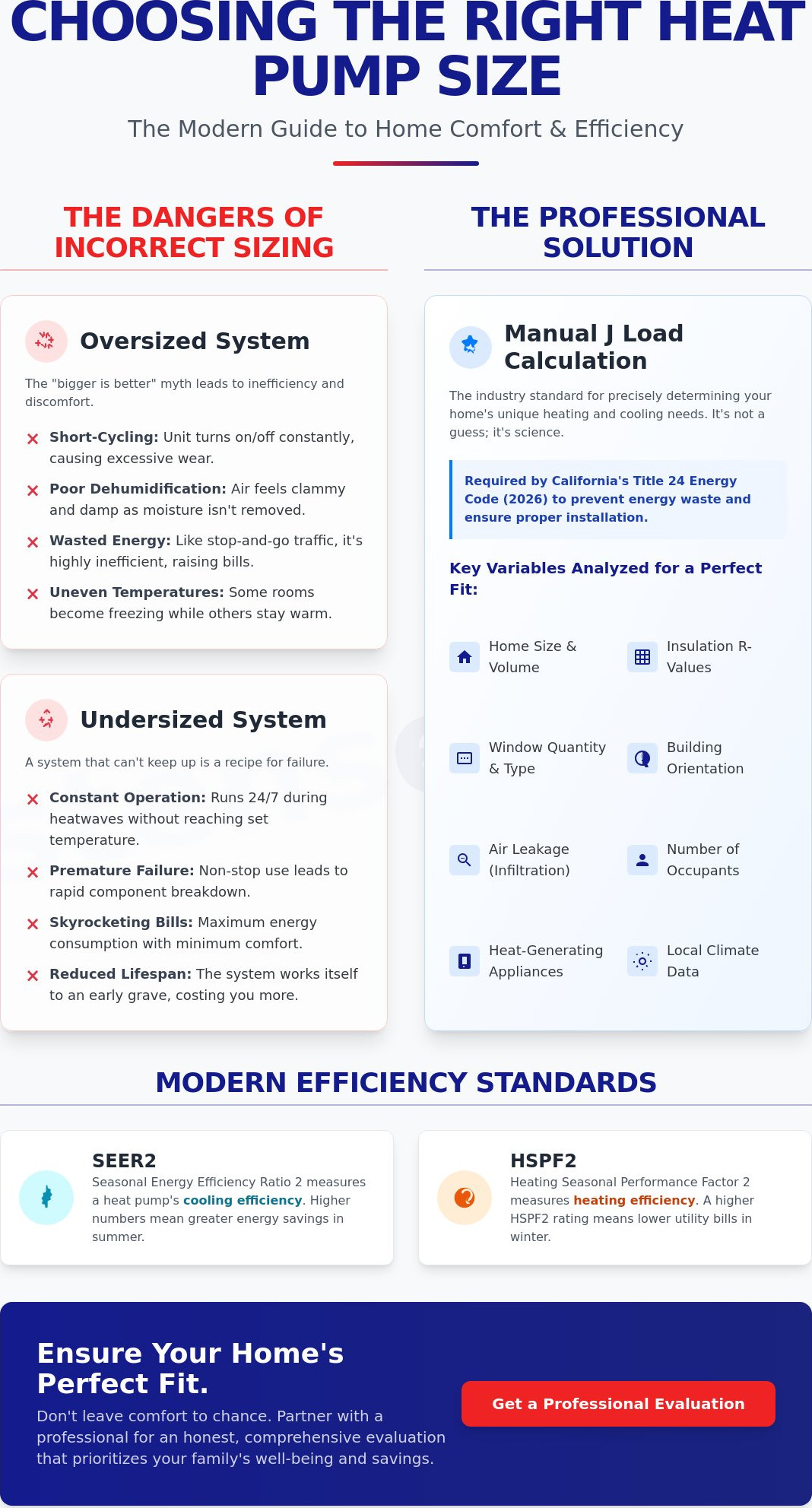
Many homeowners fall for the “bigger is better” trap. They assume a larger system will cool the house faster during a blistering July afternoon in Roseville. In reality, an oversized system cools the air so quickly that the thermostat shuts it off before it can finish a full cycle. This is called short-cycling. It puts massive wear and tear on the compressor and prevents the system from removing humidity. It’s like driving a car in stop-and-go traffic; it’s inefficient and burns through parts much faster than a steady cruise.
To better understand this concept, watch this helpful video:
On the flip side, an undersized unit is just as problematic. During a 105-degree Sacramento heatwave, a small system will run 24/7 without ever reaching your desired temperature. This constant operation leads to premature component failure and skyrocketing energy bills. We want your system to last its full expected lifespan. Proper sizing is the only way to ensure that longevity while protecting your home’s comfort.
Signs Your Current System is the Wrong Size
The signs of a sizing mismatch are often subtle until they become expensive. If your system is the wrong size, you’ll likely notice:
- The unit turns on and off every few minutes, never staying on for a full 10 to 15 minute cycle.
- Some rooms feel like ice boxes while others stay stuffy and warm.
- Your utility bills are significantly higher than your neighbors who have similar homes and habits.
The Impact on Indoor Air Quality and Comfort
A major part of home comfort is humidity control. Since oversized units shut off too early, they don’t run long enough to pull moisture from the air. This leaves your house feeling clammy even if the thermometer says it’s cool. Proper sizing ensures the airflow matches your ductwork capacity, preventing the “wind tunnel” noise of a system that’s too powerful for its pipes. If you’re looking for more ways to keep your home healthy, you can read our guide on how to improve indoor air quality. Learning how to choose the right size heat pump for my home is the first step in protecting your family’s sanctuary.
The Science of Sizing: The Manual J Load Calculation
We believe that a comfortable home starts with accurate data, not guesswork. For decades, many contractors relied on the “500 square feet per ton” rule of thumb to estimate system needs. This outdated method is now more than just inaccurate; it’s actually non-compliant with state regulations. As of January 1, 2026, the California Energy Code (Title 24) requires that heating and cooling loads be calculated for all new equipment to prevent the energy waste of oversized systems. When you ask how to choose the right size heat pump for my home, the professional answer always begins with a Manual J load calculation.
Manual J 8th Edition is the nationally recognized standard we use to determine the exact BTU capacity your home requires. We don’t just look at your floor plan; we use advanced software to create a complete thermal map of your living space. This precision allows us to select a system that maintains a steady temperature while keeping your monthly energy costs as low as possible. If you want to ensure your home is ready for the changing seasons, our team provides reliable heat pump services that prioritize technical accuracy over easy shortcuts.
Key Variables in a Load Calculation
A professional calculation considers every detail of your home’s construction. We measure the exact square footage and ceiling height of every room to determine the total volume of air that needs to be conditioned. We also evaluate the insulation levels in your attic, walls, and crawlspaces. Since Northern California is divided into 16 distinct climate zones, we factor in local weather patterns to ensure your heat pump can handle both our frosty winter mornings and searing summer afternoons. Even the tightness of your ductwork is measured to ensure the system performs as intended.
Why Your Home Orientation Matters
The direction your home faces can change your cooling needs by as much as 20 percent. In the Sacramento and Roseville area, West-facing windows are a major source of heat gain during the peak of the day. We look at the orientation of every window and door, along with the shading provided by trees or neighboring structures. We even calculate the heat generated by your indoor appliances and the number of family members in your household. This level of detail ensures your system provides the sanctuary of comfort you deserve without the mechanical stress of an improperly sized unit.
Northern California Climate Factors for Heat Pump Sizing
Living in the Sacramento Valley means preparing for a climate of extremes. We often see 100-degree afternoons followed by chilly, 30-degree winter nights. When you’re determining how to choose the right size heat pump for my home, we have to look beyond the record-breaking heatwaves. Instead, we use what’s called a “Design Temperature.” This is the temperature that our region stays at or below for 99 percent of the year. Sizing your system for that rare 112-degree day might seem safe, but it actually leads to the short-cycling problems we mentioned earlier. We want a system that runs steadily and efficiently during our typical summer conditions.
Our local geography plays a massive role in this calculation. The Sacramento Delta breeze is a blessing for our evening comfort, but your heat pump still needs the muscle to combat the dry, stagnant heat of the mid-afternoon. We take these regional nuances into account to ensure your home remains a sanctuary regardless of what the weather station says. A properly sized system will bridge the gap between the blazing sun and the cooling evening breeze without wasting energy.
The Sacramento Summer Challenge
In Placer County, we experience a dry Mediterranean climate that is perfect for heat pump technology. These systems are incredibly efficient at moving heat out of your home when the humidity is low. However, if your current unit is struggling to keep up with the rising July temperatures, it might be a sign of improper sizing or mechanical failure. If you find yourself in a bind, we offer emergency AC repair Roseville CA to get your home back to a safe temperature quickly while we evaluate your long-term needs. Understanding how to choose the right size heat pump for my home ensures your next system won’t leave you stranded in the heat.
Winter Heating Performance in the Foothills
Heating becomes the primary concern for our neighbors in Newcastle and Auburn. As you move into the higher elevations of the foothills, winter nights get significantly colder. Heat pumps are most efficient when the air is above freezing. When temperatures drop toward 30 degrees, the system has to work harder to extract warmth from the outside air. We often recommend sizing slightly differently for these microclimates or including backup electric heat strips. This ensures that even on the frostiest January morning, your family stays warm and secure without over-stressing the equipment. We’re here to help you find that perfect balance between summer cooling power and winter reliability.
Efficiency Ratings and Modern Inverter Technology
As of 2026, the metrics for measuring home comfort have become more precise than ever. We now look at SEER2 for cooling efficiency and HSPF2 for heating performance. These aren’t just new names; they represent a more rigorous testing standard that accounts for the actual pressure within your home’s ductwork. When you’re deciding how to choose the right size heat pump for my home, these ratings tell you how much energy the system will use to move heat. A higher number means more savings on your monthly bill, especially during those long Sacramento summers where the AC seems to never stop.
Modern technology has also introduced a layer of flexibility that didn’t exist a decade ago. Variable-speed inverter heat pumps can modulate their output. Unlike older systems that are either 100 percent on or completely off, an inverter system can run at 30 percent or 70 percent capacity depending on the current need. This makes “perfect” sizing slightly more forgiving. If your home’s load falls between two standard sizes, an inverter system can ramp down to prevent the short-cycling issues we discussed earlier. This adaptability is a game-changer for regional energy efficiency.
Understanding Tons vs. BTUs
Capacity is often discussed in two different units of measurement. A British Thermal Unit (BTU) is the amount of energy needed to cool or heat one pound of water by one degree. In the HVAC industry, we bundle these into “tons.” It’s that simple. One ton of capacity is equal to 12,000 BTUs. Most residential systems range from 1.5 to 5 tons to accommodate different home sizes. A 3-ton unit moves 36,000 BTUs of heat per hour. Knowing this conversion helps you understand the technical specifications your contractor provides during a quote.
Why We Recommend Inverter Systems
We often steer our neighbors toward inverter technology because it handles the unique Sacramento climate beautifully. On a mild spring day when you only need a little bit of cooling, an inverter system sips electricity rather than gulping it. This leads to significantly lower energy consumption over time. These units also operate with a whisper-quiet hum, protecting the peace and quiet of your backyard sanctuary. Choosing the right technology is just as vital as knowing how to choose the right size heat pump for my home. If you’re ready to see how these efficient systems can transform your space, our team is here to provide professional heat pump services tailored to your specific needs.
The Christensen Approach to Professional Sizing
At Christensen, we view our relationship with you as a partnership built on trust and honesty. We don’t believe in high-pressure sales tactics because we know that a comfortable home is a basic necessity for your family. When you ask us how to choose the right size heat pump for my home, we respond with a commitment to regional expertise and neighborly care. Our team takes personal pride in ensuring that every household in Northern California has a system that acts as a reliable protector of their sanctuary.
Our process begins with a deep dive into your home’s unique infrastructure. A common mistake in our industry is installing a high-efficiency heat pump into a failing distribution system. This is why our technicians carefully evaluate your existing vents and pipes during our visit. In many cases, a duct system replacement is the key to unlocking the true potential of your new equipment. We want to ensure that the air we condition actually reaches every corner of your living space without being lost to leaks or restricted by poor design.
The On-Site Evaluation Process
We perform comprehensive on-site evaluations that go far beyond a simple visual check. Our technicians measure the exact capacity of your ductwork to ensure it can handle the specific airflow requirements of a modern inverter system. We also inspect your electrical panel to confirm it meets the 2026 standards for a heat pump installation. This thoroughness allows us to provide a transparent, no-pressure quote for the right-sized system that fits your specific needs. We treat your environment with the same care we would apply to our own homes.
Ensuring Long-Term Reliability
Professional installation is about more than just getting the unit to turn on; it’s about protecting your long-term investment. A correctly sized and installed system ensures your manufacturer warranty remains valid and your equipment runs as efficiently as possible. To keep that performance steady over the years, we highly recommend our Comfort Club Maintenance Plan. This proactive care is one of the best ways to learn how to make my HVAC system last longer. Our hardworking team is dedicated to your safety and well-being. When you’re ready to find the perfect fit for your household, schedule your professional load calculation with Christensen to ensure your home remains a haven of comfort for years to come.
Secure Your Home’s Year-Round Comfort
Sizing your HVAC system is the most critical step in protecting your home’s sanctuary. By moving away from outdated rules of thumb and embracing the technical precision of a Manual J calculation, you ensure your family stays cool in July and warm in January. Modern inverter technology makes this process even more reliable by adapting to our unique Northern California climate zones while keeping energy costs low. These systems provide the steady, dependable performance your household deserves.
Determining how to choose the right size heat pump for my home doesn’t have to be a source of anxiety. Our family-owned and operated team has been serving Roseville, Rocklin, and the greater Sacramento area since 2009. We specialize in high-efficiency inverter heat pumps and take personal pride in every installation we perform. We’re here to provide the honest guidance and regional expertise you need to make the best decision for your household’s long-term well-being.
Get a Professional Heat Pump Sizing Estimate Today. We look forward to partnering with you to create a more efficient and comfortable environment for your loved ones.
Frequently Asked Questions
Can I size a heat pump based only on my home’s square footage?
No, square footage is only one small part of the equation. Relying on floor space alone ignores critical factors like your attic insulation levels, the type of windows you have, and your ceiling heights. A home with vaulted ceilings requires much more cooling capacity than a home with standard eight-foot ceilings. We use a Manual J calculation to account for all these variables so your system performs reliably for years.
What happens if my heat pump is too big for my house?
An oversized heat pump will cool your home too quickly, causing it to turn off before it can remove humidity from the air. This leads to a clammy, uncomfortable indoor environment and puts unnecessary stress on the compressor through constant starting and stopping. This short-cycling behavior shortens the lifespan of your equipment and prevents you from enjoying the steady comfort you deserve.
How much does a Manual J load calculation cost in Roseville?
The cost for a professional load calculation can vary based on the complexity of your home’s layout and the level of detail required. Many reputable local contractors include this service as a standard part of their installation estimate to ensure the equipment is sized correctly from the start. You should always ask your technician if a formal calculation is included in your quote to avoid any surprises later.
Is a 3-ton heat pump enough for a 2,000 square foot home?
It depends entirely on your home’s specific thermal performance and age. A modern home built with high-efficiency windows and R-49 attic insulation might stay perfectly comfortable with a 3-ton unit. However, a 1970s home in the Sacramento area with original single-pane windows likely needs more capacity. This is why understanding how to choose the right size heat pump for my home requires a professional on-site evaluation.
Does a ductless mini-split need a different sizing method?
Yes, ductless systems are sized room-by-room rather than using a single calculation for the entire house. Each indoor unit must be matched to the specific heating and cooling load of the individual room it serves. This allows for precise comfort in different zones of your home. We still use professional load calculations, but we apply them to each specific living space to ensure the outdoor condenser can support the total load.
Will a larger heat pump help with my high energy bills?
No, a larger system will almost always increase your monthly utility costs. HVAC systems use the most electricity during the startup phase. Because oversized units turn on and off frequently, they consume more power than a correctly sized unit that runs for longer, steadier cycles. True efficiency comes from a system that is perfectly matched to your home’s needs, allowing it to run at its intended performance level.
How do I find the BTU rating on my current HVAC unit?
You can find the capacity by looking at the model number on the data plate of your outdoor unit. Look for a two-digit number that is a multiple of 6 or 12, such as 18, 24, 30, 36, 42, 48, or 60. These numbers represent the BTUs in thousands. For example, a model number containing “36” indicates a 36,000 BTU or 3-ton system. If you’re unsure, our technicians can quickly identify this during a maintenance visit.
Should I size my heat pump for heating or cooling needs in Sacramento?
We look at both, but the cooling load is typically the dominant factor in the Sacramento Valley. Our 100-degree summer afternoons usually require more capacity than our 30-degree winter nights. When we determine how to choose the right size heat pump for my home, we ensure the unit can handle the peak summer heat while still providing enough warmth for the winter. Inverter technology helps bridge this gap by adjusting its output for both seasons.