





What if your air conditioner didn’t have to roar like a jet engine just to keep your home at 72 degrees during a 108-degree Sacramento July? Inverter heat pumps are changing the way local families handle these extreme heatwaves by ditching the noisy, all-or-nothing approach of older systems. We’ve all felt that familiar dread when the PG&E or SMUD bill arrives after a 100-degree week, especially when the upstairs bedrooms still feel like a sauna. It’s exhausting to pay a premium for comfort that feels inconsistent and loud.
Our team at Christensen Air believes your home should be a sanctuary, not a source of stress. By reading this guide, you’ll discover how this variable-speed technology can lower your monthly utility costs by 20 to 30 percent while providing the whisper-quiet operation your family deserves. We’ll walk you through the mechanics of efficiency and show you how to choose a system that stays reliable for 15 years or longer.
Key Takeaways
- Understand how the “dimmer switch” technology of inverter heat pumps provides precise temperature control while eliminating the energy spikes of traditional systems.
- Compare the real-world performance and whisper-quiet sound levels of variable-speed units against standard models during a scorching Sacramento summer.
- Determine if your specific home—whether an older neighborhood classic or a new build—is the ideal candidate for a high-efficiency system upgrade.
- Learn how to pair variable-speed technology with zoned HVAC systems to maximize comfort and energy savings in every room of your house.
- Discover why specialized professional installation is critical for ensuring your new system provides the long-term reliability and peace of mind your family deserves.
What is an Inverter Heat Pump and Why Does It Matter for Roseville Homes?
We believe your home should be a sanctuary of consistent comfort. At Christensen Air, we’ve seen how the right technology transforms a house into a peaceful retreat for your family. An inverter heat pump is a variable-speed comfort system that provides both heating and cooling in one highly efficient unit. It uses advanced inverter compressor technology to change its motor speed based on exactly how much heating or cooling your home needs at any given moment. This is a major shift from the technology of the past.
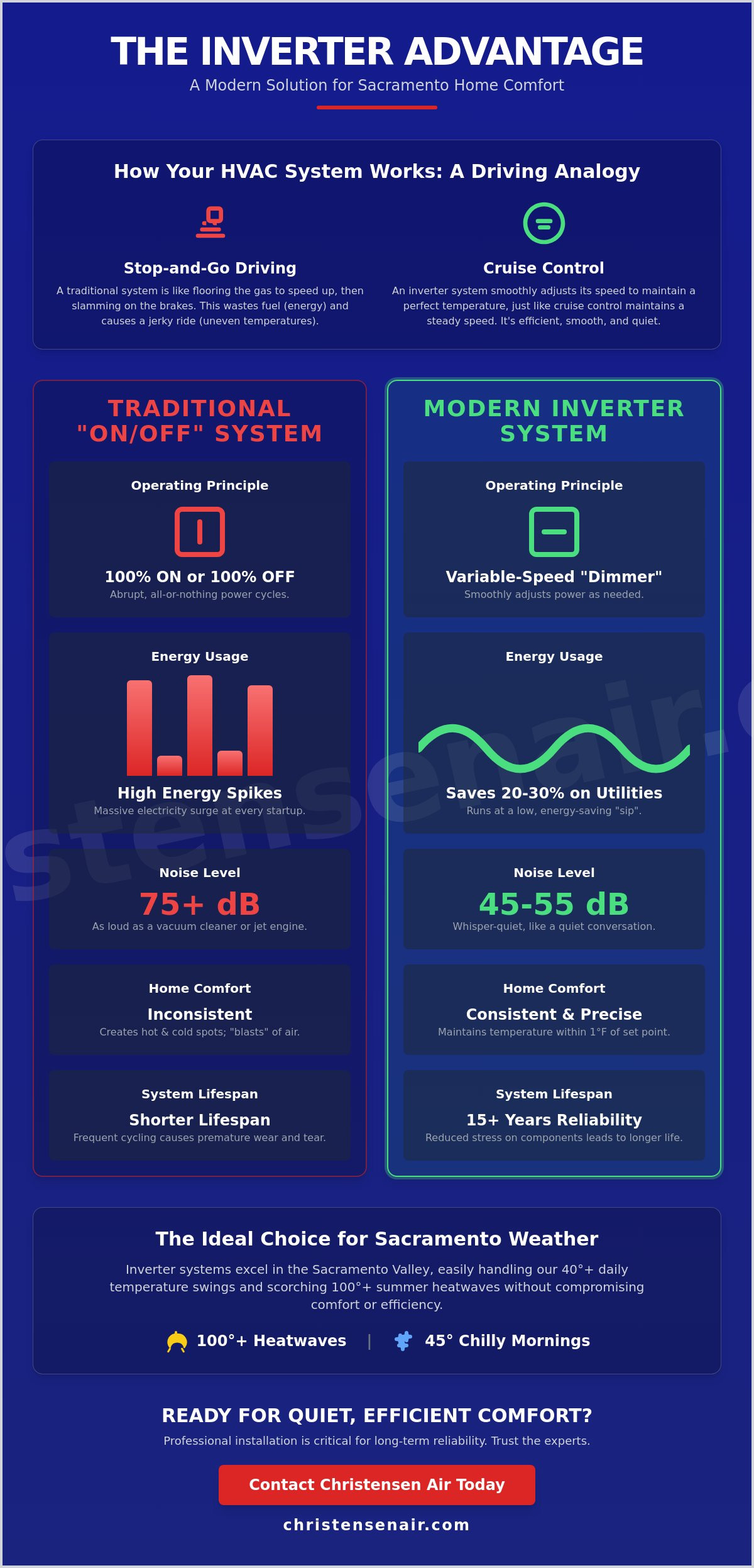
To understand the difference, think of a light switch versus a dimmer switch. A traditional unit is like a light switch; it’s either 100% on or 100% off. An inverter system works like a dimmer switch, smoothly scaling its power up or down. This precision is vital for the Sacramento Valley. In Roseville, we often experience 40-degree temperature swings within a single 24-hour period. Our systems must be flexible enough to handle a chilly 45-degree morning and a blazing 85-degree afternoon without skipping a beat.
To better understand this concept, watch this helpful video:
The Problem with Traditional “On/Off” Systems
Standard HVAC units are designed to run at full blast until they reach the set temperature, then they shut down entirely. This cycle repeats dozens of times a day. Every time a standard compressor kicks on, it requires a massive surge of electricity. For families in Folsom and Rocklin, this frequent cycling leads to premature wear and tear on expensive components. You often feel a “blast of cold air” followed by a period of stagnant warmth. This creates “hot spots” in your home and puts unnecessary stress on your electrical panel and your budget.
The Inverter Advantage in 2026
As we move through 2026, high-efficiency inverter heat pumps have become the standard for modern California living. New residential building codes and the statewide shift toward electrification make these systems more attractive than ever. By “modulating” or adjusting its power in small increments, an inverter system maintains a steady stream of comfort. These units can use up to 30% less energy than fixed-speed systems. We take personal pride in installing these systems because they offer our neighbors peace of mind through lower utility bills and superior reliability. It’s about protecting your home’s sanctuary with the most dependable technology available today.
How Inverter Technology Works: The Science of Variable Speed
The magic behind inverter heat pumps lies in the variable-frequency drive, or VFD. Think of this as the brain of your HVAC system. In a traditional unit, the compressor motor runs at one speed: 100%. It’s either roaring at full capacity or it’s completely silent. Our team often explains to Roseville families that this constant cycling is why older utility bills are so high. The VFD changes the frequency of the power sent to the motor, allowing it to “hunt” for the exact speed needed to keep your home within 1 degree of your thermostat setting. This precision means the system rarely turns off, instead running at a low, energy-saving sip of power for most of the day.
To make this possible, these systems use electronic expansion valves (EEVs). While older mechanical valves are clumsy, EEVs adjust refrigerant flow in real-time based on the exact cooling or heating demand. This makes the system an energy-efficient alternative to the bulky units of the past. Because the motor isn’t constantly grinding to a start, the operation is incredibly quiet. Most modern inverters produce about 45 to 55 decibels of sound, which is roughly the volume of a quiet conversation; this is a massive improvement over the 75-decibel rattle of a standard condenser.
The “Cruise Control” Analogy
A standard AC unit is like a driver who only knows how to use 0% or 100% throttle, flooring it to reach 70 mph and then slamming on the brakes until they hit 65 mph. An inverter maintains momentum, using just enough energy to keep the car moving steadily at the speed you set. This steady pace is vital for humidity control. On those rare muggy Sacramento nights when the air feels heavy, the long, low-speed cycles of an inverter heat pump have more time to pull moisture out of your indoor air, making your home feel much cooler without dropping the temperature too low.
Flash Injection and Cold-Weather Performance
Many homeowners in Auburn or Placerville worry about heat pumps failing when the temperature drops. Modern units solve this with flash injection technology. This process injects a small amount of refrigerant into the compressor to keep it from overheating while it works harder in the cold. It allows the system to provide steady heat even when outdoor temps hit 5 degrees Fahrenheit. This level of performance makes an inverter a legitimate gas furnace alternative for our local climate. You get the efficiency of heat transfer without the high cost of backup electric strip heating. If you’re curious about how this fits your floor plan, our family-run team at Christensen Air can help you size a system that ensures year-round peace of mind.
Inverter vs. Standard Heat Pumps: A Practical Comparison
We want you to feel completely confident when choosing a new system for your home. To understand the value of inverter heat pumps, it helps to compare them to the standard single-stage units most of us grew up with. A standard heat pump operates like a light switch; it is either 100% on or completely off. This leads to a cycle of “short-cycling” where the system starts and stops frequently. This constant toggling puts immense strain on the compressor and shortens the system’s lifespan to roughly 12 or 15 years. In contrast, an inverter system acts like a dimmer switch, adjusting its speed to meet your home’s exact needs without the constant wear and tear of stopping and starting.
The U.S. Department of Energy explains heat pump technology by highlighting how variable-speed compressors allow these systems to operate at much higher efficiency levels. During a typical 105-degree July afternoon in Sacramento, a standard unit will blast at full capacity, shut off, and then kick back on a few minutes later. An inverter unit will simply ramp down to 25% or 50% capacity, maintaining a steady temperature while using a fraction of the electricity. This also makes a massive difference in noise levels. While a standard unit might roar at 72 to 76 decibels, a high-quality inverter often operates as quietly as 54 decibels. That is the difference between a loud vacuum cleaner and a quiet conversation on your patio.
Energy Efficiency and Monthly Savings
When we look at the numbers, the efficiency gap is clear. Standard units often meet the minimum requirement of 14.3 SEER2, but inverter heat pumps frequently reach 20 SEER2 or higher. For our neighbors using SMUD or PG&E, this efficiency is vital during peak-rate hours between 4 PM and 9 PM. By avoiding the massive energy spikes required to start a single-stage motor, you keep your demand low when prices are highest. While the initial investment for an inverter system is higher, the 10-year total cost of ownership is often lower due to reduced monthly bills and fewer mechanical repairs caused by short-cycling.
Indoor Comfort and Air Quality
We often hear from families who struggle with hot and cold spots in rooms far from the air handler. Standard systems often shut off before the air can reach the furthest corners of your home. Because an inverter system runs for longer periods at a lower speed, it provides a gentle, continuous flow that eliminates those uncomfortable temperature swings. This steady movement is also a key factor in how to improve indoor air quality in your Roseville home. When air cycles through your filtration system more consistently, it captures more dust, pet dander, and pollen. You aren’t just staying cool; you’re protecting the sanctuary and well-being of your household.
Is an Inverter Heat Pump Right for Your Local Neighborhood?
We see a wide variety of housing styles across our region. A 1940s cottage in East Sacramento has very different thermal needs than a modern 4,000-square-foot estate in El Dorado Hills. Because inverter heat pumps adjust their output in real-time, they’re uniquely suited for both. However, we never guess on sizing. Our team performs a detailed Manual J load calculation for every home. This process accounts for your insulation quality, window types, and local sun exposure. It ensures your system provides perfect comfort without wasting energy or cycling too frequently.
Local Financial Incentives in 2026
Financial relief makes the transition to high-efficiency electric cooling easier than ever. As of January 2026, the federal 25C tax credit allows homeowners to offset 30% of their installation costs. This credit is capped at $2,000 per year specifically for heat pump upgrades. For our neighbors in Sacramento, SMUD continues to offer robust rebates for those switching from gas furnaces to electric systems. If you live in a PG&E service area, you can access specific Central Valley incentives designed to reward high-efficiency cooling choices. These programs help protect your family budget while you upgrade your home’s sanctuary.
Zoning: The Perfect Partner for Inverters
If you live in a multi-story home in Granite Bay or Lincoln, you probably know the frustration of a hot upstairs while the downstairs feels like a refrigerator. Pairing an inverter system with zoned HVAC systems is the most effective way to fix this. Traditional units are either 100% on or 100% off. This makes it hard to cool just one small area. Variable-speed motors in inverter heat pumps can ramp down to low capacities. This allows them to deliver a gentle, steady stream of air to a single zone without over-pressurizing your ductwork or wasting electricity on empty rooms.
- Manual J Accuracy: We measure every room to ensure your high-tech equipment isn’t oversized for your ductwork.
- Insulation Awareness: We adjust our recommendations based on whether you have original 1950s insulation or modern spray foam.
- Neighborhood Expertise: We understand the specific microclimates of the Roseville and Sacramento area.
We take pride in helping our local families find the right balance between technical performance and household budget. Our goal is to ensure your home stays comfortable regardless of how high the temperature climbs in the Central Valley. If you’re ready to see how these systems fit your specific floor plan, contact our family-owned team today for a professional home assessment.
The Christensen Air Approach to Inverter Installation & Care
Choosing the right HVAC system is only half the battle for a comfortable home. The team behind the tools makes the real difference in how that system performs over the next 15 years. At Christensen Heating and Cooling, we believe our family-owned values are what keep Sacramento homes comfortable regardless of the record-breaking heat outside. Since we opened our doors in 2009, we’ve focused on building long-term relationships through honesty and technical precision. We don’t just see a house; we see a family sanctuary that deserves reliable protection.
Modern inverter heat pumps are far more complex than the heavy-duty “on or off” units of the past. These systems rely on sophisticated inverter boards and communication wires that act as the brain of the unit. Because of this, specialized training is a requirement, not an option. Our technicians spend hours mastering the diagnostics of variable-speed technology. This expertise allows us to identify minor electrical fluctuations before they lead to a system lockout. We prioritize clear, informative guidance to help you understand your tech without the high-pressure sales tactics common in the industry.
Expert Installation Matters
Many contractors still use a “set it and forget it” mentality during installation. This approach is dangerous for high-efficiency systems. If a technician doesn’t properly calibrate the inverter board to the specific ductwork of your Roseville home, the system will never reach its rated efficiency. We take the time to adjust airflow and refrigerant charges to match our local climate. Our dry summers and cool Delta breezes require specific settings that a generic installation manual might overlook. We treat your property with the same respect we show our own homes, ensuring every connection is secure and every setting is optimized for peak performance.
Protecting Your Investment
An inverter system is a significant investment in your home’s future. To keep it running at 100 percent, regular maintenance is vital. Standard checkups often miss the nuanced data points that variable-speed systems provide. This is why we developed the Christensen Comfort Club. Our members receive dedicated attention that focuses on the longevity of these advanced components. Benefits of the club include:
- Two comprehensive precision tune-ups every year to ensure seasonal readiness.
- Priority scheduling for any unexpected service needs.
- Detailed inspections of the inverter drive and communication sensors.
- Discounts on repairs to keep your long-term costs manageable.
When you sit down with us for a professional consultation, we won’t just hand you a quote. We’ll perform a thorough evaluation of your home’s needs and discuss how inverter heat pumps can solve your specific hot or cold spots. We want you to feel confident and reassured that your family’s comfort is in good hands. Our goal is to provide the steady, dependable service that has made us a local fixture for over a decade.
Take Control of Your Home Comfort Today
Upgrading to inverter heat pumps transforms how your household experiences the changing seasons in Roseville and Sacramento. Unlike traditional systems that constantly cycle on and off, this variable-speed technology maintains a steady temperature to eliminate cold spots and reduce energy waste. You’ll benefit from systems that meet 2026 efficiency standards and qualify for significant SMUD or PG&E rebates. These local programs help offset the initial investment while providing long-term savings on every monthly utility bill.
Christensen Air has been family-owned and operated since 2009. We understand the specific climate challenges of the Sierra Foothills and prioritize your family’s peace of mind. We don’t believe in high-pressure sales; we focus on clear guidance and expert installation. Our team ensures your new system is sized correctly for maximum performance and reliability. Let’s work together to make your home the sanctuary you deserve—and if that sanctuary includes a pool, you can read more about keeping it in pristine condition year-round.
Request a Free Inverter Heat Pump Estimate for Your Home
We look forward to serving your family and bringing lasting comfort to your doorstep.
Frequently Asked Questions
Are inverter heat pumps really worth the extra money?
Yes, inverter systems are worth the investment because they reduce energy consumption by up to 40% compared to single-stage units. We see these systems paying for themselves through lower utility bills and increased home comfort. The variable-speed technology eliminates the harsh blast of air associated with older units, maintaining your indoor temperature within 0.5 degrees of your thermostat setting at all times.
Do inverter heat pumps work in freezing temperatures like we see in Auburn?
Modern inverter heat pumps are specifically designed to operate efficiently even when outdoor temperatures drop to -5 degrees Fahrenheit. While Auburn rarely sees those extremes, these systems maintain 100% heating capacity at 5 degrees. This ensures your family stays warm without relying on expensive backup heat strips during a winter cold snap, providing you with total peace of mind.
How much can I save on my SMUD or PG&E bill with an inverter system?
Homeowners typically see a 20% to 50% reduction in heating and cooling costs after switching from a standard 14 SEER unit. According to the Department of Energy, high-efficiency heat pumps save an average of $1,000 per year. Since SMUD and PG&E rates have increased consistently over the last few years, these efficiency gains help protect your monthly household budget from rising utility costs.
What is the average lifespan of an inverter heat pump compared to a standard AC?
You can expect an inverter system to last 15 to 20 years with regular professional maintenance. Standard air conditioners often begin to fail around the 12-year mark due to the mechanical stress of constant on-and-off cycling. Because inverter motors ramp up and down slowly rather than crashing on and off, they experience less wear and tear over their operational lifetime.
Can I use my existing ductwork for a new inverter heat pump installation?
Yes, we can often integrate inverter heat pumps with your current duct system after performing a thorough static pressure test. Our team checks for leaks and ensures your ducts can handle the consistent airflow these systems provide. If your ducts are undersized for your home’s needs, we’ll suggest small modifications to ensure 100% system performance and long-term reliability.
Are inverter heat pumps quieter than traditional air conditioners?
Inverter units are significantly quieter, operating at sound levels as low as 45 decibels during normal use. For comparison, a traditional AC unit often runs at 72 decibels or higher. This means you can enjoy a conversation on your patio or sleep soundly without the loud clunk and roar of a standard compressor starting up in the middle of the night.
What happens if the inverter board fails?
If the inverter board fails, the system will stop running and display a specific error code for our technicians to diagnose. Most major manufacturers provide a 10-year parts warranty that covers the cost of a replacement board if it fails due to a defect. We prioritize these repairs to restore your home’s comfort quickly, as the board is the brain that manages your system’s efficiency.
Do these systems qualify for the $2,000 federal tax credit in 2026?
Yes, high-efficiency heat pumps qualify for the Energy Efficient Home Improvement Credit, which provides a tax credit of up to $2,000 annually. This incentive was established by the Inflation Reduction Act of 2022 and is scheduled to remain available through 2032. We’ll provide all the necessary documentation so your family can confidently claim this credit on your 2026 tax return.