






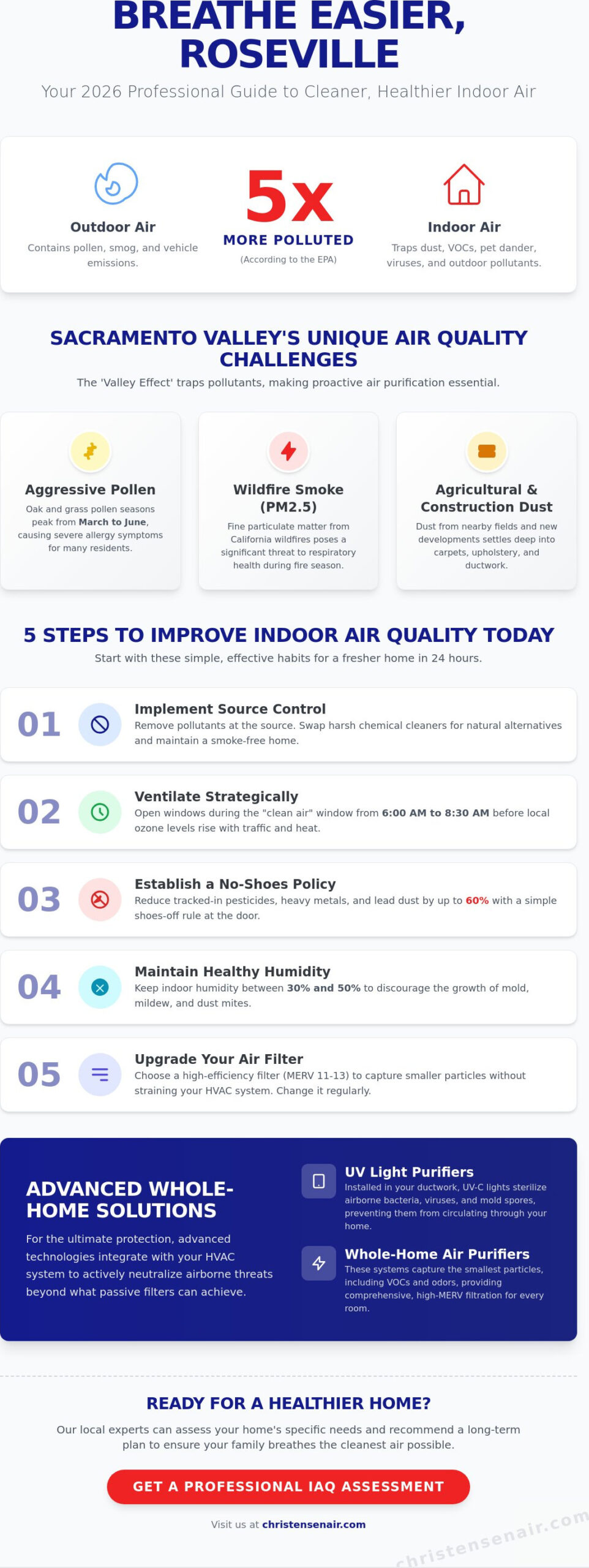
Did you know that the air inside your Roseville living room can be up to five times more polluted than the air outside near Highway 65? According to the Environmental Protection Agency, indoor pollutant levels often soar far above outdoor levels because modern homes are sealed so tightly. We all want our homes to be a safe haven from the Sacramento Valley’s heavy pollen counts and the recurring threat of summer wildfire smoke. Learning how to improve indoor air quality is the first step toward stopping the dust from settling on your furniture just hours after cleaning. You deserve a home that feels as fresh as it looks.
At Christensen Air, we believe your family’s comfort starts with the air you breathe. This 2026 guide provides the professional solutions and actionable steps you need to protect your household from local pollutants. We’ll walk through everything from high-efficiency filtration to whole-home purification systems that work with your existing HVAC setup. We’re here to share our local expertise so you can reduce allergy symptoms and enjoy a fresher, cleaner home for years to come. It’s our way of helping you find true peace of mind in your own sanctuary.
Key Takeaways
- Understand why Roseville homes often trap more pollutants than the outdoors and how our local climate impacts your family’s respiratory health.
- Discover how to improve indoor air quality immediately through simple source control and strategic ventilation during Placer County’s cleanest hours.
- Learn how to choose the right air filter to protect both your family’s lungs and your HVAC system’s motor from unnecessary strain.
- Explore advanced technologies like UV lights that go beyond passive filtering to actively neutralize airborne bacteria and viruses.
- Build a long-term plan that combines daily habits with professional oversight to ensure your home remains a healthy sanctuary year-round.
Why Indoor Air Quality Matters in the Sacramento Valley
We often think of our homes as safe havens from the dusty trails of Roseville or the heavy traffic on I-80. However, indoor air quality (IAQ) refers to the concentration of pollutants within your building’s air, and it is a growing concern for local families. Recent data shows that homes in Rocklin and Roseville often have pollutant levels 2 to 5 times higher than the air outside. This occurs because of the ‘Valley Effect,’ a geographical phenomenon where the Sierra Nevada and Coastal ranges act like a bowl, trapping smog, vehicle emissions, and allergens right at ground level. Understanding how to improve indoor air quality starts with recognizing that our local geography keeps these particles from naturally dispersing.
To better understand how these invisible particles affect your health, watch this helpful video:
Poor IAQ isn’t just a minor inconvenience; it impacts your family’s long-term well-being. Short-term effects often include constant sneezing, itchy eyes, or headaches that seem to disappear when you leave the house. Over time, exposure to poor air can lead to chronic respiratory issues and decreased sleep quality. We want to help you protect the sanctuary of your household by addressing these risks before they become a burden on your health or your wallet.
Local Pollutant Profiles: Pollen, Dust, and Smoke
In Sacramento County, our oak and grass pollen seasons are particularly aggressive, typically peaking between March and June each year. Particulate Matter (PM2.5) stands as the primary threat to our respiratory health during California wildfire seasons. For our neighbors in Loomis and Lincoln, agricultural dust from nearby fields and orchards frequently enters suburban homes through small gaps in window seals, settling deep into carpets and upholstery. These local factors make learning how to improve indoor air quality a necessity for every household in the region.
The ‘Tight Home’ Paradox
Modern, energy-efficient homes in Granite Bay are built to be airtight to save on utility bills, but this creates a ‘tight home’ paradox where stale air is trapped inside. Volatile Organic Compounds (VOCs) from new furniture, carpets, and building materials can linger for months without proper ventilation. We view your HVAC system as the ‘lungs’ of your home. It must be managed with precision to ensure it filters out these chemicals while providing the fresh air your family needs for peace of mind. Our team takes personal pride in helping you balance energy efficiency with a healthy living environment.
5 Immediate Steps to Improve Your Indoor Air Quality Today
We believe your home should be a sanctuary where your family breathes easy. Learning how to improve indoor air quality doesn’t always require a massive renovation; it starts with simple, intentional habits. Our team has seen how small changes in Roseville households lead to significant health benefits. By focusing on these five steps, you can create a cleaner environment in just 24 hours.
- Implement source control: The most effective way to protect your air is to remove the problem at the start. This involves swapping out harsh synthetic cleaners for natural alternatives and ensuring no tobacco products are used inside. Citing basic strategies to improve indoor air quality helps us understand that stopping pollutants before they enter the air is more efficient than trying to filter them out later.
- Optimize natural ventilation: Take advantage of the “clean air” window in the Placer County morning. Opening your windows between 6:00 AM and 8:30 AM allows fresh air to circulate before daily traffic and heat increase local ozone levels.
- Establish a no-shoes policy: Shoes track in more than just dirt. They carry pesticides, heavy metals, and lawn chemicals. A 2025 study showed that a strict “shoes off” rule can reduce indoor lead dust by up to 60%.
- Maintain humidity levels: Keep your home between 30% and 50% humidity. In Diamond Springs homes, moisture levels exceeding 55% can trigger mold spores to colonize on drywall and upholstery in less than 48 hours.
- Use a HEPA-filter vacuum: Regular vacuuming with a HEPA machine is vital. These filters are designed to capture 99.97% of particles as small as 0.3 microns, preventing dust and dander from being kicked back into your breathing zone.
Smart Ventilation Strategies
Check the Sacramento Air Quality Index (AQI) daily before you open your home. If the AQI exceeds 100, it’s better to keep windows shut. Use your kitchen and bathroom exhaust fans for at least 20 minutes after cooking or showering. This simple act vents moisture and volatile organic compounds (VOCs) directly outside. During high-pollen days in the spring, keep your thermostat on the “fan on” setting. This ensures your indoor air is constantly passing through your home’s filtration system rather than sitting stagnant.
Controlling Allergens at the Source
Reducing your home’s “chemical load” is a primary goal for long-term health. Switch to low-VOC paints and cleaning supplies to prevent off-gassing. For pet owners, frequent grooming and keeping bedrooms as pet-free zones can lower dander levels by 50% in sleeping areas. Gaining a deeper understanding of what is hvac technology allows you to see how these particles travel through your vents and return to your living spaces. If you’re worried about your home’s current air levels, the family at Christensen Air is here to help with a professional air quality check.
Optimizing Your HVAC System for Cleaner Air
We view your HVAC system as the lungs of your Roseville home. It circulates air through every room multiple times per hour, making it the most critical tool for managing your home environment. When you’re looking at how to improve indoor air quality, the air filter is your first and most important line of defense. Many homeowners rely on basic fiberglass filters, but these are designed only to protect the mechanical parts from large “boulders” of dust. They don’t capture the microscopic pollutants that affect your family’s health.
We often suggest upgrading the air filter in your HVAC system to high-efficiency pleated options. These filters have significantly more surface area to trap pollutants like wildfire smoke, pollen, and dust mites. It’s a simple change that makes a massive difference in how your family feels every day, especially during the peak allergy seasons we see here in Placer County.
Understanding MERV Ratings
MERV stands for Minimum Efficiency Reporting Value, and it’s the industry standard for measuring filter effectiveness on a scale of 1 to 20. For most residential systems in the Sacramento Valley, we’ve found that MERV 8 to 11 is the ideal “sweet spot.” These filters capture up to 85% of large particles and a significant portion of smaller ones without restricting the airflow your system needs to breathe.
You should be cautious about using filters rated MERV 16 or higher unless your system is specifically modified for them. These high-density filters create high static pressure. In the middle of a 105-degree Roseville afternoon in July 2026, that extra strain can cause your blower motor to overheat or your evaporator coil to freeze. We want you to have clean air, but we also want to ensure your system doesn’t fail when you need it most. Our team can help you find the highest rating your specific equipment can handle safely.
The Impact of Regular Maintenance
Airflow is the lifeblood of your home’s comfort. When filters are neglected, dust and debris eventually find their way onto your evaporator coil. This coil is naturally damp from the dehumidification process, which makes it a prime breeding ground for biological growth and mold. This buildup doesn’t just ruin your air quality; it also kills efficiency and forces your utility bills to climb.
In our years of service, we’ve seen that the need for ac repair roseville homeowners experience often starts with these simple airflow restrictions. We created our Comfort Club to prevent these issues before they start. By joining this partnership, you get regular professional cleanings that keep your coils pristine and your air fresh. It’s our way of looking out for our neighbors and ensuring your home remains a sanctuary of health and reliability. Consistent maintenance is the only way to ensure how to improve indoor air quality remains a long-term reality rather than a temporary fix.
Advanced Purification: UV Lights and Ductwork Solutions
Standard air filters are passive. They sit and wait for particles to hit them. If you want to know how to improve indoor air quality effectively, you have to look at active purification. We often recommend Ultraviolet Germicidal Irradiation (UVGI) to our neighbors who want a deeper level of protection. This technology does not just catch germs; it destroys them before they ever reach your living room.
UV-C light operates at a 254-nanometer wavelength. This specific frequency penetrates the cellular walls of biological contaminants. It scrambles the DNA of mold spores, bacteria, and viruses so they cannot reproduce or cause illness. This is a top recommendation for Carmichael families dealing with chronic allergies or weakened immune systems. When we install these lights directly inside your air handler, they also prevent “dirty sock syndrome.” This is that musty, damp smell caused by microbial growth on your cooling coils. By neutralizing these pathogens at the source, you ensure the air circulating through your home is truly clean.
UV Light Installation Benefits
Installing UV lights provides a constant cleaning cycle for your HVAC components. By keeping the evaporator coil clear of organic growth, your system runs more efficiently and maintains better airflow. This is not just about health; it is about protecting your equipment. A clean coil can improve heat transfer by up to 15 percent. This lowers your monthly utility bills while keeping your home comfortable and safe.
When to Consider Duct System Replacement
There is a common misconception that duct cleaning is a permanent fix for a dusty home. While cleaning has its place, it is often a temporary band-aid for deeper structural issues. For many homes in El Dorado Hills built more than 20 years ago, the original flexible ductwork is often degraded. When the inner lining of your ducts breaks down, it creates gaps that pull in unfiltered attic dust, rodent waste, and fiberglass insulation fibers.
According to Energy Star data, the average home loses 20 to 30 percent of its conditioned air through these leaks. If your home remains dusty despite constant cleaning, or if you notice uneven temperatures between rooms, your ducts are likely contaminating your air. A professional duct system replacement using modern R-8 insulated materials ensures that the air you breathe is the same air you just paid to filter. This upgrade is one of the most effective ways to master how to improve indoor air quality for the long term.
Creating a Long-Term Healthy Home Plan in Roseville
Achieving lasting results for your family requires more than a one-time fix. We believe the secret to how to improve indoor air quality lies in the balance between your daily habits and our professional technical oversight. While high-tech gadgets help, your consistency remains the most powerful tool in your arsenal. We view ourselves as your partners in this journey, helping you turn complex HVAC data into a simple, manageable routine.
We often see homeowners searching for the most expensive “hospital-grade” filter available. In reality, a standard MERV 8 or 11 filter changed every 90 days outperforms a premium filter left in for six months. When your system works harder to pull air through a clogged, expensive filter, it reduces efficiency and can even damage your blower motor. During the peak cooling months of July and August, we recommend checking that filter every 30 days to keep your air moving freely.
Consumer IAQ monitors have improved significantly by 2026. Investing in a device that tracks PM2.5 levels gives you real-time data during our local wildfire seasons. When outdoor levels exceed 50 µg/m³, you’ll know exactly when to seal your windows and activate your system’s recirculate mode. This proactive approach takes the guesswork out of your home’s safety.
Seasonal IAQ Checklists
Spring: Prepare for the Sacramento Valley pollen explosion that typically peaks between March and May. We recommend a full duct inspection before the oak and cedar counts skyrocket to ensure allergens aren’t settling in your vents. This is also the best time to test your system’s dehumidification performance before the valley heat arrives.
Summer: Focus on smoke infiltration and high-load filtration. Our local wildfire season demands that your system is ready for heavy use. Ensure your weather stripping is intact and your HVAC system has the static pressure capacity to handle a MERV 13 filter if air quality dips due to regional fires. We can help you calibrate your system to handle these denser filters safely.
Winter: This is the season for gas furnace safety checks. We focus on carbon monoxide monitoring and combatting the 15% humidity levels that often lead to dry skin and respiratory irritation. Keeping your furnace burners clean ensures you aren’t introducing combustion byproducts into your breathing zone while the house is sealed tight.
Your Next Steps for Better Air
Every Roseville home has a unique footprint. A professional IAQ consultation allows us to measure the specific airflow and pollutant levels in your living space. We don’t believe in one-size-fits-all solutions. Our team treats your home like our own, providing honest recommendations that prioritize your family’s health over a quick sale. This local expertise ensures you aren’t overspending on equipment you don’t need.
Small changes, like upgrading your vacuum’s HEPA filter or learning how to improve indoor air quality through better ventilation, create a compound effect. We’re here to guide you through these choices. As a local, family-owned business, our goal is to ensure you breathe easy every single day. Your home should be your sanctuary, and we’re committed to keeping it that way.
Take Control of Your Home’s Health and Comfort
Your home should be a sanctuary where every breath feels refreshing. We’ve covered the essential steps for optimizing your HVAC system and the benefits of high-tech solutions like UV light installations. By learning how to improve indoor air quality, you’re making a vital investment in your family’s long-term well-being. Since 2009, our family-owned and operated team has served the Sacramento Valley with a commitment to honesty and technical excellence. We understand the specific seasonal pollutants that affect Roseville homes; we’re here to help you eliminate them for good.
We specialize in professional duct replacement and advanced purification systems that provide lasting peace of mind. You don’t have to navigate these technical choices alone. Our experts bring over 15 years of local experience to every project, treating your living space with neighborly care and respect. We’re ready to help you breathe easier and live better. Schedule a Professional IAQ Consultation with Christensen Heating and Cooling to begin your journey toward a cleaner, healthier home today. You deserve a house that supports your health every single day.
Frequently Asked Questions
Is it better to run the HVAC fan on ‘Auto’ or ‘On’ for air quality?
We recommend running your HVAC fan in the “On” position to provide continuous filtration and air movement. While the “Auto” setting only cycles air during heating or cooling, keeping the fan running ensures your air passes through the filter 24 hours a day. This constant circulation helps capture airborne particles and maintains a more consistent temperature throughout your Roseville home.
Can indoor plants actually remove significant amounts of pollutants from my home?
Most indoor plants don’t remove a significant amount of pollutants from a standard living space. A 1989 NASA study suggested plants could clean air, but recent research from Drexel University in 2019 found you’d need between 10 and 1,000 plants per square meter to match the air exchange rate of a typical ventilation system. We suggest focusing on mechanical filtration for real results.
How often should I change my air filter during a California wildfire?
You should check your air filter every 7 days and likely replace it every 2 to 4 weeks during active California wildfires. Smoke carries fine particulate matter, known as PM2.5, that clogs filters 3 times faster than normal household dust. Keeping a fresh filter in place is a critical step in how to improve indoor air quality when the Air Quality Index exceeds 150 in the Sacramento Valley.
What is the best MERV rating for a standard home HVAC system?
A MERV 11 or MERV 13 filter offers the best balance of filtration and airflow for most residential systems. MERV 13 filters capture at least 90 percent of large particles and 50 percent of smaller particles like smoke and bacteria. We don’t recommend going above MERV 13 without a professional evaluation, as higher ratings can restrict airflow and strain your blower motor.
Do UV lights in my HVAC system really kill viruses and bacteria?
UV-C germicidal lights effectively neutralize 99.9 percent of certain viruses, bacteria, and mold spores that pass through your HVAC system. These lights break down the DNA of microorganisms to prevent them from reproducing. We install these lamps near the evaporator coil to keep the system clean and ensure the air your family breathes remains as healthy as possible.
How do I know if my home’s air quality is actually poor?
You can identify poor air quality by tracking physical symptoms like frequent headaches, dry eyes, or increased asthma flare-ups among 2 or more family members. Visible signs like heavy dust buildup on surfaces within 3 days of cleaning also indicate issues. For a precise reading, we use professional monitors to measure VOC levels and particulate counts to show you exactly what’s in your air.
Is duct cleaning or duct replacement better for air quality?
Duct replacement is better if your current ductwork is over 15 years old or has visible gaps where 20 percent of your conditioned air might be escaping. Cleaning is a great maintenance step for newer ducts, but it won’t fix structural issues or mold growth embedded in old insulation. We’ll help you determine if a fresh start with new R-8 insulated ducting is the right choice for your home’s health.
What should the humidity level be in my Sacramento home during winter?
You should aim to keep your home’s humidity between 30 percent and 50 percent during the Sacramento winter. When levels drop below 30 percent, your skin gets dry and viruses can spread more easily. Maintaining this balance is a key part of how to improve indoor air quality because it prevents both the survival of pathogens and the growth of dust mites.