





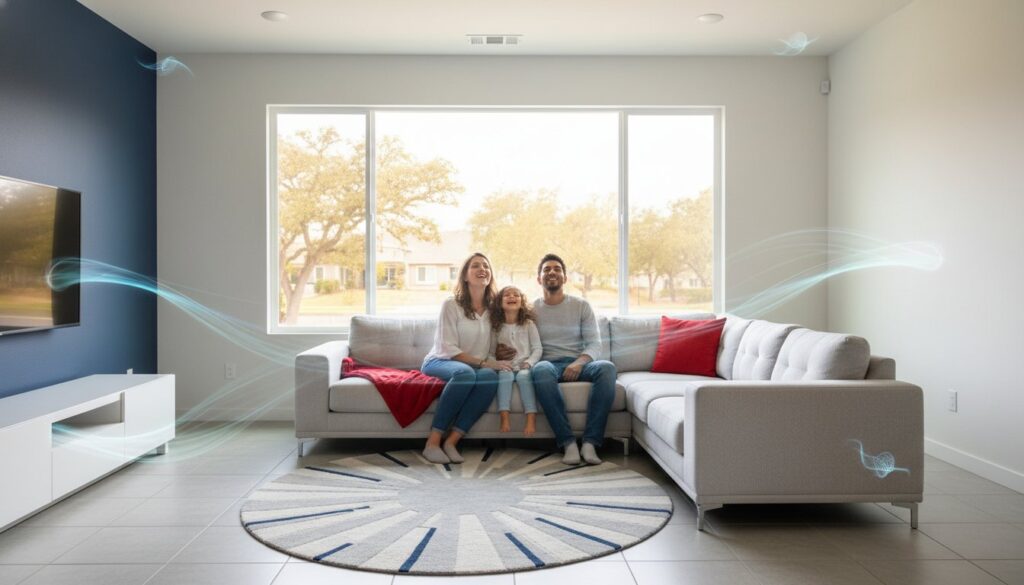
Last Tuesday, a Roseville homeowner told us they felt more congested inside their house than they did while gardening at Maidu Regional Park. It’s a frustrating reality for many, especially since data shows that nearly 25% of residents in the Sacramento Valley struggle with seasonal sensitivities. You shouldn’t have to fight for every breath in your own living room. Optimizing your hvac for allergies is about more than just swapping a filter; it’s about reclaiming your home’s air quality and your family’s peace of mind.
We agree that the confusion over MERV ratings and constant dust accumulation can feel overwhelming. You deserve a clear path to comfort that doesn’t involve high-pressure sales or technical jargon. Our team at Christensen Air is here to help you turn your home into a true pollen-free sanctuary with strategies designed for our local environment. In this 2026 guide, we’ll walk you through the best filtration levels for your specific equipment, the benefits of modern air purification, and the routine care steps that keep your household breathing easy all year long.
Key Takeaways
- Discover why the Sacramento Valley is called “Allergy Alley” and how we can turn your existing system into a powerful whole-home air scrubber.
- Learn how to navigate MERV ratings to select high-efficiency filters that actually capture microscopic pollen instead of letting it circulate through your living spaces.
- Explore active purification technologies like UV-C lights to eliminate mold growth and maximize the effectiveness of your hvac for allergies.
- Get a practical, step-by-step checklist to allergy-proof your home this season, starting with essential maintenance to clear out accumulated winter dust.
- Find out how leaky ductwork might be pulling attic pollutants into your breathing air and how professional sealing provides lasting peace of mind for your family.
Understanding the Sacramento Sneeze: Why Your HVAC is Your Best Defense
Living in the Sacramento Valley means dealing with a unique environmental challenge. We often call this region “Allergy Alley” because our geography traps particulates between the coastal range and the Sierras. Your heating and cooling system does more than just regulate temperature; it acts as a whole-house air scrubber. We see our neighbors in Roseville struggling with itchy eyes and sneezing every spring, and we want you to know that your home can be a true sanctuary. A properly maintained hvac for allergies is your first line of defense against these irritants.
The famous Delta Breeze might cool our summer nights, but it also carries dust and agricultural pollutants from across the valley floor. Recent data from the 2024 fire season showed that outdoor air quality in Northern California can shift from “Good” to “Unhealthy” in under four hours due to shifting winds. This makes your home’s internal air quality vital for your family’s health. We focus on ensuring your system creates a safe environment where you can breathe easily, regardless of what is happening outside.
To better understand how your home’s systems can improve your health, watch this helpful video:
The Pollen Cycle in Placer County
Placer County residents face a relentless pollen calendar. Oak season typically peaks between March and May, followed closely by Pine in April and Grasses through July. These microscopic spores settle on your carpets and furniture if they aren’t caught mid-air. It’s vital to understand the difference between cooling air and cleaning air. While any unit can lower the temperature, cleaning the air requires meeting specific HEPA filter standards to trap 99.97% of particles as small as 0.3 microns. We recommend using your hvac for allergies by upgrading to high-efficiency filters that catch these spores before they ever reach your living space.
Why “Fresh Air” Isn’t Always Best
Choosing the Right Air Filter: The MERV Rating Guide for Allergy Sufferers
Your air filter is more than just a piece of cardboard and mesh; it’s the primary defense for your family’s health. When we discuss optimizing your hvac for allergies, we always start with the Minimum Efficiency Reporting Value (MERV) scale. This rating system measures how effectively a filter traps particles between 0.3 and 10 microns. While many Sacramento homeowners still use standard 1-inch fiberglass filters, these basic models typically only have a MERV 1 to 4 rating. They’re designed to protect the mechanical equipment from large dust bunnies, not to protect your respiratory system from microscopic triggers.
MERV 8 vs. MERV 11 vs. MERV 13
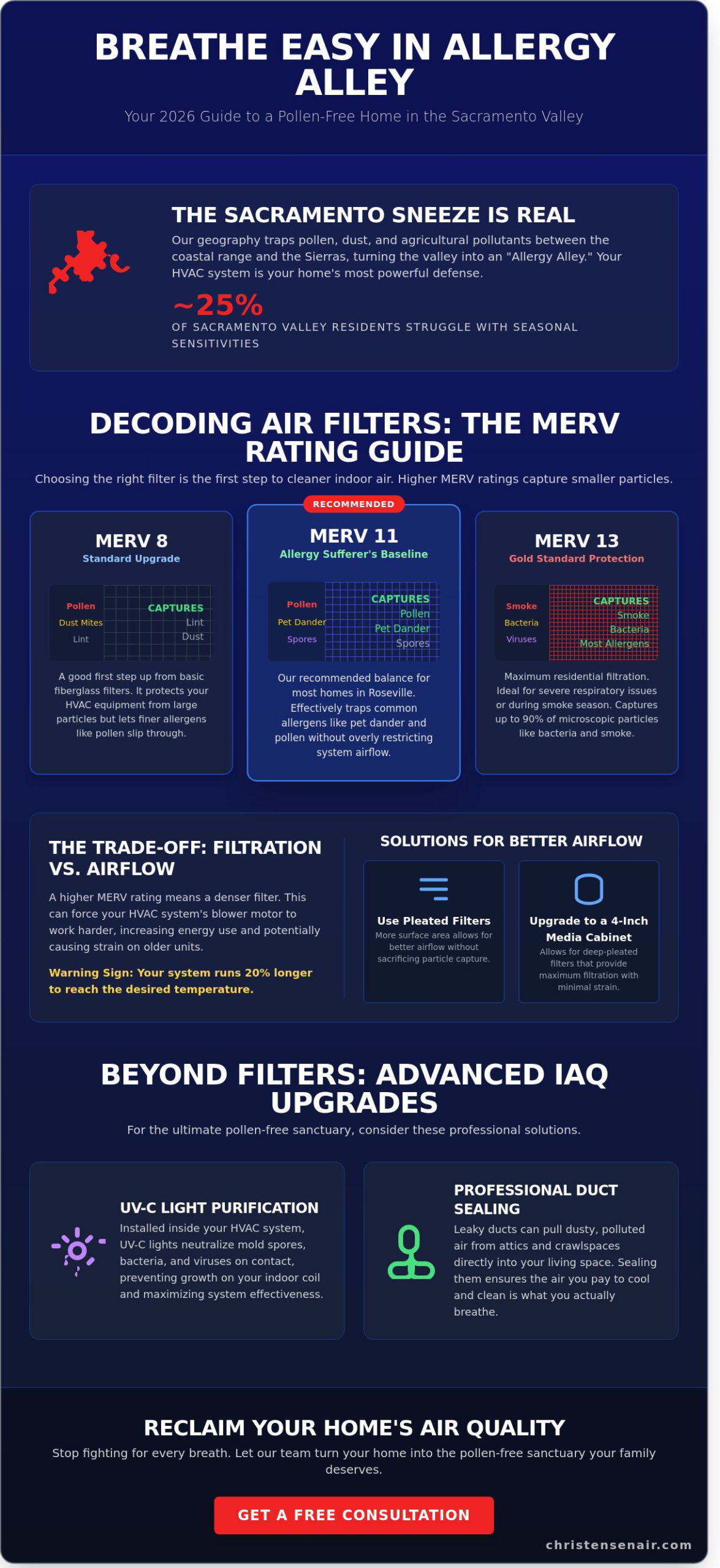
Choosing the right level depends on your specific health needs and the age of your system. A MERV 8 filter is a standard upgrade that captures dust and lint, but it often lets fine pollen slip through. For moderate allergy sufferers in Roseville, our team recommends MERV 11 as the baseline. It traps pet dander and smaller spores effectively. If you’re dealing with severe respiratory issues or want protection during the Central Valley’s smoke season, MERV 13 is the gold standard. It captures up to 90% of particles like bacteria and smoke. For more technical details on how these ratings impact your indoor environment, the EPA’s Guide to Air Cleaners provides a deep dive into how filtration layers work together.
Balancing Filtration and Static Pressure
Higher filtration comes with a trade-off. Thick, dense filters can act like a wall, forcing your blower motor to work harder to pull air through. We’ve seen older AC units in Rocklin struggle with airflow because a MERV 13 filter was too restrictive for their 15-year-old motors. To avoid this, we suggest using “pleated” filters. These have more surface area, which allows for better airflow without sacrificing particle capture. If your system is struggling, it’s a great time to consult with our experts about a 4-inch media cabinet upgrade. These larger cabinets allow for deep-pleated filters that provide maximum filtration with minimal strain on your furnace.
Watch for these three warning signs that your filter is too restrictive for your home:
- Your HVAC system runs for 20% longer than usual to reach the set temperature on your thermostat.
- You hear a high-pitched whistling or “whooshing” sound near the return air vent.
- The air coming from your registers feels significantly weaker than it did during your last service call.
Maintaining the right balance ensures your hvac for allergies works for you rather than against your utility bill. We take pride in helping our neighbors find that “sweet spot” where the air is clean and the equipment stays healthy. Since every home in the Sacramento area has unique ductwork, testing your system’s static pressure is the only way to be 100% sure your filter choice is safe.
Beyond Filters: UV Lights and Air Purifiers for a Pollen-Free Home
While a high-quality filter acts as a reliable net for your home, it’s a passive solution that only works when particles physically touch the mesh. For our neighbors in Roseville and Sacramento who suffer during peak pollen seasons, we often recommend moving toward active air purification. This approach transforms your hvac for allergies from a simple cooling machine into a comprehensive air scrubbing station. Instead of just waiting for dust to arrive, active systems neutralize contaminants at the source.
We see many homeowners wonder if these additions are truly worth the investment. According to data from the Environmental Protection Agency, indoor air can be two to five times more polluted than the air outside. When you consider that the average Californian spends 90 percent of their time indoors, the value of these systems becomes clear. These upgrades don’t just help you breathe better; they also protect your HVAC components from buildup, which helps your system run more efficiently and prevents premature breakdowns.
The Science of UV Light Installation
Your air conditioner’s evaporator coil is a dark, damp environment where condensation naturally collects. This makes it a perfect breeding ground for mold and bacteria. UV-C light systems use specific wavelengths of ultraviolet radiation to penetrate the cellular walls of these organic contaminants. By disrupting their DNA, the light prevents mold from ever taking root on your coils. This ensures that the air passing into your living spaces stays sterile and odor-free. You can learn more about UV Light Installation in Roseville to see how our team integrates these lamps into your existing setup for maximum protection.
Whole-House Air Purifiers vs. Ionizers
Portable room units are popular, but they only treat a small radius. A whole-house air cleaner works within your ductwork to treat every cubic foot of air in your home. Many of these systems use ionization to “charge” microscopic particles. Once charged, these particles stick to each other or to the filter media more effectively. To properly Control Indoor Allergens like pet dander and smoke, we prioritize equipment that carries ozone-free certification. We trust and install top-tier brands like Honeywell and Aprilaire because they provide high-efficiency results without producing harmful byproducts. Our family-owned team focuses on these reliable solutions to ensure your home remains a safe sanctuary for your children and pets.
- Active Neutralization: Kills bacteria and viruses rather than just trapping them.
- Total Coverage: Every room in your house receives treated air simultaneously.
- System Longevity: Cleaner coils and blowers mean fewer emergency repairs.
- Ozone Safety: Modern systems prioritize respiratory health with zero-ozone technology.
We take personal pride in helping you select the right technology for your specific needs. Whether you’re dealing with heavy oak pollen in the spring or wildfire smoke in the autumn, these tools provide the peace of mind that your hvac for allergies is working around the clock to keep your family comfortable.
Step-by-Step: How to Allergy-Proof Your HVAC System This Season
Living in Roseville means preparing for a heavy pollen season as early as March. We want your home to be a sanctuary. Using your hvac for allergies starts with clearing out the winter dust that settled during those cold December nights. Check your window seals and door sweeps for leak points. These small gaps allow up to 15% of unfiltered outdoor air to bypass your filtration system and enter your living space. Modern smart thermostats in 2026 allow you to monitor indoor air quality levels in real-time. If your smart hub shows a spike in PM2.5 particles, it’s time to run a dedicated filtration cycle to scrub the air.
Our neighbors often ask how to stay ahead of the curve. It starts with a proactive mindset. We’ve seen that consistent attention to your system prevents the “spring sneeze” before it starts. By addressing the mechanical health of your unit, you’re protecting your family’s well-being. We treat every home like our own, ensuring no detail is overlooked during your seasonal transition.
Monthly Maintenance Routine for Allergy Sufferers
Consistency is your best defense against indoor triggers. Follow these three steps every month to keep your air clean:
- Step 1: Inspect and change filters every 30 to 60 days. Standard 1-inch filters often clog quickly during peak Roseville bloom seasons.
- Step 2: Clear debris from the outdoor condenser. Keep a 2-foot perimeter clear of weeds and grass clippings to maintain proper airflow.
- Step 3: Wipe down supply registers and return grilles with a damp microfiber cloth to prevent recirculating dust.
Professional Tune-Ups: The Comfort Club Advantage
While DIY steps help, a professional deep clean reaches where homeowners can’t. We focus on the blower motor and evaporator coils because dust on these components can harbor moisture and allergens. Our Comfort Club Maintenance Plan ensures these parts stay pristine throughout the year. We also verify your condensate drain is clear. A clogged drain leads to standing water, which can trigger mold growth in as little as 48 hours. This proactive approach keeps your hvac for allergies working at its peak performance while providing you with total peace of mind.
Ready to breathe easier and protect your home? Schedule your professional spring tune-up with our local team today.
Professional IAQ Upgrades: Why Duct Integrity Matters for Roseville Families
We often focus on high-tech filters when discussing how to optimize your hvac for allergies. However, your indoor air quality is only as good as the channels that carry it. If your ductwork is compromised, even a hospital-grade filtration system can’t protect your family. We’ve found that many Roseville homes lose between 20% and 30% of their conditioned air through small cracks and loose connections in the attic or crawlspace.
This isn’t just an efficiency problem; it’s a health hazard. When your system runs, holes in the return ducts create a “venturi effect.” This physical phenomenon acts like a vacuum, pulling in fiberglass insulation particles, dust mites, and rodent dander from unfinished spaces directly into your breathing air. Instead of circulating clean, filtered air, your system becomes a delivery vehicle for the very triggers you’re trying to avoid. We believe your home should be a sanctuary, and that starts with airtight infrastructure.
Leaky Ducts: The Source of Your Symptoms?
If you notice fine gray dust settling on your furniture shortly after cleaning, your ducts might be the culprit. In older Folsom homes built in the 1990s or early 2000s, we frequently find crushed or disconnected flex ducts. These gaps mean your air is bypassing the filter entirely. Beyond the sneezing and itchy eyes, these leaks force your system to work harder. If your energy bills have climbed by 15% without a change in usage, your ductwork is likely leaking money and air quality simultaneously.
Duct System Replacement and Sealing
Sometimes, a simple cleaning isn’t enough to fix decades of wear. We often recommend a full transition to R-8 insulated ductwork for our neighbors in the Sacramento valley. This modern standard provides superior thermal protection and a permanent seal against outdoor pollutants. Our team views your ductwork as the “lungs” of your household. We take personal pride in ensuring those lungs are clear and efficient. To ensure your family is breathing the cleanest air possible, you can book a Duct System Replacement evaluation with our specialists today. We’ll provide a straightforward assessment of your system’s health and help you find the peace of mind you deserve.
Take Control of Your Home’s Air Quality Today
Living in the Sacramento Valley means facing some of the highest pollen counts in California according to the Asthma and Allergy Foundation of America. You don’t have to let seasonal triggers dictate your comfort indoors. By upgrading to a MERV 13 filter and ensuring your ductwork is sealed, you can effectively reduce airborne particulates. The EPA confirms that high-efficiency filtration captures 90 percent of particles in the 3 to 10 micron range. Integrating UV lights provides an extra layer of protection against biological contaminants that standard filters might miss. Since 2009, our family at Christensen Heating and Cooling has helped Roseville and Rocklin homeowners optimize their hvac for allergies to create a true sanctuary. We take pride in treating your home like our own. If you’re a Comfort Club member, you’ll even receive priority scheduling for all indoor air quality services. We’re ready to help your family breathe better and enjoy the peace of mind you deserve.
Frequently Asked Questions
Can my HVAC system actually help with my seasonal allergies?
Yes, your HVAC system acts as your home’s primary defense against outdoor pollutants by circulating air through a filtration cycle. In the Sacramento Valley, where spring pollen counts often exceed 50 grains per cubic meter, a well-maintained system captures these particles before they reach your lungs. We focus on optimizing your airflow to ensure your family breathes easier every day.
What is the best MERV rating for someone with severe allergies?
A MERV 13 filter is the most effective choice for homeowners dealing with significant respiratory sensitivities. These filters capture 90 percent of particles as small as 1 micron, including fine dust and smoke. We recommend this specific rating because it balances high-level filtration with the necessary airflow for most modern residential systems in Roseville.
Will a high-efficiency filter damage my air conditioner?
High-efficiency filters won’t damage your air conditioner as long as your system’s blower motor is rated for the added resistance. A MERV 13 filter can increase static pressure by 10 to 15 percent compared to basic fiberglass versions. We always test your system’s pressure levels to ensure the motor doesn’t overheat or cause the cooling coils to freeze.
Do UV lights in HVAC systems really work for mold and pollen?
UV-C lights are highly effective at neutralizing organic growth like mold and bacteria on your cooling coils. EPA studies show these lamps can eliminate 99 percent of biological contaminants in a laboratory setting. While they don’t physically remove heavy pollen grains, they prevent mold from colonizing your damp HVAC cabinet and spreading spores through your home.
How often should I change my air filter if I have pets and allergies?
You should change your air filter every 30 to 60 days if you share your home with pets. A single domestic cat or dog can shed 10 pounds of dander and hair annually, which quickly clogs filter pleats. Regularly replacing your filter is the easiest way to maintain your hvac for allergies and keep your energy bills from spiking during the summer.
Is duct cleaning better than duct replacement for allergy relief?
Duct cleaning removes accumulated debris, but duct replacement is the better option if your current system is over 20 years old or has visible mold. The NADCA suggests cleaning every 3 to 5 years to manage dust. However, if your ducts have 25 percent air leakage, they’ll pull allergens from your attic regardless of how clean the interior surfaces are.
What are the signs that my HVAC system is making my allergies worse?
Visible dust buildup on your supply vents and a musty odor when the fan starts are primary indicators of a problem. If your sneezing fits begin within 15 minutes of the AC turning on, your ductwork likely needs professional attention. We also look for humidity levels above 50 percent, which creates a breeding ground for dust mites and mold spores.
How much does it cost to upgrade my HVAC for better air quality?
The cost of air quality upgrades depends on the technology you select, such as HEPA filtration or electronic air cleaners. National data from HomeAdvisor shows that whole-house air purifiers typically range from 500 to 2,500 dollars for equipment and installation. Investing in your hvac for allergies provides long-term peace of mind and protects the health of everyone in your household.