





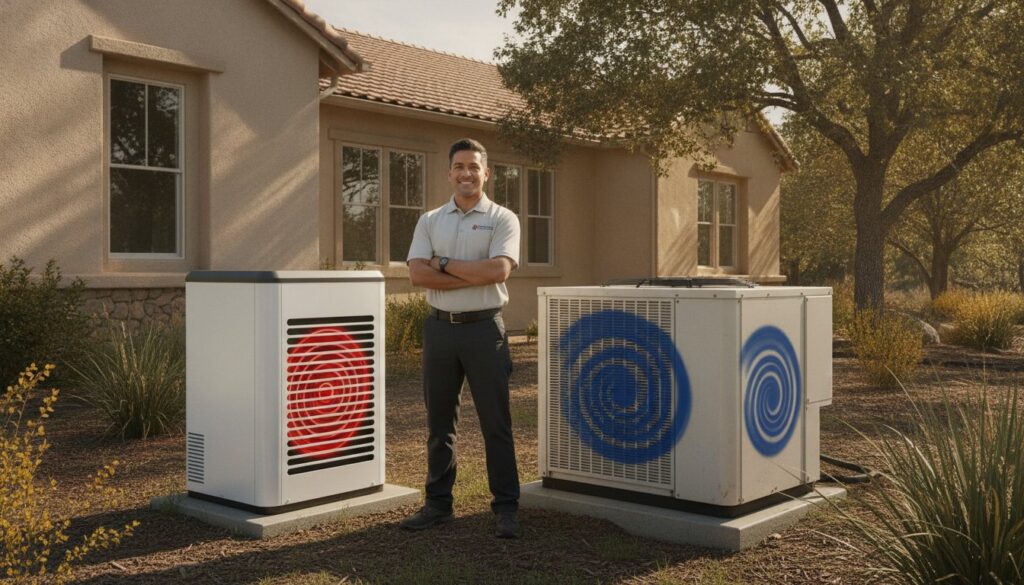
What if the smartest way to lower your Roseville utility bill isn’t by using less energy, but by changing how you use it? As we look at the 2026 heat pump vs furnace Roseville landscape, many of our neighbors are surprised to find that traditional gas heating is no longer the automatic winner for our local climate. We know it’s frustrating to watch PG&E gas prices climb while you worry about keeping your family warm on those 30°F January mornings. It’s easy to feel overwhelmed by shifting state mandates and confusing utility rate structures.
This guide clears the air, showing you exactly how to secure year-round comfort without overpaying. We’ll compare real-world operating costs using Roseville Electric’s specific tiers, explain local rebates worth up to $2,500, and show how modern inverter technology handles our 105°F summers just as easily as our winter frost. We’ll also clarify why the latest Title 24 standards aren’t a gas ban, but a roadmap to help you maximize your home’s efficiency and long-term value. Our goal is to help you protect your household sanctuary with a system that’s as reliable as it is affordable.
Key Takeaways
- Learn why Roseville’s specific mix of hot summers and mild winters makes our region the ideal environment for high-efficiency heat pump technology.
- Discover how to leverage Roseville Electric’s stable rates to potentially lower your monthly costs when comparing a heat pump vs furnace Roseville installation.
- Understand the comfort differences between the intense heat of a gas furnace and the steady, consistent warmth provided by modern inverter systems during a winter freeze.
- Get the latest 2026 updates on local rebates worth up to $2,500 and how to navigate the current state of federal tax credits.
- Find out how the age of your neighborhood and your home’s electrical capacity influence which heating system is the safest and most reliable choice for your family.
Understanding the Heating Shift in Roseville: Heat Pump vs. Furnace
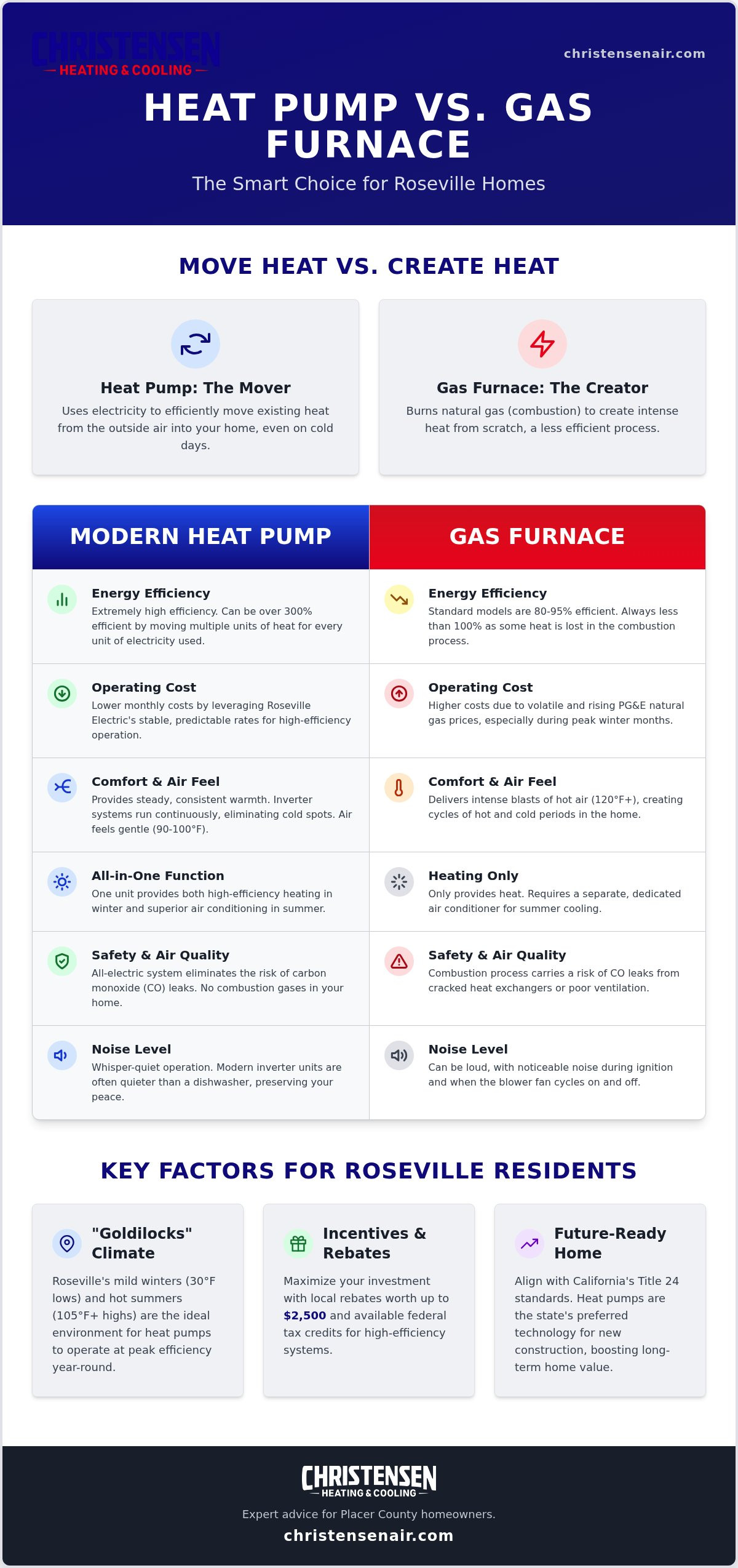
Choosing between a heat pump vs furnace Roseville homeowners often find that the decision boils down to one fundamental choice: do you want to create heat or move it? A furnace is a creator. It burns fuel to generate warmth from scratch. A heat pump is a mover. It uses electricity to harvest existing thermal energy from the outdoor air and pull it inside. We’ve helped thousands of families in Placer County make this choice, and we believe understanding this basic mechanic is the first step toward long-term home comfort.
Our local climate is the “Goldilocks” zone for this technology. We don’t deal with the sub-zero extremes of the Midwest, but we definitely feel the chill on those 30°F mornings in Placer County. Because our winters are relatively mild, a heat pump doesn’t have to work nearly as hard as a furnace to keep your family cozy. It’s an efficient way to maintain a sanctuary of warmth without the heavy energy consumption of traditional combustion.
The 2026 California Title 24 standards have made heat pumps the prescriptive default for new construction. While there isn’t a ban on gas furnaces for existing homes, the state is clearly leaning toward residential electrification. In our community, this shift is gaining momentum because it simplifies your home’s infrastructure. Choosing between these systems today impacts more than just your January gas bill. It determines how efficiently your home will stay cool when the Roseville sun hits 105°F in July.
How a Gas Furnace Works in Northern California
Gas furnaces rely on a process called combustion. When your thermostat calls for heat, natural gas ignites in a burner, sending flames into a metal component called a heat exchanger. Your blower fan then pushes air over the outside of that hot metal, warming the air before it travels through your ducts. This provides that “instant” blast of high-temperature air many people grew up with. However, older furnaces in our area often struggle with reliability. We frequently see cracked heat exchangers or pilot light failures that can compromise your home’s safety. These issues often lead to emergency calls on the coldest nights of the year.
How Modern Heat Pumps Redefine Efficiency
Think of a heat pump as a refrigerator that can run in reverse. During the winter, it extracts even small amounts of heat from the cold outdoor air and compresses it to warm your home. In the summer, it simply flips that process, acting as a high-efficiency air conditioner to dump indoor heat outside. This dual-purpose design is why so many of our neighbors are making the switch during their next system replacement.
An inverter heat pump modulates its energy use like a dimmer switch rather than an on/off light, constantly adjusting its speed to match your home’s exact needs. This eliminates the noisy, energy-wasting cycles of traditional systems. By moving heat instead of burning fuel, these systems provide a steady, gentle warmth that protects your household well-being while keeping utility costs under control.
Performance Comparison: Comfort and Reliability in Placer County
When weighing a heat pump vs furnace Roseville families often ask about the “feel” of the air coming from their vents. A gas furnace is a high-heat machine, typically discharging air at 120°F or higher. This creates a cycle of intense heat blasts followed by noticeable chills as the system shuts down. Modern heat pumps operate differently, delivering air between 90°F and 100°F. While this temperature is lower than a furnace, it remains significantly warmer than your body temperature. Because inverter systems run almost continuously at variable speeds, they provide a steady, even warmth that protects your household sanctuary from those annoying cold spots.
Reliability also involves your family’s safety and the quietness of your home environment. Traditional gas furnaces rely on combustion, which introduces the risk of carbon monoxide leaks if a component fails. Moving to an all-electric system removes these combustion gases entirely, instantly improving your indoor air quality. Beyond safety, the noise difference is remarkable. While an old furnace-and-AC combo can be loud enough to disrupt a backyard dinner, modern inverter heat pumps are whisper-quiet, often operating at decibel levels lower than a standard dishwasher.
Winter Warmth: Is a Heat Pump ‘Hot Enough’?
The “Roseville Freeze” usually arrives on those crisp January mornings when temperatures dip into the high 20s. There is a common misconception that electric systems fail in these conditions. However, 2026 inverter technology is engineered to extract heat even when it is freezing outside, ensuring you stay cozy without a backup furnace. To maximize this performance, we frequently suggest a duct system replacement if your current ductwork is old or leaky. Properly sealed ducts ensure that every bit of heat reaches your living space instead of being lost in the crawlspace or attic.
Summer Cooling: The Hidden Advantage of Heat Pumps
It is helpful to remember that a heat pump is essentially a high-efficiency air conditioner that can run in reverse. When Roseville temperatures climb toward 105°F, these systems provide exceptional cooling and dehumidification. Having one unit handle both seasons means you have fewer mechanical components that could potentially fail during a July heatwave. This streamlined approach simplifies your annual maintenance and gives you one dependable system to protect your home’s comfort. We take pride in helping our neighbors find the right balance, and we’d be happy to perform a custom comfort evaluation for your specific floor plan.
The Roseville Utility Factor: Roseville Electric vs. PG&E
One of the greatest advantages of living in our community is something many of our neighbors take for granted: we own our power. Because we rely on Roseville Electric rather than a massive corporate utility, we enjoy some of the most stable and affordable energy rates in Northern California. When you are deciding on a heat pump vs furnace Roseville homeowners have a unique financial edge. While PG&E natural gas prices have shown significant volatility, our local electric rates remain consistently lower than the state average. This creates a rare opportunity to lock in long-term savings by switching to an all-electric system.
We’ve found that the total cost of ownership over a 15-year period often favors the heat pump because of this utility structure. As California continues its push toward electrification, the infrastructure for natural gas is becoming more expensive to maintain, which eventually reflects on your monthly bill. In contrast, Roseville Electric’s Tier 1 rate of $0.1469 per kWh makes running a high-efficiency electric system incredibly cost-effective. By choosing a system that leverages our local resources, you aren’t just buying equipment; you are making a strategic investment in your household’s financial security.
Operational Costs: Doing the Math
The efficiency gap between these two technologies is staggering. A high-efficiency gas furnace is roughly 96% efficient, meaning four cents of every dollar you spend is wasted. A modern heat pump, however, can reach efficiency levels of 300% to 400% because it moves existing heat rather than creating it through combustion. When you look at your Roseville Electric bill, you can see how staying within Tier 1 or even Tier 2 ($0.1912 per kWh) keeps your heating costs predictable. We often help our clients analyze their previous winter bills to show exactly how much they could save by moving away from $2.78-per-therm natural gas prices.
Rebates and Tax Credits: The 2026 Landscape
The transition to a more efficient home is supported by substantial financial incentives this year. Under the Inflation Reduction Act, you may be eligible for 25C tax credits worth up to $2,000 for a qualified heat pump installation. Locally, Roseville Electric is currently offering generous rebates to encourage the switch from gas to electric. Homeowners can secure up to $2,500 for a variable-stage system or $1,500 for a two-stage heat pump. Our team takes personal pride in helping you navigate this paperwork. We ensure you maximize every available dollar so that your path to a more comfortable, sustainable home is as affordable as possible.
Choosing the Right System for Your Roseville Neighborhood
The decision between a heat pump vs furnace Roseville homeowners face often depends as much on the age of their home as it does on their utility goals. Our city is a beautiful mix of historic charm and modern expansion, and each neighborhood presents its own set of technical requirements. Whether you are living in a classic bungalow downtown or a sprawling new build in West Roseville, your home’s existing infrastructure determines which system will provide the most reliable comfort for your family.
Beyond the technical fit, we also encourage you to consider your home’s long-term resale value. In our competitive local real estate market, a high-efficiency heating and cooling system is a significant selling point. Modern buyers are increasingly looking for homes that are already optimized for lower utility bills and environmental responsibility. Choosing a system that fits your neighborhood’s specific needs ensures your investment protects both your daily comfort and your home’s future equity.
Newer Subdivisions: West Park, Fiddyment Farm, and Morgan Creek
Homes built in these newer areas are often the best candidates for a full transition to an inverter heat pump. Most of these properties were constructed with 200-amp electrical panels, providing plenty of capacity for an all-electric heating system without needing expensive panel upgrades. These homes also feature modern insulation and high-efficiency windows, which allow a heat pump to maintain a steady, gentle temperature with minimal effort. When it is time to replace your original unit, avoid the temptation to install another “builder-grade” system. Moving to a high-performance heat pump can significantly enhance the comfort of these larger, two-story floor plans.
Historic and Established Areas: Downtown, Cherry Glen, and Enwood
In our more established neighborhoods, the path to comfort requires a bit more neighborly care and planning. Many homes in Downtown or Cherry Glen still operate on 100-amp electrical service, which may not be enough to support a large electric heat pump alongside modern appliances. In these cases, a gas furnace replacement is often the most practical choice. It allows you to keep your existing electrical setup while still upgrading to a much safer, more efficient combustion system. For those who want the best of both worlds, a “dual fuel” system pairs a gas furnace with an electric heat pump, providing high-efficiency cooling in the summer and reliable gas heat on those rare freezing winter mornings. Schedule your personalized home comfort audit with our team today to see which setup fits your neighborhood’s unique requirements.
The Christensen Solution: Finding Your Perfect Comfort Match
Deciding between a heat pump vs furnace Roseville homeowners often find that the most important step isn’t picking a brand, but choosing the right partner for the installation. We don’t believe in “one-size-fits-all” solutions. Every home has a unique footprint, which is why our process begins with a precise heat load calculation. We measure your square footage, window orientations, and insulation levels to ensure your new system is sized perfectly for your sanctuary. An oversized unit will cycle too often and waste energy, while an undersized one will struggle during a July heatwave. We take the guesswork out of the equation so you can feel confident in your investment.
For neighbors who aren’t quite ready to go fully electric, we often recommend a “Hybrid” or Dual Fuel solution. This setup combines the high-efficiency cooling and mild-weather heating of an inverter heat pump with the dependable power of a gas furnace for those few freezing mornings. It offers the ultimate reliability, giving you a safety net while still drastically reducing your monthly gas consumption. This flexibility allows you to leverage Roseville Electric’s low rates most of the year without giving up the “instant” heat of a traditional furnace when you want it most.
Why Inverter Technology is the ‘Roseville Standard’
In many of our local two-story homes, the upstairs can feel like a sauna while the downstairs stays chilly. We prioritize inverter technology because it solves this specific problem. Unlike traditional systems that are either 100% on or 100% off, an inverter system adjusts its speed in tiny increments. This constant, gentle airflow eliminates hot and cold spots and keeps your family comfortable on every floor. Proper HVAC maintenance protects the sensitive electronics in inverter systems from the dust and heat of our Placer County summers. By joining our Comfort Club, you ensure these high-tech components are cleaned and calibrated twice a year, helping your system reach its full 15+ year lifespan.
The Christensen Difference: Locally Owned, Legacy Driven
We’ve been family-owned and operated since 2009, and we treat every home with the same care we’d apply to our own. Our team knows the specific challenges of Placer County soil and sun because we live here too. We are committed to providing honest, neighborly advice. If your home’s electrical panel isn’t ready for a full heat pump conversion, we’ll tell you upfront and help you find a safer alternative. We value long-term relationships over quick sales, and we take personal pride in every task we perform. Ready to see the math for your home? Schedule your Roseville comfort assessment with Christensen Heating and Cooling today!
Securing Your Home’s Comfort for the Decade Ahead
Deciding on a heat pump vs furnace Roseville homeowners face is about more than just picking a piece of equipment. It’s about leveraging our unique local electric rates and protecting your household sanctuary from rising gas costs. We’ve seen how inverter technology can transform a drafty two-story home into a consistent environment of warmth and cooling. Whether you choose a high-efficiency all-electric system or a reliable dual-fuel hybrid, the right choice will lower your monthly bills while increasing your home’s long-term value. We’re here to make sure you get the honest, neighborly guidance you deserve.
As your local inverter heat pump specialists, we take personal pride in serving our community. We’ve been family-owned and operated since 2009, focusing on lasting reliability through our Comfort Club priority service. We’ll help you navigate the 2026 rebate landscape and ensure your system is perfectly sized for your specific neighborhood and floor plan. It’s time to stop worrying about your utility bills and start enjoying a more comfortable, efficient home. Compare your options with a free Roseville heating estimate from Christensen Heating and Cooling today! We look forward to helping you protect your home.
Frequently Asked Questions
Is a heat pump more expensive to install than a furnace in Roseville?
Heat pumps generally have a higher upfront installation cost than a standalone gas furnace. However, it’s important to remember that a heat pump replaces both your furnace and your air conditioner. When you compare the price of a single heat pump against the combined cost of a new furnace and a separate AC unit, the gap narrows significantly. We often find that local rebates and long-term energy savings make the heat pump a more financially sound investment for many households.
Will I need to upgrade my electrical panel to install a heat pump?
Whether you need a panel upgrade depends on your home’s current electrical capacity and existing appliances. Many homes built after 2000 in West Roseville already have 200-amp panels that can handle a heat pump easily. If you live in an older neighborhood with a 100-amp service, an upgrade might be necessary to support the all-electric load. We always perform a thorough inspection of your electrical system before making a recommendation to ensure your family’s safety and comfort.
Do heat pumps really work when it drops below freezing in Placer County?
Modern inverter heat pumps are specifically engineered to provide reliable warmth even when temperatures drop into the 20s. While older models struggled in the cold, 2026 technology extracts heat from the outdoor air with incredible efficiency. You won’t have to worry about waking up to a cold house on those frosty Placer County mornings. These systems maintain a steady temperature without the need for a backup heat source in our relatively mild Mediterranean climate.
How much can I save on my Roseville Electric bill by switching?
Switching can lead to noticeable savings because Roseville Electric’s Tier 1 rate of $0.1469 per kWh is significantly lower than the cost of natural gas from PG&E. When comparing a heat pump vs furnace Roseville homeowners often see their total energy costs drop because heat pumps are 300% to 400% efficient. By moving away from monthly gas charges and leveraging our local municipal utility, you can keep your household budget more predictable throughout the entire year.
What is a ‘Dual Fuel’ or Hybrid heating system?
A Dual Fuel system is a hybrid setup that pairs an electric heat pump with a gas furnace. The heat pump handles the heating and cooling during most of the year when temperatures are moderate. When the thermometer dips below a certain point, the system automatically switches to the gas furnace for a boost of intense heat. This provides an extra layer of reassurance for those who want the efficiency of electric with the traditional backup of gas.
How long does a typical heat pump or furnace last in our climate?
A well-maintained heat pump or furnace typically lasts between 15 and 20 years in our region. Because we don’t deal with extreme humidity or salt air, our equipment tends to hold up well over time. The key to reaching that 20-year mark is consistent care. We recommend regular check-ups to keep the sensitive electronics and mechanical parts in peak condition, ensuring your system continues to protect your home’s sanctuary for nearly two decades.
What rebates are currently available for Roseville homeowners in 2026?
Roseville homeowners have access to several valuable incentives this year. Roseville Electric currently offers rebates up to $2,500 for variable-stage heat pumps when switching from gas to electric. Additionally, the TECH Clean California program provides statewide incentives through enrolled contractors. While some federal tax credits expired in 2025, our team stays updated on every available local program to help you maximize your savings. We’ll guide you through the paperwork to ensure you don’t miss out on these funds.
Does a heat pump require more maintenance than a standard furnace?
A heat pump requires about the same amount of maintenance as a standard furnace and AC combo, but it happens on a different schedule. Since a heat pump works year-round for both heating and cooling, it’s essential to have it serviced twice a year. Our Comfort Club maintenance plan is designed to handle these seasonal tunings. We focus on cleaning coils and checking refrigerant levels to ensure your heat pump vs furnace Roseville choice remains efficient and reliable for years to come.