





With residential electricity bills projected to jump by 8.5 percent this summer, your air conditioner is no longer just a luxury; it’s a major line item in your family budget. We know the stress that comes with a Northern California heatwave, especially when you’re worried about high utility costs or a sudden system failure during a 100-degree day. It’s a feeling we’ve helped our neighbors navigate for years. We believe that staying ahead of the heat shouldn’t be a source of anxiety for your household.
You deserve a home that feels like a sanctuary, even when the valley temperatures soar and wildfire smoke begins to drift. That’s why we’ve put together this comprehensive preventative AC maintenance checklist for 2026. This guide is designed to help you lower your monthly energy costs and extend the lifespan of your equipment through simple DIY care and expert professional oversight. We’ll walk you through the specifics of MERV 13 filters for smoke protection, the latest SEER2 efficiency standards, and the exact steps you can take today to ensure your family stays cool and safe all season long.
Key Takeaways
- Learn how proactive care acts as a shield against the rising utility costs of 2026 and prevents expensive emergency repairs during heatwaves.
- Master a safe, high-impact preventative AC maintenance checklist you can perform at home to keep your system breathing clearly.
- Understand the technical diagnostic tools and electrical inspections our experts use to ensure your system’s refrigerant chemistry is balanced and safe.
- Discover how to protect your outdoor unit from Northern California wildfire ash. We’ll explain why this debris can turn into a concrete-like substance if it isn’t cleaned properly.
- See how a dedicated maintenance plan can automate your home comfort. It’s the simplest way to ensure your system receives the neighborly care it deserves.
Why Preventative AC Maintenance is Non-Negotiable in 2026
Think of your air conditioner as the heart of your home’s comfort. In 2026, with residential electricity bills projected to be 8.5 percent higher than last year, staying ahead of mechanical issues is no longer optional. We view a preventative AC maintenance checklist as more than a simple set of chores; it is a proactive shield that protects your family from the sudden stress of a system failure. By identifying tiny points of friction before they turn into catastrophic breakdowns, we help ensure your sanctuary remains cool even when the outside world is sweltering.
To see exactly what these checks look like in action, watch this helpful video:
Beyond just cooling the air, your system manages the quality of the environment your family breathes every day. Dust, pollen, and pet dander accumulate on sensitive HVAC system components, which forces the unit to work harder while blowing those particles back into your living spaces. Regular cleaning keeps these pathways clear and the air fresh. Additionally, most manufacturers now require documented annual service to keep your warranty valid. If a major part fails in 2026, the manufacturer may ask for proof of professional maintenance before they agree to cover the replacement cost. Skipping a year could mean paying out of pocket for a repair that should have been covered.
The Financial Benefits of Proactive Care
A well-maintained system can use up to 15 percent less energy than one that has been neglected for a season or two. This efficiency is vital during Sacramento’s peak summer rate periods when every kilowatt counts toward your monthly total. We frequently encounter “cascading failures” in our line of work. This happens when a simple dirty coil or a worn capacitor puts enough strain on the motor to eventually burn out the compressor. Replacing a compressor is one of the most expensive repairs in the industry. It is a heavy financial burden that is often entirely avoidable with the right care and a consistent preventative AC maintenance checklist.
Reliability During Northern California Heatwaves
There is a specific kind of anxiety that comes with watching the local forecast hit 100 degrees when you aren’t sure if your AC will hold up. Our region’s extreme heat puts immense pressure on unmaintained units, often causing them to quit at the exact moment you need them most. Pre-season verification gives you the peace of mind that your equipment is ready for the challenge. Learning how to make my HVAC system last longer starts with this commitment to reliability. It is about protecting your home and your budget from the unpredictability of the summer season through steady, dependable maintenance that treats your home with the same care we would give our own.
The Homeowner DIY AC Maintenance Checklist
We want to empower you to take charge of your home’s comfort. While some technical work requires our specialized diagnostic tools, there are several high-impact steps you can take to keep your system breathing easily. Safety is our top priority. Before you begin any task on your preventative AC maintenance checklist, please ensure you turn off the power at both the thermostat and the main circuit breaker. This simple step protects you and your equipment while you perform your monthly inspections during these high-use summer months.
Sometimes, your DIY inspection will reveal a problem that needs a professional touch. If you notice ice forming on the copper refrigerant lines, smell a metallic burning scent, or hear unusual grinding noises, it’s time to step back. These signs often point to electrical or chemical issues that require expert attention to prevent a total system breakdown. Following these DIY maintenance tips from Energy.gov can help you spot these red flags before they leave you without cooling on a 100-degree afternoon.
Air Filter Management and MERV Ratings
Filters act as the lungs of your home. In Roseville, the combination of summer heat and local environmental factors means you should check your filters every 30 days. A clogged filter restricts airflow, which forces your motor to work harder and drives up your energy bills. Standard filters might stop large debris, but high-efficiency MERV filters are designed to capture smaller particles like pollen and fine dust. Choosing the right filter is a foundational step in how to improve indoor air quality for your family.
Clearing the Outdoor Condenser Area
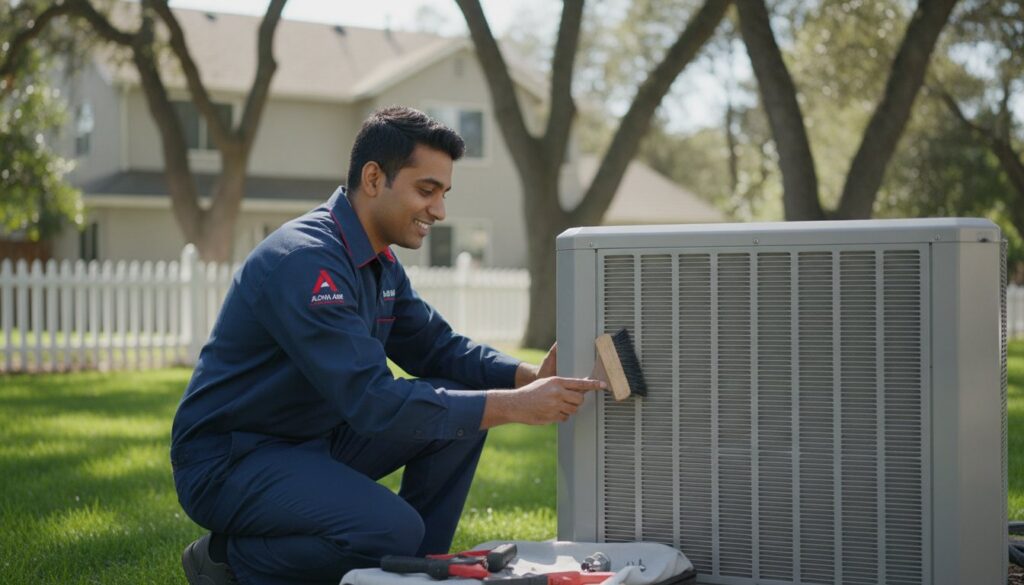
Your outdoor unit needs plenty of space to release the heat it pulls from your home. We recommend maintaining at least a 2-foot clearance of empty space around the entire condenser. Overgrown shrubs, tall grass, or piles of leaves can choke the unit and cause it to overheat. You can safely remove loose leaves and grass clippings from the exterior fins using a soft brush. Never use a high-pressure power washer on these delicate metal fins. The intense pressure can bend the aluminum, permanently restricting airflow and damaging your system’s efficiency.
If you prefer the peace of mind that comes with a professional eye, our Comfort Club Maintenance Plan is a great way to ensure these tasks are handled with expert care every season.
What Happens During a Professional AC Tune-Up?
While a homeowner’s preventative AC maintenance checklist covers the essential basics, a professional visit goes much deeper into the technical heart of your system. We use specialized diagnostic equipment to look inside the unit’s “brain” and “circulatory system.” Our goal is to verify that every component operates within the manufacturer’s specific tolerances. We don’t just look at parts; we measure their performance. This level of precision is what separates a simple check-up from a professional tune-up that truly protects your home.
We follow a “test, don’t guess” philosophy. This means using digital manifolds to check refrigerant pressure and multimeters to measure electrical draw. By gathering this data, we provide a clear, written picture of your system’s health. This documentation is incredibly valuable for your records. If you ever decide to sell your home or need to make a manufacturer warranty claim, having a professional report proves you’ve taken excellent care of your investment. It replaces uncertainty with documented reliability.
Electrical and Mechanical Component Testing
We start by tightening every electrical connection within the system. Loose wires cause voltage drops that can lead to melted insulation or even electrical fires. In the intense Roseville heat, capacitors are a frequent failure point. These small parts act like batteries to kickstart your motors. We measure their microfarads to see if they’re weakening. If a capacitor is out of range, we can replace it before it leaves you stranded without air on a Sunday afternoon. We also lubricate all moving parts. This reduces mechanical friction, which lowers the amperage your system draws and saves you money on every utility bill.
Refrigerant and Coil Health
Refrigerant is the lifeblood of your cooling system. If the charge is even slightly off, your system loses its ability to transfer heat efficiently. We check for tiny leaks and ensure the levels are perfect for the 2026 standards. We also perform a deep clean of both the indoor evaporator coil and the outdoor condenser coil. When these coils are caked with dust or local debris, the system can’t “breathe” properly. Ignoring this buildup leads to frozen lines and total shutdowns. Often, homeowners only call for emergency AC repair Roseville once a neglected coil has already caused a major mechanical breakdown. Regular professional maintenance stops that cycle of stress before it starts, keeping your sanctuary comfortable all summer long.

Regional Factors: Wildfires, Ash, and Utility Rates
Living in the Sacramento Valley brings specific challenges that national maintenance guides often overlook. When we talk about a preventative AC maintenance checklist, we have to address the grit, ash, and intense heat that define our local summers. For homeowners who have invested in modern technology like inverter heat pumps, these systems offer incredible precision and comfort, but they still need to be shielded from the environmental stressors unique to our region. We treat every home with the same care we would give our own, and that means understanding how our local air quality affects your mechanical equipment.
One of the most significant regional threats is wildfire ash. When fine particulates settle into your outdoor unit, they don’t just sit there. They mix with condensation or morning moisture to form a thick, gray sludge. As the valley sun hits the unit, this mixture bakes into a substance that acts like concrete, sealing off the metal fins and blocking the airflow your system needs to stay cool. This doesn’t just lower efficiency; it can lead to a total system seizure during a 100-degree day. We believe in being proactive so you never have to face that kind of stress.
Post-Wildfire Maintenance Steps
After any smoke event in Roseville or the surrounding areas, we recommend a gentle rinse of your outdoor coils with a garden hose. This simple step prevents the “concrete” effect from setting in and hardening. You should also replace your air filters immediately after the smoke clears. Even if the filter is only a few weeks old, smoke particulates can clog the fibers and restrict airflow, which drives up your energy use. To further protect the sanctuary of your home, you might explore how UV lights for wildfire smoke can act as a secondary defense against lingering odors and microscopic debris.
Optimizing for SMUD and PG&E Time-of-Use
With summer cooling costs expected to rise to an average of $792 in 2026, managing your energy use is a financial necessity. Both SMUD and PG&E use time-of-use rates that peak between 4 PM and 9 PM. A well-maintained system allows you to “pre-cool” your home effectively. This strategy involves running your AC earlier in the afternoon to drop the temperature before the high-rate window begins. A calibrated thermostat ensures your system doesn’t run a minute longer than necessary. By ensuring your system is at peak efficiency, you can let the indoor temperature drift during those peak hours, saving you money without sacrificing the comfort of your family.
If you want to ensure your system is optimized for our local climate and utility rates, sign up for our Comfort Club Maintenance Plan to get expert, neighborly protection for your household.
The Christensen Comfort Club: Reliable Local Protection
We understand that life in Northern California is busy. Between work, family, and community, managing a preventative AC maintenance checklist can easily slip to the bottom of your to-do list. That’s why we created the Comfort Club. It is our way of taking the stress out of home maintenance by automating the care your system needs. As a family-owned local business, we don’t see our clients as just another service call. We view you as neighbors. Our team takes personal pride in ensuring your home remains a cool sanctuary, regardless of how high the valley temperatures climb.
Professional care is an investment that consistently pays for itself. By maintaining peak efficiency, your system uses less energy and experiences far less wear and tear over its lifespan. This proactive approach helps you avoid the high costs of emergency repairs and the frustration of a system failure during a heatwave. We believe in building long-term relationships based on honesty and quality, providing the steady, dependable service that larger corporate entities often lack. When you partner with us, you’re choosing a team that treats your environment with the same respect we would give our own homes.
Comprehensive Multi-Point Inspections
Our Comfort Club plan includes a rigorous evaluation of your entire cooling system. We don’t just check the basics; we dive into the technical details that keep your home safe and efficient. This includes testing electrical components, measuring refrigerant chemistry, and ensuring your thermostat is perfectly calibrated. We pay special attention to high-efficiency solutions like ductless mini-splits, which require specific technical expertise to maintain correctly. Our goal is to identify and resolve tiny points of friction before they turn into major mechanical issues, ensuring your system is ready for the 2026 summer season.
Priority Service and Member Perks
When the forecast shows 105 degrees in Rocklin, our call volume naturally spikes. This is when the true value of the Comfort Club shines. Members receive priority service, which means you move to the front of our schedule if your system ever needs attention during the peak of summer. You shouldn’t have to wait in a hot house for days when the heat is at its most dangerous. This priority status, combined with regular maintenance, provides the ultimate peace of mind for your household. We are dedicated to your comfort and safety all year long. Join the Comfort Club today for worry-free cooling!
Secure Your Home Comfort for the 2026 Season
Staying ahead of the Sacramento Valley heat requires a blend of consistent DIY care and professional expertise. We have explored how simple tasks like monthly filter changes and clearing debris from your outdoor unit can protect your system from the “concrete” effect of wildfire ash. More importantly, we’ve highlighted why technical diagnostic checks are essential for maintaining the high-efficiency performance of modern inverter and ductless systems. By committing to this preventative AC maintenance checklist, you’re not just saving money on utility bills; you’re protecting the sanctuary of your home and the well-being of your family.
Our team has been family-owned and operated since 2009. We take personal pride in serving our neighbors throughout Roseville, Rocklin, and the Greater Sacramento area. We specialize in high-efficiency technology and long-term reliability. We invite you to Schedule Your Precision AC Tune-Up with Christensen Heating and Cooling today. Let us handle the technical details so you can enjoy a worry-free summer. We look forward to welcoming you into our community of comfortable homeowners.
Frequently Asked Questions
How often should I really have my AC serviced in Roseville?
You should have your AC serviced once every year, preferably in the spring before the first major heatwave hits. Our local climate puts immense stress on cooling systems, and an annual check ensures your unit can handle consistent 100-degree days. This regular cadence helps catch small issues like weakening capacitors before they leave you without air on a sweltering Sunday afternoon.
Can I clean my own AC coils with a garden hose?
You can safely clean your outdoor condenser coils using a garden hose with a gentle spray setting. This is an excellent way to remove the dust and wildfire ash that accumulates on the metal fins during the summer. However, never use a power washer or a high-pressure nozzle. The intense force can easily bend the delicate aluminum fins, which permanently restricts airflow and harms your system’s efficiency.
What is the best MERV rating for filters during Northern California fire season?
We recommend using a MERV 13 filter during the Northern California fire season to effectively capture fine smoke and ash particles. This rating provides a high level of filtration without putting excessive strain on most residential blowers. While some systems can handle higher ratings, MERV 13 is the sweet spot for protecting both your family’s lungs and your equipment’s motor from heavy particulate buildup.
Why is my AC blowing warm air even after I changed the filter?
Warm air usually signals a deeper mechanical issue like a refrigerant leak or a failed compressor capacitor. While a clean filter improves airflow, it cannot fix a system that has lost its chemical ability to transfer heat. If your vents aren’t blowing cold air, it’s best to turn the system off immediately. Running a struggling unit can lead to much more expensive failures in the motor or compressor.
Will preventative maintenance actually lower my SMUD or PG&E bill?
Yes, keeping your system in top shape can reduce your energy consumption by up to 15 percent, directly lowering your SMUD or PG&E bills. A clean unit doesn’t have to work as hard to move air or cool your home. This efficiency is a core benefit of following a preventative AC maintenance checklist, especially with residential cooling costs projected to rise significantly throughout 2026.
What are the signs that my AC needs a professional tune-up immediately?
You should call for a professional tune-up immediately if you hear grinding sounds, smell metallic burning odors, or notice your system cycling on and off every few minutes. Other red flags include ice forming on the refrigerant lines or water leaking from the indoor unit. These symptoms suggest that your system is under extreme stress and is likely on the verge of a total mechanical breakdown.
Is a maintenance plan worth it for a brand-new AC system?
A maintenance plan is essential even for a brand-new system because it protects your manufacturer’s warranty. Most companies require proof of annual professional service to honor claims for expensive parts like compressors. Starting a preventative AC maintenance checklist early also prevents the gradual buildup of dust and grime, ensuring your new investment stays as efficient as the day it was installed for years to come.
What is the difference between a “tune-up” and a “repair” visit?
A tune-up is a proactive health check to prevent future breakdowns, whereas a repair visit is a reactive response to an existing problem. During a tune-up, we clean the system, tighten connections, and test component performance to ensure everything is within factory specs. A repair visit is focused on diagnosing why a specific part failed and getting the system back online. Think of a tune-up as a routine physical and a repair as a surgery.