






Imagine walking through your beautiful, historic Rocklin home and realizing the upstairs feels like a sauna, yet the thought of cutting into your original plaster walls to install bulky ductwork feels like a heartbreak. Many of our neighbors face this exact dilemma as we navigate the hot 2026 cooling season. We know you value the architectural character of your house, but you shouldn’t have to choose between historical charm and modern comfort. It is common to feel stuck between high energy bills from aging units and the fear of a messy, invasive remodel.
In this guide, we will help you weigh the pros and cons of a ductless mini split vs central air for older homes Rocklin so you can find the most efficient way to stay cool. We’ll explore how the latest 2026 Title 24 standards and heat pump technologies allow you to achieve lower monthly costs and quiet operation without sacrificing your crown molding. From comparing energy loss in traditional ducts to the benefits of zoned cooling, we provide the clear, expert guidance you need to protect your sanctuary and keep your family comfortable all year long.
Key Takeaways
- Learn how to modernize your cooling system without damaging original architectural details like delicate plaster or crown molding.
- Compare the pros and cons of a ductless mini split vs central air for older homes Rocklin to see which system fits your home’s unique footprint best.
- Discover how 2026 Title 24 standards influence your choice and why modern heat pump technology is now the benchmark for efficiency.
- Understand the long-term energy savings of zoned cooling and how it eliminates hot upstairs rooms and cold spots throughout your house.
- Find out why a professional load calculation is the essential first step to ensuring your new system provides lasting comfort and reliability for your sanctuary.
The Challenge of Cooling Older Rocklin Homes
Rocklin is famous for its rich history and its punishing summer heat. When July arrives and temperatures regularly climb past 100°F, older homes in neighborhoods like the Quarry District face a unique battle. These structures were built for character, not for modern climate control. Retrofitting, which is the process of installing contemporary HVAC systems into buildings not originally designed for them, often feels like a puzzle with missing pieces. Many of these classic residences rely on thick walls and high ceilings to stay cool, but that is rarely enough to combat the dry, intense heat of a modern California summer.
Choosing between a ductless mini split vs central air for older homes Rocklin requires a deep understanding of how your home’s “bones” interact with the air. Unlike the newer builds in Whitney Ranch, older bungalows often lack the wall cavities needed for massive ducts. Without a proper solution, you end up with “hot spots” where the kitchen feels like a furnace while the bedrooms remain barely tolerable. This creates significant mechanical strain on your equipment and sends your utility bills skyrocketing during the peak cooling months. During wildfire season, these older, leakier structures can also struggle to maintain healthy indoor air, making a sealed and efficient system a necessity for your family’s well-being.
To better understand how these two systems compare in a real-world setting, watch this helpful video:
Architectural Constraints in Local Neighborhoods
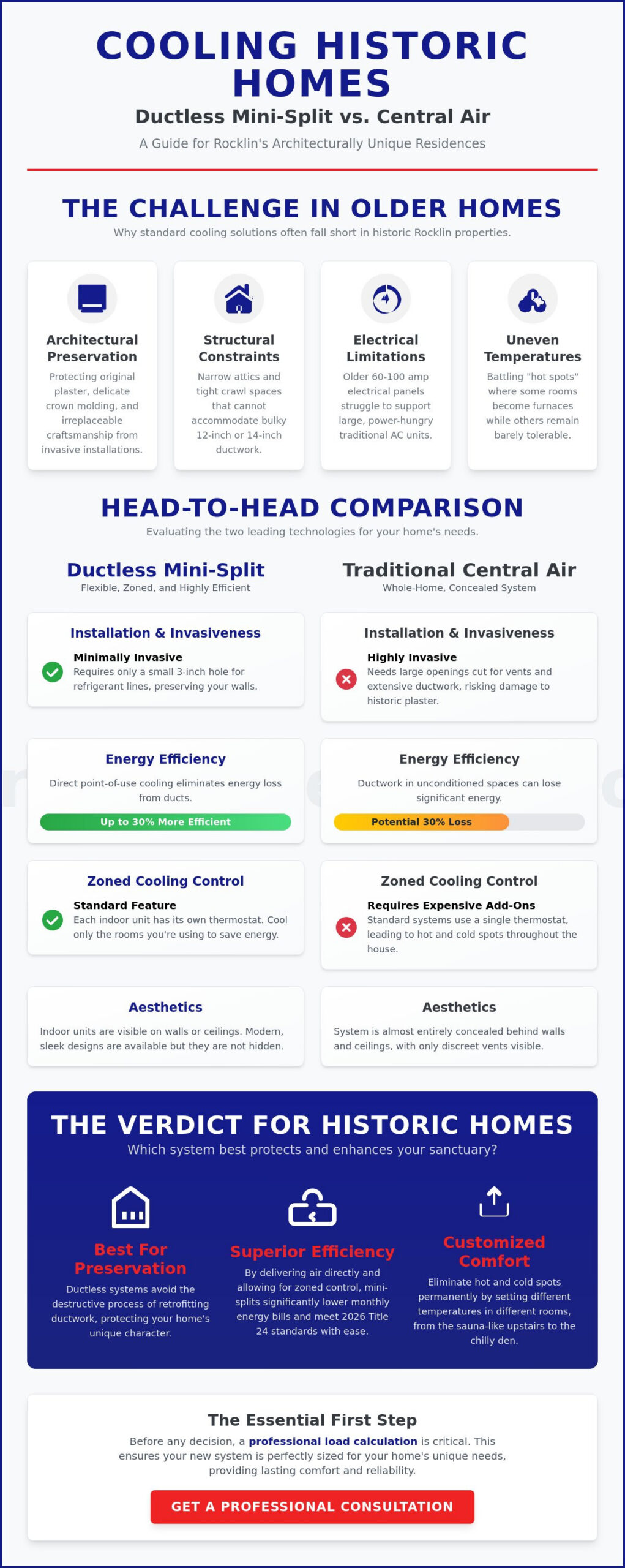
Many classic Rocklin residences feature narrow attics or tight crawl spaces that simply cannot accommodate standard 12-inch or 14-inch ductwork. If your home has original lath and plaster walls, the installation of a central system can be a nightmare. We often see homeowners worry that cutting large holes for vents will cause historic plaster to crack or crumble, destroying irreplaceable craftsmanship. Vaulted ceilings and unique additions also complicate airflow, making it difficult for a single central unit to push air evenly into every corner of the house. This is where a more flexible approach often becomes the better choice for preserving your home’s sanctuary.
Electrical Capacity in Established Residences
Your home’s electrical panel is another major factor. Many older homes in our community operate on 60-amp or 100-amp service, which often isn’t enough to support a large, traditional 5-ton central air unit. Upgrading a panel can be a significant hidden cost in an HVAC project. However, modern heat pump technology has changed the landscape. These high-efficiency systems, particularly ductless mini-splits, draw much less power than older models. By choosing a system that prioritizes efficiency, you can often meet strict 2026 California building codes without needing a total electrical overhaul, keeping your project on track and your budget intact.
- Mechanical Strain: Undersized ducts in old homes force units to work harder, leading to frequent repairs.
- Preservation: Maintaining crown molding and original finishes is a priority for historic value.
- Zoning: Older homes often need different temperatures in different rooms due to sun exposure.
Understanding the Technology: Mini Split vs Central Air
Deciding between a ductless mini split vs central air for older homes Rocklin requires a clear look at how each system moves air. Central air is the traditional choice we see in many established neighborhoods. It uses one large outdoor unit and an indoor coil to push conditioned air through a network of hidden ducts. Ductless mini-splits take a different path. These systems use smaller indoor air handlers mounted directly in the rooms you use most, all connected to a single outdoor compressor. Both systems now prioritize efficiency to meet the strict 2026 California energy codes, but they achieve that comfort in very different ways.
One of the biggest advancements for 2026 is the universal shift toward inverter technology. In the past, HVAC units were either “on” or “off,” which created a massive power surge every time the system started. For an older Rocklin home with a sensitive electrical panel, those surges can cause flickering lights or tripped breakers. Modern inverter heat pumps maintain steady temperatures by ramping their speed up and down gradually, much like a dimmer switch on a light. This technology protects your electrical system and provides a much more consistent “sanctuary” feel without the sudden blasts of cold air.
How Central Air Works in a Retrofit
If your classic home doesn’t have existing ductwork, we often look at “furring out” walls or utilizing the back of closets to create vertical chases for new air paths. It’s a more invasive process, but it keeps the cooling equipment completely out of sight. If your home already has a system from the early 2000s, a full duct system replacement is almost always necessary. Older ducts are often too small or too leaky to handle the airflow requirements of high-efficiency 2026 models. Proper sizing is the key to a quiet home; if the ducts are too narrow, you’ll hear a constant “squealing” or whistling sound every time the AC kicks on. If you aren’t sure which path fits your layout, you can schedule a home assessment with our team to explore the possibilities.
The Mechanics of Ductless Comfort
Ductless systems are the champions of flexibility. Instead of massive metal pipes, they use a “line set” consisting of small copper tubes and electrical wiring. This requires only a tiny 3-inch hole in your exterior wall, which is easy to seal and protects your home’s architectural integrity. Because each room has its own thermostat, you gain true zoning capabilities. You can keep the kitchen cool while you’re cooking and turn off the air in the guest room to save money. The Energy efficiency of ductless systems is often higher because you don’t lose 20% to 30% of your cooling through attic duct leaks. Whether you choose central or ductless, our Comfort Club maintenance plans ensure your investment stays reliable during those long Rocklin summers.
- Central Air: Best for whole-home cooling when you want the equipment hidden.
- Ductless Mini-Splits: Perfect for homes without attics or for cooling specific “problem” rooms.
- Inverter Advantage: Both systems now offer quieter operation and lower electrical strain.
Performance, Aesthetics, and Indoor Air Quality
For many of our neighbors, the biggest hesitation when choosing between a ductless mini split vs central air for older homes Rocklin is the visual impact on their living space. Central air remains the gold standard for invisibility because it utilizes discreet floor or ceiling vents that blend into the background. However, we have seen a massive shift in ductless design over the last few years. You are no longer limited to a large white box mounted high on the wall. Modern options now include floor-mounted units that resemble low-profile radiators or recessed ceiling cassettes that sit nearly flush with your ceiling. This Department of Energy guide to ductless mini-splits highlights how these systems offer incredible flexibility without the need for invasive construction that might ruin your home’s historic charm.
Noise is another area where technology has leaped forward. Older HVAC units often clatter and bang, disrupting the peace of your sanctuary. Whether you choose a central system or a ductless setup, 2026 models operate at a whisper. Modern compressors are designed to minimize vibration, meaning you can enjoy a cool home without a constant mechanical hum in the background. This quiet operation is essential for maintaining the serene atmosphere of an established Rocklin neighborhood.
Filtration and Wildfire Smoke Protection
Living in Rocklin means preparing for the annual wildfire smoke season. Central air systems have a distinct advantage here because their ductwork allows for thick, high-MERV whole-home filters that scrub the air as it circulates. While ductless systems provide excellent localized filtration for specific rooms, they don’t always offer the same level of whole-house purification. To bridge this gap, we often suggest a UV light installation. These systems work alongside your filters to neutralize airborne pathogens and smoke odors, ensuring the air your family breathes is as clean as possible during the hazy summer months.
Temperature Consistency and Zoning
Older homes are notorious for having a “hot upstairs” while the downstairs feels like a refrigerator. Central air can struggle with these multi-story imbalances, especially if the original ductwork was not designed for the home’s current layout. If a central system is oversized to fix this, it often leads to “short-cycling,” where the unit turns on and off too frequently to remove humidity. Ductless systems solve this by creating independent zones. You can keep your sunny kitchen at a crisp 72 degrees while allowing an unused guest room to stay warmer, which eliminates hot spots and significantly reduces mechanical strain on your equipment.
- Visual Options: Choose between hidden vents, floor units, or recessed cassettes.
- Quiet Operation: 2026 models are significantly quieter than units from a decade ago.
- Zoning Control: Stop fighting with a single thermostat to cool a multi-story home.
Comparing Costs and Long-Term Value in Rocklin
Evaluating the total investment for your home cooling project involves more than just the initial equipment price. When we compare a ductless mini split vs central air for older homes Rocklin, the deciding factor is often the state of your current infrastructure. If your classic home lacks ductwork entirely, the labor costs to “fur out” walls or drop ceilings for a central system can be substantial. In these scenarios, a ductless installation is frequently the more cost-effective choice because it avoids invasive construction. For a typical 2,000 sq. ft. Rocklin residence, switching to a ductless system can reduce monthly cooling costs by 25% to 40% compared to traditional central air, primarily by eliminating the energy loss that occurs in leaky attic ducts.
We always encourage our neighbors to explore local utility incentives before making a final decision. As of 2026, providers like SMUD and PG&E often offer rebates for homeowners who upgrade to high-efficiency inverter heat pumps. These programs are designed to help us meet California’s latest Title 24 energy standards, which prioritize all-electric heating and cooling solutions. By leveraging these rebates, you can offset a portion of your upgrade costs while securing a system that protects your sanctuary for years to come.
The ROI of Energy Efficiency
In the intense heat of the Sacramento Valley, SEER2 ratings are your best guide to long-term savings. While modern central air systems usually range between 14 and 21 SEER2, high-end ductless systems can achieve ratings of 18 to 30 or higher. These efficiency gains mean the benefits of a ductless mini split often outweigh a higher upfront cost within just a few years of operation. From a resale perspective, Rocklin buyers are increasingly looking for homes with “smart” zoning and high-efficiency ratings, making either upgrade a solid investment in your property’s future value.
The Hybrid Approach: The Best of Both Worlds
You don’t always have to choose just one system. We often recommend a “hybrid” approach for multi-story older homes where the existing central air works fine for the main floor but fails to cool a finished attic or a new sunroom addition. By keeping your central system for the primary living areas and adding a ductless unit for problem zones, you create a balanced environment. This strategy reduces the mechanical strain on your main unit, which can help you avoid frequent residential AC repair needs and extends the overall lifespan of your entire HVAC setup. If you want to see which combination works best for your layout, you can request a custom efficiency audit from our local team.
- Installation Savings: Ductless avoids the high cost of retrofitting ducts into historic plaster walls.
- Monthly Savings: Higher SEER2 ratings lead to significantly lower utility bills during 100°F+ days.
- Incentives: 2026 state and local rebates favor high-efficiency heat pump technology.
Choosing the Right System for Your Sanctuary
Selecting the right system for your historic Rocklin property isn’t just a technical decision; it’s about honoring the story of your home. If your residence already has functional ductwork in good condition, a modern central Air Conditioning Installation might be the most seamless way to achieve whole-home comfort. However, if you are determined to preserve original lath and plaster or want to finally eliminate those stubborn hot upstairs bedrooms, Ductless Mini Split Installations offer the precision and efficiency your sanctuary deserves. The choice between a ductless mini split vs central air for older homes Rocklin ultimately comes down to your home’s unique layout, your budget, and how you use your living space every day.
We never recommend a system without first performing a professional load calculation. This technical assessment looks at your home’s specific square footage, window orientation, and insulation levels to ensure your new unit is sized perfectly. An oversized system will cycle on and off too quickly, which leads to humidity issues, while an undersized one will struggle to keep up with a 105°F July afternoon. By getting the math right from the start, we protect your equipment from unnecessary mechanical strain and ensure your long-term comfort and peace of mind.
Leading industry professionals, such as the team at Zee Jay Mechanical, advocate for these detailed assessments to ensure that every installation delivers peak performance and energy savings, regardless of the local climate.
The Christensen Installation Difference
We take personal pride in every project we handle across Placer County. Our team treats your home with the same care we would apply to our own, taking extra precautions to protect your flooring, walls, and historic finishes during the installation process. We prioritize the use of high-efficiency Inverter Heat Pumps because they offer the most steady, quiet, and energy-efficient performance available in 2026. Once your system is in place, we remain your partner through our Comfort Club Maintenance Plan. This program provides the steady, dependable care needed to keep your system running at peak performance, protecting your investment and your family’s comfort for years to come.
Next Steps for Rocklin Homeowners
Ready to find the perfect cooling solution for your classic home? We make the process simple and stress-free. When you schedule a comfort assessment, our technicians will look at your electrical panel, attic clearance, and wall structures to provide a clear, honest recommendation that fits your needs. To prepare for our arrival, please ensure we have clear access to your current HVAC equipment and any specific rooms where you are experiencing comfort issues. We are here to provide the informative, neighborly guidance you need to make the best choice for your household’s well-being.
Contact Christensen Heating and Cooling for a custom comfort consultation.
- Expert Assessment: We match the system to your home’s “bones” to maximize efficiency.
- Historic Preservation: Our installation techniques prioritize the architectural integrity of your property.
- Reliable Support: We offer long-term maintenance to ensure your system survives every Rocklin heatwave.
Secure Your Home’s Comfort for the Seasons Ahead
Your historic Rocklin home is a sanctuary that deserves a cooling system as reliable and unique as its architecture. We’ve explored how modern inverter technology and smart zoning can finally eliminate those stubborn hot spots while keeping your monthly utility bills manageable. Whether you decide on a ductless mini split vs central air for older homes Rocklin, the goal remains the same: a quiet, efficient environment that protects your family’s well-being without compromising your home’s original character.
Since 2009, our family-owned and operated team has specialized in the delicate task of historic home HVAC retrofits. We bring deep expertise in inverter heat pump technology to every project, ensuring you benefit from the highest 2026 efficiency standards. We are here to help you find the perfect balance between modern performance and timeless charm. Schedule Your Rocklin Home Comfort Assessment Today and let us help you create the comfortable, efficient home you’ve always wanted. We look forward to serving you and keeping your household cool for many summers to come.
Frequently Asked Questions
Is it cheaper to install a mini-split or central air in an old house?
Installing a ductless system is usually more affordable if your home lacks existing ductwork. Central air requires significant structural changes, like dropping ceilings or cutting into historic walls, which adds high labor costs. If your home already has functional ducts, a central system might be the more direct path. We evaluate each structure to find the most cost-effective way to protect your sanctuary and your budget.
Can a ductless mini-split cool an entire 1,500 square foot home?
Yes, a multi-zone ductless system can easily cool a 1,500 square foot home. By connecting several indoor air handlers to one outdoor compressor, you can provide targeted cooling to every bedroom and living area. This setup is often more effective than central air in older layouts because it eliminates the hot spots caused by poor airflow through traditional vents. It is a reliable way to ensure whole-home comfort.
How long does it take to install central air in a home with no existing ducts?
Retrofitting central air into a home without ducts typically takes between three and five days of work. This timeline includes the time needed to install the duct network, the indoor coil, and the outdoor unit while protecting your home’s interior. In contrast, most ductless systems can be fully operational in just one or two days. We prioritize a clean, efficient workspace to minimize the disruption to your daily family life.
Do mini-splits increase the resale value of older homes in Rocklin?
Modern HVAC upgrades significantly boost resale value by showing buyers the home is energy-efficient and move-in ready. When comparing a ductless mini split vs central air for older homes Rocklin, both options appeal to local buyers who want to avoid high utility bills. Zoned cooling is a major selling point in Placer County, as it allows future owners to customize their comfort while meeting strict 2026 California energy standards.
Which system is better for filtering out wildfire smoke in Northern California?
Central air systems generally offer superior whole-home smoke filtration because they can accommodate thick, high-MERV filters. These filters scrub the air as it moves through the ductwork, which is a major benefit during Northern California’s wildfire season. While ductless units provide excellent localized air cleaning, they work best when supplemented with a UV light installation to neutralize odors and fine particles in specific rooms like bedrooms or home offices.
Can I install a mini-split myself to save on costs?
We strongly advise against DIY installation because it can void your manufacturer’s warranty and lead to expensive repairs later. California law requires a licensed professional to handle refrigerant and ensure the system meets Title 24 energy codes. A professional installation also includes a precise load calculation, which prevents you from buying a unit that is too small or too large for your home’s unique footprint and insulation levels.
How often do I need to clean the filters on a ductless system?
You should check and clean your ductless filters every two to four weeks during the heavy cooling season. These filters are designed to be easily removed, rinsed, and reused by the homeowner. Keeping them clear of dust and pet hair is the simplest way to maintain high indoor air quality and prevent the system from overworking. If you prefer a hands-off approach, our Comfort Club maintenance plan includes deep cleaning for peak performance.
What happens if my older electrical panel can’t support a new HVAC system?
If your electrical panel is at capacity, we may recommend a high-efficiency inverter heat pump that draws less power than traditional units. In many cases, these modern systems allow you to avoid a costly panel upgrade while still meeting your cooling needs. If an upgrade is unavoidable, we will let you know early in the assessment process so you can make an informed decision about the safety and reliability of your home’s electrical sanctuary.