





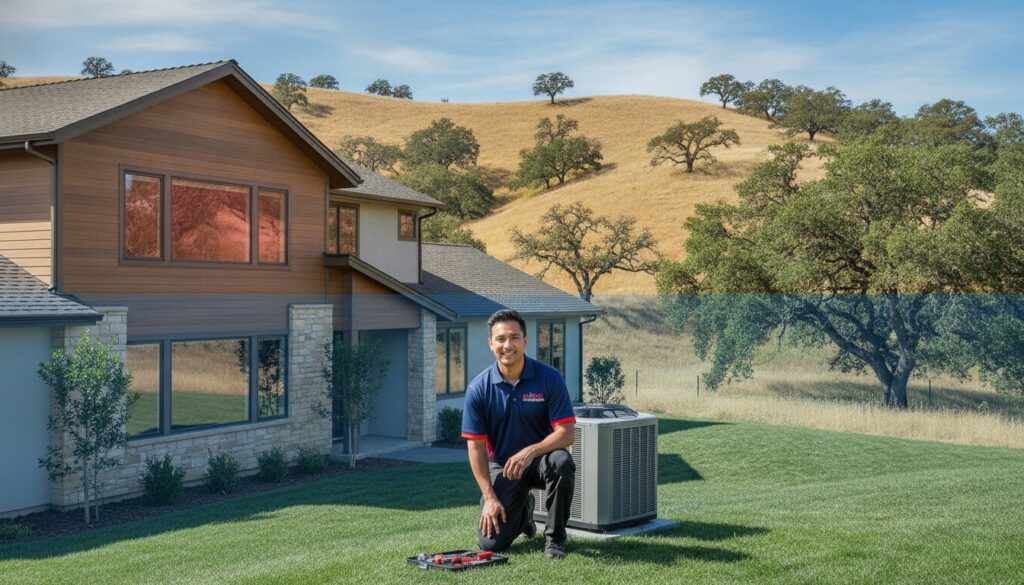
Imagine it’s a typical summer evening here in the foothills. You’ve set your thermostat to a crisp 72 degrees, yet as you walk upstairs to bed, you’re hit by a wall of stagnant, heavy heat. It’s incredibly frustrating to deal with uneven heating and cooling in two-story home Shingle Springs properties, especially when your living room feels like an icebox while your master suite feels like a sauna. You shouldn’t have to choose between a good night’s sleep and a reasonable utility bill.
We know that constant arguments over the thermostat and those climbing energy costs can make your sanctuary feel like a source of stress. You’re likely experiencing more than just the natural tendency of heat to rise; it’s often a sign that your home’s air distribution wasn’t optimized for our local thermal loads. We’ve put together this guide to help you discover why these stubborn temperature swings persist and the specific local solutions that will restore total comfort to your household. We’ll preview how modern zoned systems, ductwork repairs, and high-efficiency heat pumps can finally bring harmony to your home’s climate and give you the peace of mind you deserve.
Key Takeaways
- Learn why the “stack effect” and specific foothill home designs create those frustrating temperature gaps between your floors.
- Discover simple DIY adjustments for your air filters and registers that can help balance airflow throughout the day.
- Understand why undersized or poorly designed ductwork is frequently the root cause of uneven heating and cooling in two-story home Shingle Springs residences.
- Explore how professional solutions like HVAC zoning and ductless mini-splits provide permanent relief for hot upstairs bedrooms.
- Find out how local expertise and regular maintenance protect your system’s longevity while ensuring consistent comfort in every room.
Why Your Shingle Springs Home Has Hot and Cold Spots
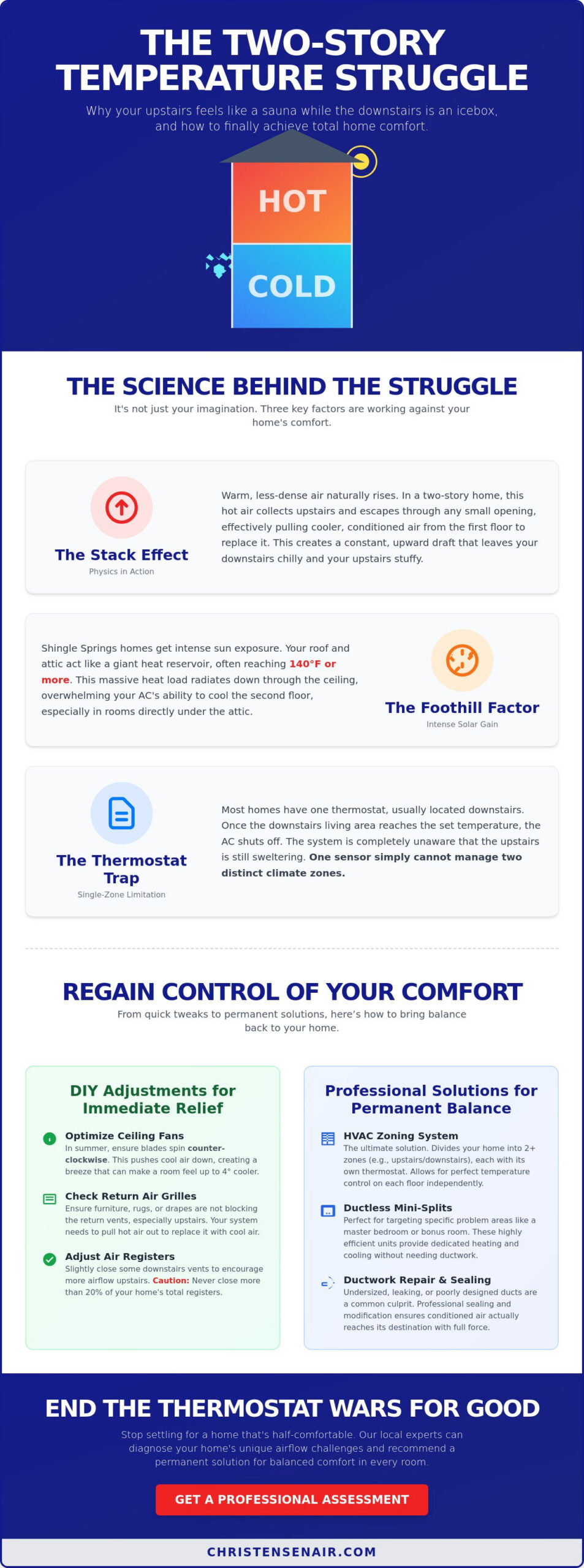
Living in the Shingle Springs foothills offers beautiful views and a sense of community, but it also presents a unique set of challenges for your home’s comfort. Many of our neighbors come to us struggling with a phenomenon we call the “Two-Story Struggle.” This isn’t just a minor inconvenience; it’s a fundamental conflict between your home’s design and the laws of physics. When you experience uneven heating and cooling in two-story home Shingle Springs residences, you’re often fighting against The Stack Effect. This physical process occurs when warmer, less dense air rises and escapes through the top of your home. This movement effectively pulls cooler air out of your first floor, creating a pressure imbalance that makes your upstairs feel like a different climate zone entirely.
To better understand this concept, watch this helpful video:
The Foothill Factor: Solar Gain and Elevation
Our geographic position in the Sierra Nevada foothills means our homes are often more exposed to intense, direct sunlight. On those long summer afternoons, the Shingle Springs sun beats down on two-story roofs with incredible intensity. Because a two-story home has a higher profile, it catches more solar radiation on its south-facing walls. Without proper ventilation, attic temperatures in our region can easily climb to 140 degrees. This massive heat reservoir sits right above your bedrooms, radiating through the ceiling and making your air conditioner work twice as hard to keep up. We also have to consider our elevation. The air is slightly thinner here than in the valley, which affects air density. This means your HVAC fan motors must work harder to move the same volume of air, which often results in weaker airflow at the end of long duct runs.
The Single-Zone Limitation
The biggest hurdle to comfort is often the system’s brain: the thermostat. Most older homes in our area rely on a single thermostat, usually located in a central hallway on the first floor. This creates a fundamental “Thermostat Trap” that we see all the time. Once the downstairs reaches your target temperature, the system shuts off. It’s completely unaware that the upstairs is still a sweltering several degrees warmer. One sensor simply cannot manage two distinct thermal environments at once. Your HVAC system also has to push air vertically against gravity. In many Shingle Springs homes, the distance the air must travel to reach a second-floor master bedroom is simply too far for a standard single-zone system to handle. By the time that air reaches the vent, it has lost much of its cooling power, leaving you with a room that never feels quite right.
Troubleshooting Uneven Temperatures: DIY Fixes for Homeowners
Before you assume your entire HVAC system needs a complete overhaul, there are several practical steps you can take to mitigate uneven heating and cooling in two-story home Shingle Springs properties. We often find that small, intentional adjustments to how air moves through your house can make a noticeable difference in your daily comfort. It’s about working with the physics of your home rather than against them. If your upstairs bedroom feels like a different climate than your kitchen, these troubleshooting steps are the best place to start.
One of the most effective tools at your disposal is your ceiling fan. During the summer, make sure your fans are spinning counter-clockwise to create a direct downdraft. This helps break up the thermal boundary layer where hot air traps against the ceiling. By moving this air, you can make a room feel up to four degrees cooler without actually lowering the thermostat setting. Additionally, take a walk through your upstairs hallways and bedrooms to check your return air grilles. If a large piece of furniture or a thick rug is blocking these vents, your system can’t pull the warm air out of the room. This leads to stagnant, heavy air that no amount of AC can easily fix.
Register and Vent Optimization
We often see neighbors trying to solve temperature swings by completely closing off downstairs vents. We want to caution you against this; closing more than 20% of your home’s registers can create excessive backpressure. This “static pressure” puts immense strain on your blower motor and can even lead to a cracked heat exchanger. Instead, try a more balanced approach. Partially close the vents in the coolest downstairs rooms to gently nudge more airflow toward the upstairs. You can also install “aimable” registers that allow you to direct air toward the center of the room rather than letting it blow directly against a window or wall where the cooling is lost.
Simple Maintenance Tasks
Your choice of air filter matters more than you might think. While high-efficiency MERV 11 or 13 filters are great for air quality, they are very dense. If your duct system wasn’t designed for that level of restriction, it can rob your upstairs vents of the “push” they need to deliver air. Try switching to a standard pleated filter to see if your airflow improves. You should also step outside and check your condenser unit. Shingle Springs is famous for its beautiful oak trees, but the debris and pollen they drop can quickly clog your system’s fins. A clean outdoor unit sheds heat much more efficiently, ensuring your system has the capacity to cool the entire house. While these DIY steps provide relief, the U.S. Department of Energy emphasizes that Sealing and Insulating Your Ducts is often required for a permanent fix. If you’ve tried these adjustments and still feel the heat, it might be time for a professional Air Conditioning Repair to diagnose deeper airflow issues.
The Science of Airflow: Why Ductwork is Often the Culprit
While physics and thermostat placement play their parts, the most common culprit for uneven heating and cooling in two-story home Shingle Springs properties is the ductwork itself. Think of your ducts as the circulatory system of your home. If the “veins” are pinched or too small, the “heart” (your AC unit) has to pump significantly harder to get air where it needs to go. Many older homes in our area were built with ductwork sized for older, less powerful systems. When you upgrade to a modern unit without resizing the ducts, you create a mismatch that almost always leaves the second floor under-served.
We also have to look at the physical condition of the ducts. In the tight crawlspaces and scorching attics of Shingle Springs, flex ducts can easily become kinked or collapsed over time. Even worse, leaky duct joints in a 140-degree attic will pull that hot, dusty air directly into your living space. This doesn’t just make the upstairs hotter; it compromises your indoor air quality and forces your system to run longer cycles, which drives up your monthly utility bills.
Static Pressure and Air Distribution
Air is naturally inclined to take the path of least resistance. In a two-story layout, that path is usually the first floor. This is due to duct friction. As air travels through those long runs toward the upstairs bedrooms, it loses velocity and pressure. We often see homeowners try to fix this with “booster fans.” While these might provide a temporary boost, they are usually a band-aid for a deeper issue. They don’t address the underlying static pressure problem that strains your blower motor. For a truly comfortable home, a professional duct system replacement is often the only way to ensure every room receives the exact amount of air it requires.
Return Air Deficiencies
Cooling a room isn’t just about blowing cold air in; it’s about pulling the warm air out. If your upstairs doesn’t have enough return air vents, the hot air has nowhere to go. This creates the “Closed Door Problem.” When you close a bedroom door, you essentially create an air dam. The supply air can’t enter because the room is already pressurized with stagnant air. You can test this yourself with the “tissue test.” Hold a single ply of tissue near the bottom of a closed bedroom door while the AC is running. If the tissue flutters wildly or gets sucked toward the gap, your room is air-starved and needs more return capacity to balance the pressure. This simple test is often the first step in diagnosing why your home struggles with uneven heating and cooling in two-story home Shingle Springs scenarios.
Professional Solutions for Permanent Temperature Balance
While DIY adjustments can provide some relief, achieving total harmony between your first and second floors usually requires a more robust approach. We’ve found that the most reliable way to resolve uneven heating and cooling in two-story home Shingle Springs properties is to move away from the “all or nothing” logic of traditional HVAC systems. In our region, where afternoon sun and elevation play such a massive role in indoor temperatures, your home needs a system that can think and adapt in real time. We focus on solutions that address the specific thermal load of each floor rather than treating the entire house as one giant room.
One common question we hear is whether it’s better to seal existing ducts or opt for a full replacement. While sealing is a valuable maintenance step, a professional duct system replacement often provides a much higher return on investment for two-story homes. Replacement allows us to correct original design flaws, such as undersized runs to the second floor, which sealing alone cannot fix. This whole-house approach, combined with proper insulation and attic ventilation, ensures your equipment doesn’t have to work overtime to compensate for poor infrastructure.
Zoning vs. Multi-Stage Equipment
HVAC zoning systems use motorized dampers inside your ductwork to direct air exactly where it’s needed. However, we want to be clear that zoning works best when paired with the right equipment. Adding zoning to an old, single-stage system can actually lead to premature failure. Because a single-stage unit only has one speed (100% power), closing off zones can cause pressure to build up and damage the compressor. This is why we highly recommend inverter heat pumps. These variable-speed systems can slow down or speed up in tiny increments, allowing them to provide just the right amount of airflow for a single zone without straining the system. It’s a much more efficient way to maintain a uniform temperature throughout the year.
Targeted Cooling with Mini-Splits
For some Shingle Springs homes, a single central system might never be enough for a stubborn bonus room or a master suite with vaulted ceilings. In these cases, ductless mini-split systems offer the perfect supplement. These units provide independent temperature control for a specific area without requiring any new ductwork. They are incredibly efficient because they allow you to cool only the rooms you’re currently using, like an upstairs bedroom at night, while leaving the rest of the house at a more energy-efficient setting. If you’re ready to stop the thermostat wars, our team can provide a professional Air Conditioning Installation quote to help you choose the best technology for your home’s unique layout.
Restoring Comfort to Your Shingle Springs Sanctuary
Your home should be the place where you can finally relax after a long day, not a place where you’re constantly chasing a comfortable temperature from room to room. We understand that solving uneven heating and cooling in two-story home Shingle Springs properties requires more than just a generic fix. It takes a deep understanding of how our local foothills architecture interacts with the unique climate of El Dorado County. Whether your home is a legacy build or a newer property, we bring the regional expertise needed to balance your climate and protect your sanctuary. We don’t just see ourselves as service providers; we’re your neighbors, and we take personal pride in ensuring your household remains a haven of comfort.
Maintaining that balance is an ongoing commitment rather than a one-time event. This is why we developed our Comfort Club Maintenance Plan. Regular inspections allow our team to catch the small issues, like a slightly loosened duct joint or a dust-clogged coil, before they turn into major airflow-related breakdowns. By keeping your system tuned to peak performance, we ensure that the air distribution stays consistent year-round. This proactive care protects your equipment from the strain of “static pressure” issues and helps keep your monthly utility bills as low as possible.
The Christensen Advantage
We believe in a science-based approach to every project we undertake. Instead of guessing which unit might work for your layout, we use industry-standard Manual J and Manual D calculations. These technical assessments allow us to determine the exact heating and cooling loads of your specific floor plan and design a duct system that can handle the vertical challenges of a two-story home. This level of precision ensures your system is sized perfectly, preventing the short-cycling and uneven temperatures that plague so many houses in our area. We promise to treat your home with the same care and respect we would apply to our own.
Next Steps for a Balanced Home
The journey to a perfectly tempered home starts with a comprehensive airflow diagnostic and static pressure test. During this audit, we evaluate your ductwork, check your return air capacity, and identify the specific friction losses that might be robbing your upstairs of cool air. Once we find the root cause of your uneven heating and cooling in two-story home Shingle Springs issues, we’ll provide clear, honest guidance on the best path forward. We avoid high-pressure sales tactics in favor of helping you make the best decision for your family’s long-term comfort. If you’re ready to enjoy a uniform temperature on every floor, we’re here to help.
Schedule your comfort consultation with Christensen Heating and Cooling today!
Enjoy Consistent Comfort Throughout Your Entire Home
You don’t have to accept a home where the downstairs is freezing while the upstairs remains uncomfortably warm. We’ve looked at how the unique foothill climate and the natural physics of your home’s layout contribute to uneven heating and cooling in two-story home Shingle Springs properties. Whether the root cause is undersized ductwork or the limitations of a single-zone system, modern technology like zoning and variable-speed inverter heat pumps can finally bring your house into balance.
Our team has been family-owned since 2009, and we take personal pride in serving El Dorado County with neighborly care. We specialize in high-efficiency solutions that protect your sanctuary and lower your monthly utility costs. We believe that every room in your house should be usable and comfortable, regardless of the season. If you’re ready to stop the thermostat arguments and start enjoying total peace of mind, we’re here to help you find the right path forward.
Get a Professional Comfort Audit for Your Shingle Springs Home
Let’s work together to make your home the perfectly tempered retreat you and your family deserve.
Frequently Asked Questions
Why is my upstairs so much hotter than my downstairs in the summer?
Your upstairs is hotter because heat naturally rises and your attic acts as a massive heat reservoir. In the Shingle Springs foothills, attic temperatures can frequently reach 140 degrees during the summer months. This intense heat radiates through your ceiling and into your bedrooms, making it difficult for a standard HVAC system to keep up with the cooling demand on the second floor.
Will closing vents downstairs help cool my upstairs more effectively?
Closing vents is only a partial solution and can be risky if you close too many. We recommend never closing more than 20% of your home’s total registers. Completely shutting off downstairs vents creates excessive static pressure within your system. This pressure puts immense strain on your blower motor and can eventually lead to a cracked heat exchanger or a failed compressor.
How much does it cost to add a second zone to an existing HVAC system?
The cost to add a second zone varies significantly based on your current system’s age and the layout of your ductwork. Some systems require new motorized dampers and a specialized control board, while others might need a full equipment upgrade to handle variable speeds. We provide detailed, in-person assessments to determine the most cost-effective way to add zoning to your specific home.
Can a smart thermostat fix uneven heating and cooling?
A smart thermostat can help manage uneven heating and cooling in two-story home Shingle Springs properties if you use it with remote sensors. By placing a sensor in a hot upstairs bedroom, the thermostat can prioritize that room’s comfort over the hallway temperature. While this helps balance the climate, it won’t fix physical issues like leaky ducts or an undersized AC unit.
What is the “stack effect” and how does it affect my energy bill?
The stack effect is a physical process where warm air rises and escapes through the top of your house, creating a vacuum that pulls air from the lower levels. This pressure imbalance forces your air conditioner to run much longer cycles to compensate for the lost cooling. This constant extra work directly leads to higher monthly utility bills and faster wear on your equipment.
Is a ductless mini-split better than a traditional central AC for a two-story home?
Ductless mini-splits are often an ideal supplement for stubborn rooms that central AC can’t reach. They provide independent temperature control for a specific area, such as an upstairs master suite or a bonus room. This allows you to stay perfectly comfortable in the room you’re actually using without wasting energy by over-cooling the entire downstairs of your home.
How often should I have my ductwork inspected for leaks in Shingle Springs?
We recommend a professional ductwork inspection every 3 to 5 years to ensure your system remains efficient. In our local climate, temperature swings can cause duct seals to expand and contract, eventually leading to leaks. Keeping your ducts airtight is a critical step in maintaining uneven heating and cooling in two-story home Shingle Springs residences and protecting your indoor air quality.
Does attic insulation help with uneven temperatures between floors?
Attic insulation is a vital barrier that slows the transfer of heat from your roof into your living space. If your insulation is thin or uneven, the heat from a 140-degree attic will easily seep through your drywall. Improving your insulation levels helps keep the upstairs cooler in the summer and warmer in the winter, making it much easier for your HVAC system to maintain a uniform temperature.