





The most powerful air conditioner on the market might actually be the worst choice for your home’s comfort. It’s a common misconception that a bigger unit will cool your rooms faster and keep you more relaxed during a heatwave. We understand why that logic seems sound, especially when you’re looking for the best way to protect your family from the summer heat. However, the risks of an oversized air conditioner are significant; they often lead to a home that feels clammy and a system that wears out years before its time.
We believe your HVAC system should be a marathon machine, not a sprinter that shuts off before it can properly dehumidify your space. In this guide, we’ll show you why an oversized unit actually sacrifices your comfort, increases your monthly bills by as much as 30 percent, and shortens your equipment’s lifespan by up to half. You’ll learn how to identify if your current unit is too large and why a professional Manual J load calculation is the only way to ensure your home remains the sanctuary it’s meant to be.
Key Takeaways
- Learn why excess cooling capacity doesn’t lead to better performance and how to recognize if your system is struggling with its size.
- Understand the mechanical risks of an oversized air conditioner, specifically how frequent short-cycling causes premature wear on vital components.
- Discover the connection between cycle length and humidity control to ensure your home feels crisp and dry rather than cold and clammy.
- See how frequent system startups draw significantly more power, leading to higher monthly utility bills and wasted energy.
- Find out why we rely on the industry-standard Manual J Load Calculation to find the perfect balance between comfort and efficiency for your home.
Debunking the “Bigger is Better” Cooling Myth
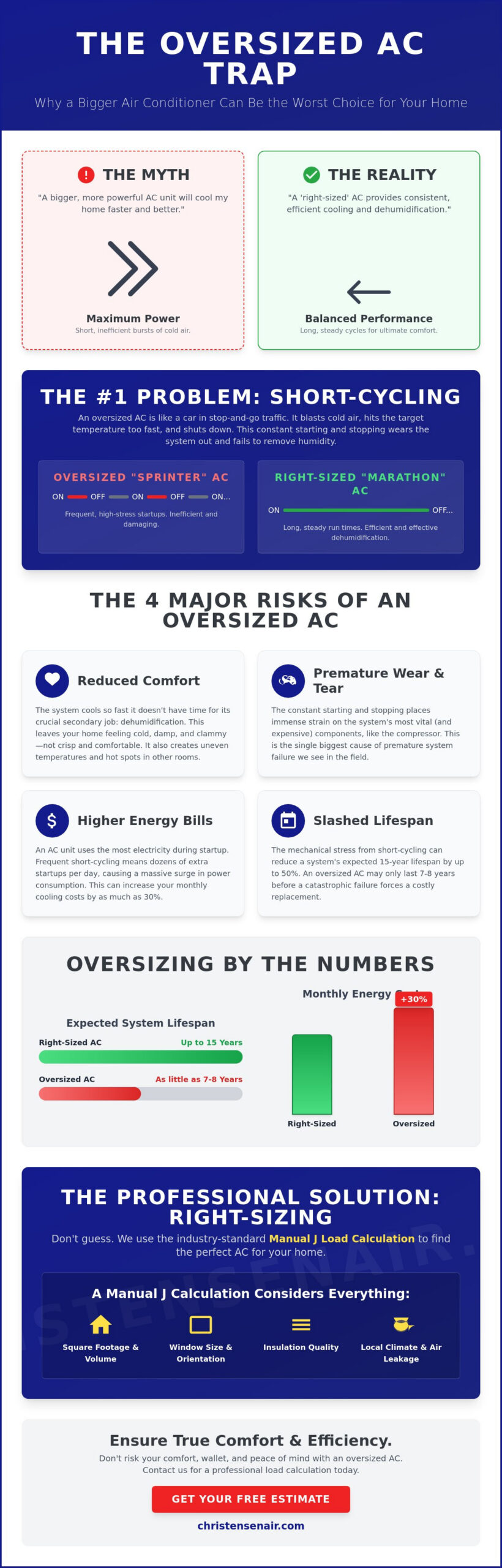
We often hear from neighbors who believe that installing a massive air conditioning unit is the ultimate solution for summer comfort. It feels logical: if a small unit works well, a bigger one must work faster and better. However, an oversized air conditioner is simply a system with cooling capacity (tonnage) that far exceeds the actual needs of your home’s square footage and heat load. While it might seem like a shortcut to a cold house, the risks of an oversized air conditioner start with the fact that these machines are engineered for long, steady cycles rather than short, powerful bursts. Choosing a unit that is too large for your space is like buying a high-performance sports car to drive exclusively in a school zone; you have all that power, but you can never use it efficiently.
True comfort comes from “Right-Sizing,” which is the professional standard for matching a system’s output to your home’s specific requirements. When a unit is too large, it reaches the thermostat’s set point so quickly that it never has the chance to perform its secondary, crucial job: removing humidity. This leaves you with a home that is technically cold but feels damp and uncomfortable. We focus on finding that perfect balance to ensure your system runs exactly as the manufacturers intended, protecting your sanctuary from both heat and excess moisture.
To better understand how this sizing mismatch affects your home, watch this helpful video:
The Psychology of the “Power” Purchase
We understand the stress that comes with a Roseville heat wave. When the temperature spikes, it is tempting to request a 5-ton unit for a home that only requires 3 tons of cooling. This “power purchase” is often driven by the fear of being left in the heat, but it results in the “instant cooling” fallacy. You get a blast of cold air that shuts off the system within minutes, creating hot spots in other rooms and leaving the air feeling heavy. We prioritize your long-term comfort over a quick fix that ultimately fails to protect your family’s well-being.
Tonnage and BTUs: A Quick Primer
To understand sizing, you need to know about tonnage and BTUs. In the HVAC world, one “ton” of cooling is equal to 12,000 British Thermal Units (BTUs) per hour. While many old-school “rules of thumb” suggest one ton for every 500 square feet, modern standards are much more precise. Professionals now look at the total volume of your home, including ceiling height, window orientation, and insulation quality, rather than just floor space. Tonnage is a measure of heat removal capacity that must be carefully calculated to match your home’s unique footprint.
The Mechanical Toll: Short-Cycling and Component Wear
When an air conditioner is too large for the space it serves, it suffers from a phenomenon known as short-cycling. This occurs when the unit reaches the thermostat’s set point so quickly that it shuts down before completing a full, healthy cooling cycle. We often compare an oversized AC to a car trapped in heavy stop-and-go traffic. Just as constant braking and accelerating wears down an engine faster than cruising at a steady highway speed, the frequent starting and stopping of a massive AC unit puts immense strain on its internal parts. These risks of an oversized air conditioner are not just theoretical; they lead to real mechanical damage that we see in the field every day.
The startup phase is the most taxing part of any air conditioner’s operation. During those first few seconds, the system requires a massive surge of electricity to get the motor and compressor moving. When a system is correctly sized, it starts up, runs for a significant period to remove heat and humidity, and then rests. An oversized unit, however, might cycle on and off dozens of times more than necessary. This constant “inrush current” places heavy stress on the compressor, which is the most expensive component of your system. If you’ve noticed your unit turning on and off every few minutes, our team can perform a thorough Air Conditioning Repair assessment to see if short-cycling is damaging your investment.
Premature System Failure
Short-cycling effectively cuts years off the expected 15-year lifespan of a modern HVAC system. Research indicates that the mechanical stress from frequent starting and stopping can reduce a system’s life by as much as 50 percent. This rapid wear often leads to electrical component burnout, specifically in capacitors and relays that weren’t designed for such high-frequency use. Overpowering a home often results in the need for complex residential AC repair Carmichael homeowners can avoid by choosing a properly sized unit from the start.
The Noise Factor
Oversized units are significantly louder than their right-sized counterparts. Because they are designed to move a large volume of air, you will often hear a loud “whoosh” or a heavy thud when the system kicks on. This indicates that your duct system is being over-pressurized. When too much air is forced through ducts designed for a smaller system, it can lead to distracting vibrations or whistling sounds. We want your home to be a quiet sanctuary, but an oversized unit often makes its presence known through constant, disruptive noise.
The Comfort Trap: Humidity and Uneven Temperatures
Most people view an air conditioner as a machine that simply makes the air colder. In reality, your AC has a dual role: it must cool the air and remove excess moisture simultaneously. For the system to dehumidify effectively, the evaporator coil needs time to get cold enough to condense water vapor from the air. This process typically takes at least 10 to 15 minutes of continuous operation. One of the most frustrating risks of an oversized air conditioner is that it reaches your thermostat’s target temperature so quickly that it shuts down before the dehumidification process even begins.
This creates what we call “Clammy House” syndrome. You might look at your thermostat and see a perfect 72 degrees, yet you still feel sticky and uncomfortable. When indoor humidity remains high, typically above 50 or 60 percent, it creates an environment where mold growth and dust mite activity can thrive. We believe your home should be a crisp, dry sanctuary, but an oversized unit often leaves the air feeling heavy and damp, which can eventually lead to musty odors and damage to sensitive wood furniture or flooring.
Hot and Cold Spots
An oversized unit doesn’t just struggle with moisture; it fails at basic air circulation. Because the system is too powerful for the space, it “dumps” a massive blast of cold air into the rooms closest to the indoor unit and then cycles off. This prevents the air from mixing properly throughout the entire house. The result is a living room that feels like a walk-in freezer while the back bedrooms remain uncomfortably warm. This lack of balance completely ruins the high efficiency air conditioner installation Loomis homeowners expect when they invest in a modern system.
Impact on Indoor Air Quality
Your HVAC system serves as the primary lungs of your home. Every time the blower motor runs, it pulls air through your filtration system to remove dust, pollen, and pet dander. When an oversized unit short-cycles, the air remains stagnant for longer periods. This allows allergens and volatile organic compounds (VOCs) to settle on surfaces rather than being captured by your filter. By ensuring your unit runs for the appropriate cycle length, we help improve indoor air quality, giving your filtration system the time it needs to properly scrub the air your family breathes every day.
Calculating the Financial Risks of an Oversized AC
When we discuss the risks of an oversized air conditioner with our clients, we always look beyond the immediate purchase price to the long-term impact on your wallet. The most significant financial drain comes from the “Inrush Current” problem. Every time your air conditioner kicks on, the compressor draws six to eight times more electrical current during those first few seconds than it does while running continuously. Because an oversized unit starts and stops far more often than a correctly sized one, you are paying for that massive power surge dozens of times a day. This inefficient cycling can increase your annual utility bills by 20 percent to 30 percent, effectively erasing any savings you hoped to gain from a high-efficiency system.
We see this as a hidden tax on your home comfort. Instead of your investment going toward a cool and dry sanctuary, your money is wasted on the mechanical stress of constant startups. Over time, these small spikes in energy usage add up to thousands of dollars in wasted electricity. If you are concerned that your current system is draining your budget, we can help you find a better balance with a professional Air Conditioning Installation that prioritizes precision over raw power.
Upfront vs. Long-Term Costs
Choosing a larger unit often means paying a premium for cooling capacity your home simply cannot use. When you review the cost of new AC unit Roseville homeowners face, the price difference between a 3-ton and a 5-ton unit is substantial. Furthermore, an oversized unit negates the return on investment of modern SEER2 ratings. A high-efficiency rating only delivers its promised savings when the system runs for complete, steady cycles. By overpaying for a larger unit, you are essentially paying more upfront for a system that will cost more to operate every single month.
The Repair Spiral
The financial burden continues with what we call the “Repair Spiral.” Because the system never runs long enough to properly drain moisture, humidity can build up inside the cabinet, leading to rusted coils and frequent drain line clogs. The constant electrical surges also take a heavy toll on capacitors and contactors, which are among the most common parts to fail in oversized systems. You may also encounter frozen evaporator coils, a paradox where a unit that is “too powerful” actually stops cooling altogether because the lack of proper airflow causes the system to ice over. These frequent service calls represent a significant “invisible cost” that quickly outweighs any perceived benefit of a larger unit.
The Solution: Precision Sizing and Load Calculations
We’ve spent much of this guide discussing the mechanical and financial risks of an oversized air conditioner, but the good news is that these issues are entirely preventable. The industry gold standard for avoiding these pitfalls is the Manual J Load Calculation. This isn’t just a simple estimate; it’s a comprehensive scientific analysis designed to match a cooling system to the unique thermal characteristics of your specific home. We believe that every family deserves a system that provides steady, reliable comfort without the stress of constant short-cycling.
Relying on an outdated rule of thumb, such as one ton of cooling for every 500 square feet, is a dangerous gamble. Modern homes are built with vastly different insulation values, window types, and airtightness than homes built thirty years ago. Our team at Christensen Heating and Cooling treats every sizing project as a unique engineering task. We prioritize your long-term comfort and system health over the “bigger is better” shortcut, ensuring your new unit runs for the long, efficient cycles it was designed for.
This commitment to precision is shared by industry leaders like E.R.S. Heating & Cooling, who specialize in ensuring heat pumps and HVAC systems are perfectly calibrated for their specific environment and heat load.
What a Professional Load Calculation Includes
A true Manual J calculation goes deep into the details of your home’s construction. We measure the heat gain through your walls, roof, and windows, considering the direction your home faces and the amount of shade you receive. We also account for the specific climate extremes of the Sacramento valley, where dry summer heat puts unique demands on HVAC equipment. Finally, we analyze your existing ductwork capacity. If your ducts aren’t large enough to handle the airflow of a massive unit, the system will struggle and fail prematurely, regardless of its SEER2 rating.
Steps to Take if Your AC is Already Oversized
If you’ve realized your current system is too big, you don’t necessarily have to replace it immediately. We can often help mitigate the negative effects through a few strategic adjustments:
- Adjusting blower speeds: We can sometimes lower the fan speed to increase the time air spends on the cooling coil, which helps with dehumidification.
- Smart thermostats: Installing a high-quality smart thermostat can help manage cycle counts more effectively and prevent extreme temperature swings.
- Whole-home dehumidifiers: Adding a dedicated dehumidifier can offset the “clammy” feeling caused by short-cycling.
- Partial system replacement: In some cases, replacing just the indoor or outdoor unit with a properly matched component can save you money in the long run.
While these fixes can help, the best path to a comfortable home is always a precision-sized Air Conditioning Installation that respects the specific needs of your household. The same principle of precision sizing applies to your heating equipment as well; understanding what to expect during a furnace installation ensures your entire home comfort ecosystem is engineered to the right specifications from the start.
Protecting Your Home’s Long-Term Comfort
Choosing the right air conditioner is about more than just picking a brand; it’s about matching the system to the unique needs of your home. We’ve seen how the risks of an oversized air conditioner extend from shortened equipment life to high utility bills and poor indoor air quality. By prioritizing a system that runs for steady, efficient cycles, you protect both your financial investment and the daily well-being of your family. It’s the difference between a home that is simply cold and one that is truly comfortable.
As a family-owned business serving Roseville and the Greater Sacramento Area since 2009, we take personal pride in getting these details right. We don’t rely on guesswork or outdated rules of thumb. Our team uses expert Manual J Load Calculations to ensure your home remains a sanctuary of crisp, dry air even on the hottest valley days. We’re dedicated to building long-term relationships through honest, professional guidance that puts your needs first.
This level of dedication to quality and precision is a hallmark of family-run HVAC experts, much like the team at Around the Clock Heating and Air Conditioning, who have provided specialized care and right-sized solutions to their community for over five decades.
We are here to help you find the perfect balance between power and performance. Get a Precision Load Calculation from Christensen Today and enjoy the peace of mind that comes with a truly right-sized system. We look forward to serving you and keeping your household comfortable for years to come.
Frequently Asked Questions
How do I know if my AC is too big for my house?
You can identify an oversized unit by looking for short run times, typically under 10 minutes, and persistent indoor humidity. If your home feels cold yet clammy, or if you notice significant temperature swings between rooms, your system is likely too powerful for the space. We often see these signs in homes where the unit cycles on and off constantly throughout the day.
What is short-cycling and why is it a problem?
Short-cycling occurs when an air conditioner shuts down before completing a full, healthy cooling cycle. This is a major issue because the startup phase is the most taxing part of the system’s operation. Frequent starts increase the risks of an oversized air conditioner by putting excessive strain on the compressor and electrical components, which leads to more frequent repairs and a much shorter lifespan.
Can an oversized air conditioner cause mold growth?
Yes, an oversized unit can indirectly contribute to mold growth because it fails to properly dehumidify your home. Since the system shuts off so quickly, the evaporator coil doesn’t have enough time to remove moisture from the air. This leaves your indoor humidity levels high, creating a damp environment where mold and mildew can thrive in carpets, upholstery, and ductwork.
Will a bigger AC unit cool my house faster?
A larger unit will drop the air temperature quickly, but this rapid cooling is actually a disadvantage. It “dumps” cold air into the rooms nearest the vents without giving the air time to circulate properly into corners and hallways. This results in uneven temperatures and a lack of the deep, consistent comfort that a correctly sized system provides during a long, steady cycle.
Does an oversized AC use more electricity than a correctly sized one?
An oversized unit is significantly less efficient and will likely increase your monthly utility bills by 20 percent to 30 percent. This happens because a compressor draws six to eight times more electrical current during the first few seconds of startup than it does while running. By starting and stopping dozens of times a day, the unit consumes far more energy than a system that runs continuously.
How do HVAC professionals calculate the right size for my home?
We use a combination of industry standards known as Manual J, S, and D procedures to determine the perfect fit. Instead of using outdated “rules of thumb,” we analyze your home’s total volume, insulation quality, window types, and even the direction your house faces. This scientific approach ensures your system is matched to the specific heat gain of your living space.
What is the “Manual J” calculation?
Manual J is the professional standard for calculating the exact amount of heating and cooling a building needs. It is a detailed assessment that accounts for every factor that affects your home’s temperature, from the number of occupants to the local Sacramento valley climate. This calculation is the only way to avoid the risks of an oversized air conditioner and ensure long-term efficiency.
Is it better to have an AC that is slightly too small or too big?
If you must choose, a system that is slightly smaller is generally better for comfort than one that is too large. A slightly smaller unit will run longer cycles, which provides superior dehumidification, better air filtration, and more even temperatures throughout the house. However, our goal is always to provide a “right-sized” system that balances peak-load performance with everyday efficiency.